Myles Garrett to the Rams: How a 23-Sack Machine Fixes a Pressure-to-Production Problem
By Erik Schwartz ·
Los Angeles gave up future draft capital for a pass rusher who forces offenses into collapse—and that efficiency gap is the real edge the Rams are buying.
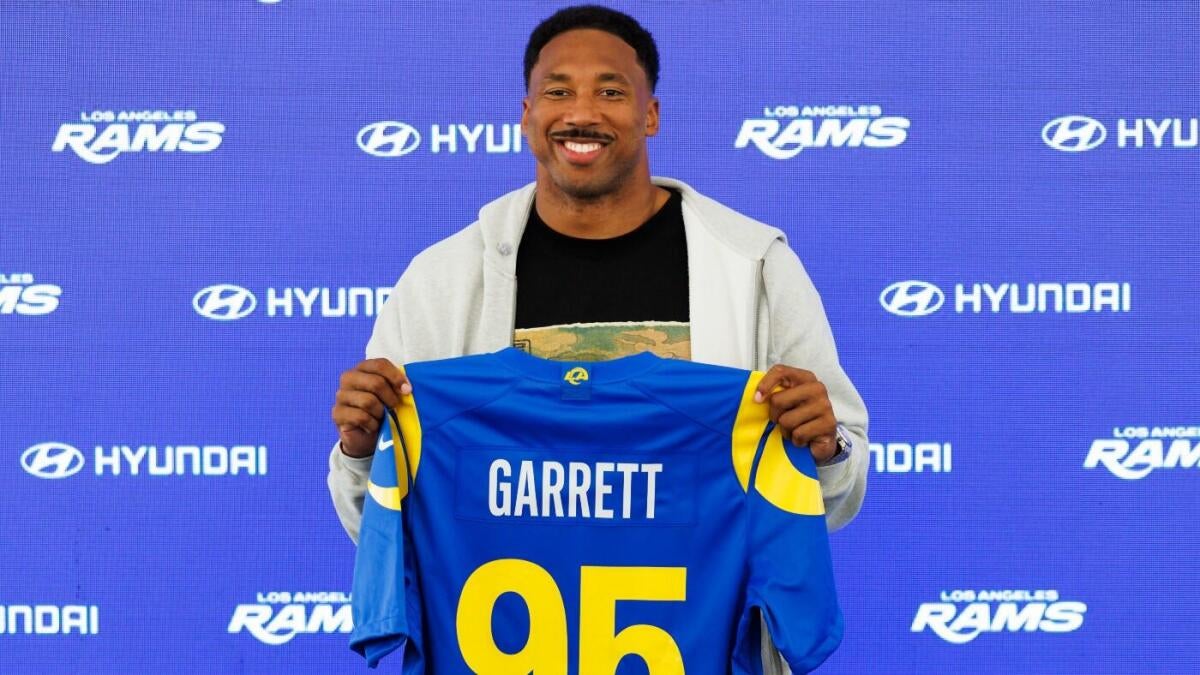
The Rams traded Jared Verse, a 2027 first-round pick, a 2028 second-round pick, and a 2029 third-round pick to acquire Myles Garrett from Cleveland. It reads as an aggressive play by a franchise chasing another Super Bowl, and the math underneath it is sharper than the headline suggests. The Rams' 2025 defense ranked fourth in pressure rate but converted just 18% of those pressures into sacks—21st in the NFL. That gap between noise and havoc is what killed them in close games. Garrett, fresh off a record 23-sack season and 31 quick pressures (fifth-most in the league), doesn't have that problem.
Verse and Byron Young combined for 34 quick pressures last year, a respectable count that misses the point entirely. The Rams' pass rush worked by accumulating volume—Young, Verse, Kobie Turner, and Braden Fiske all win the same way, converting speed into power. It's effective. It's also predictable. Garrett operates on a different axis. He wins instantly with corner speed, forces offenses to chip him with extra blockers, and generates the kind of immediate chaos that opens doors for everyone else on the line. The Browns led the NFL in both sack conversion rate (the percentage of pressures that land negative plays) and Havoc Rate (TFLs, pass deflections, interceptions, forced fumbles, sacks combined)—both stats driven by Garrett's presence.
Coordinator Chris Shula now has a player who dictates offensive protection schemes before the snap fires. Over the past five years, Garrett faced more chip blocks than any edge rusher in football, a direct measure of the attention he commands. That gravitational pull—forcing quarterbacks to hold the ball longer, tilting protection schemes, opening creases for interior linemen—is what separates elite from prolific. Shula's pass-rush package already deployed creative games and personnel shifts; Garrett's addition doesn't just add a sack source, it multiplies the effectiveness of what was already there.
For betting purposes, this trade reshapes Rams defensive props in two ways. First, sacks become more predictable; Garrett's presence means the conversion of Los Angeles' pressure rate into actual negative plays will climb significantly closer to league average or better. If the Rams' pressure rate stays stable (fourth in the league) but their sack conversion improves from 18% to the league median of 24-26%, they add roughly two to three sacks per game to the total. Second, opposing quarterback total yards and passing touchdowns face structural downward pressure—not because the Rams' secondary suddenly improved, but because quarterbacks will face earlier pocket collapses and longer decision windows will shrink. Teams facing the Rams will spend more snaps in third-and-long situations, a direct mechanic that depresses offensive output. The edge here is that market lines on opponent passing yards may not yet reflect the full sack-conversion upgrade; squares often anchor to pressure volume and ignore efficiency variance.