Chiefs' D-Line Overhaul Reshapes Jones' Role—and the Defensive Betting Landscape
By Ty Whitney ·
Kansas City's investment in youth around Chris Jones signals a strategic shift that will reshape individual defensive workloads and team defensive totals.
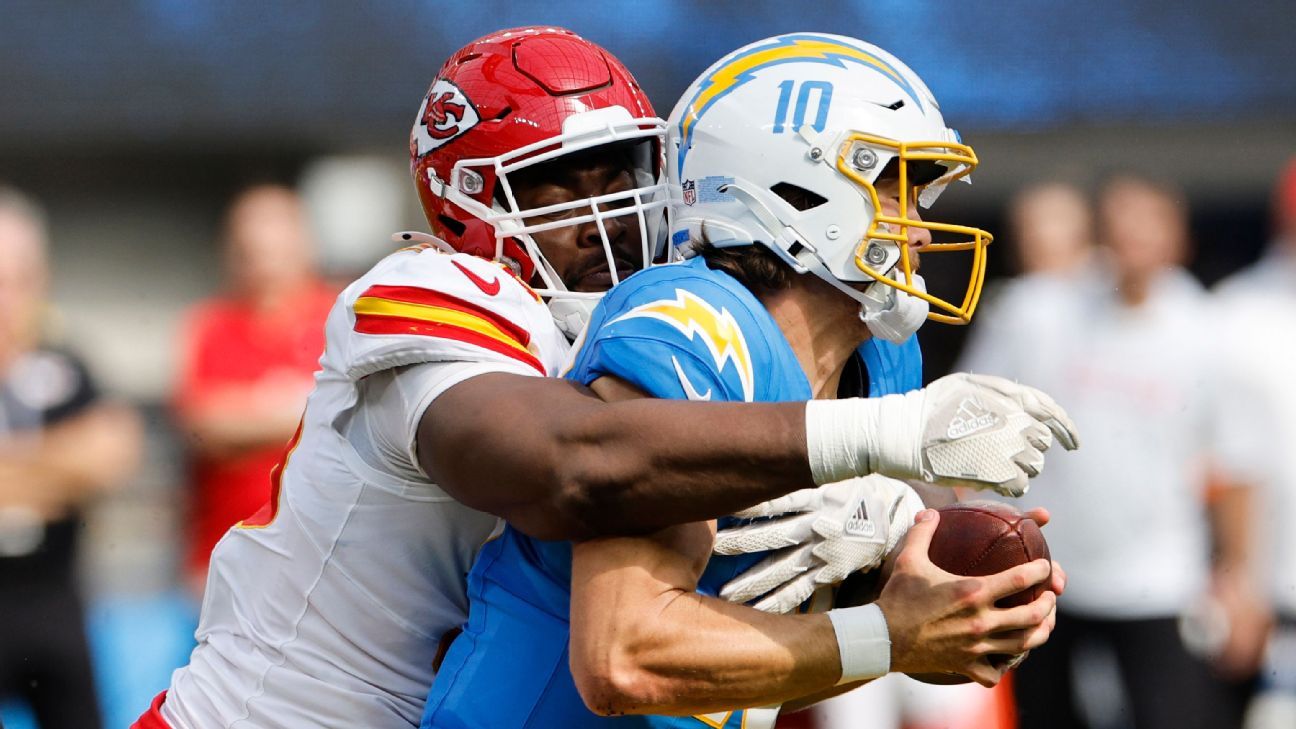
The Chiefs' defensive architecture just shifted. Chris Jones, the 32-year-old anchor of Kansas City's pass rush, spent the offseason surrounded by a generation of reconstructed talent: Peter Woods (21, second overall) and R Mason Thomas (22, second round) alongside him in the trenches, while Khyiris Tonga arrived in free agency to share interior-line reps. This isn't incremental roster maintenance. Kansas City missed the playoffs for the first time since 2014 last season, and the front office responded by wholesale retooling the defensive line—a clear signal that individual workload distribution is about to recalibrate.
The mechanism here matters for betting. Jones has carried an outsized share of the Chiefs' pass-rush burden for years; his presence on the field has traditionally meant elevated snap counts and leverage situations because Kansas City lacked credible interior-line depth around him. Now, with Woods and Thomas contributing legitimate first- and second-round pedigrees, the team can afford to rotate Jones differently—reducing his total snaps-per-game while maintaining his efficiency on premium opportunities. Woods and Thomas aren't just depth pieces; they're being groomed as co-featured rushers from day one of padded practice.
This matters specifically because defensive-line usage patterns don't always track linearly with talent upgrades. A younger, fresher pass-rush room typically means the veteran's snap count drops while his pressure-per-snap ratio may hold or even improve. Jones' sack and tackle totals could compress simply because he's on the field less, not because his per-play production declined. Bettors who chase Jones' historical volume numbers without accounting for the new rotation will overestimate his 2026 output.
The team's investment valuation is worth noting here too. Two first- or second-round picks dedicated to the defensive line is a franchise declaration that pass rush was a crisis point. The Chiefs wouldn't spend that capital if they expected Jones to maintain his historical workload; they're explicitly redistributing the labor. For Jones' individual sack and tackle props, this creates a mechanical drag. For team sack totals, the picture is murkier—it depends on whether the young talent converges faster than the coaching staff's rotation schedule, but the base case is that early-season volume for the new faces (and reduced opportunities for Jones) will depress total production until the pairing chemistry solidifies over 8-10 weeks.
The defensive betting angle hinges on recognizing that organizational investment in youth doesn't always correlate with improved individual star production in Year One. Jones remains elite per snap, but the number of snaps is the variable that just moved.