Giants Bet On Miami Tackle-To-Guard Conversion; Daniel Jones's Protection Now Rests On Unproven Interior Pivot
By Erik Schwartz ·
New York used the No. 10 pick on Francis Mauigoa to address guard depth, but moving a right tackle to the interior muddies an already fragile offensive line picture for a quarterback running out of time.
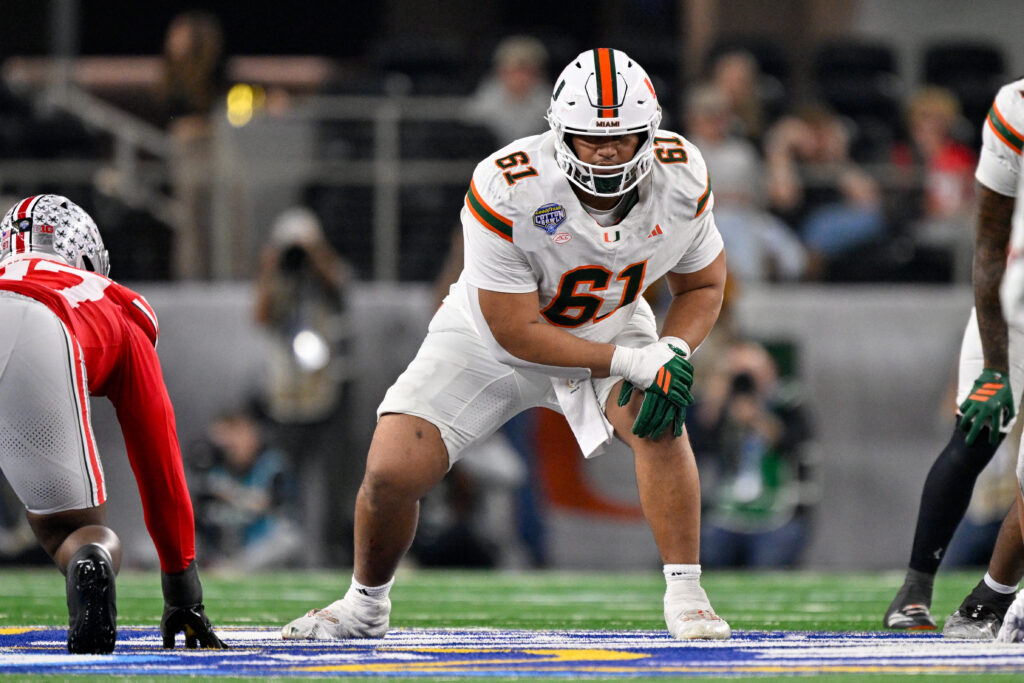
The Giants signed Francis Mauigoa to his rookie deal Wednesday, locking in the Miami tackle they selected 10th overall with a fully guaranteed $30.96 million package. The decision to move Mauigoa inside to right guard—where veteran Greg Van Roten played the past two seasons—telegraphs New York's confidence that he can handle interior play immediately, yet raises a structural question: why spend a top-10 asset on positional versatility when you've just re-signed your starting right tackle to a three-year, $39 million extension?
The Dexter Lawrence trade that netted the Giants this pick was supposed to open doors at safety or edge; instead, management drafted offensive line depth and delegated Mauigoa to a position he did not primarily occupy at Miami. Caleb Downs, the safety prospect John Harbaugh wanted for his defense, went to Dallas one pick later. The optics matter less than the execution: a 21-year-old college right tackle learning guard assignments in a new scheme is not a proven interior solution, and the margin for error at that position is razor-thin when your quarterback—Daniel Jones—has already absorbed 36 sacks over two seasons.
Mauigoa's tape shows the athleticism and length you want from an offensive lineman: his footwork in the run game is decisive, and he can redirect defenders at the point of attack. But interior play demands different angles, tighter spaces, and quicker reaction windows. Teams that have moved elite tackles inside—think Jack Conklin to Dallas, or more recently Evan Anderson to Carolina—typically did so because the tackle had already demonstrated guard-caliber traits. Mauigoa is a projection, not a proven conversion. If he stumbles in camp, the Giants have no credible backup plan; Van Roten is aging, and the position becomes a weak link in an already brittle line.
For prop purposes, this signals elevated passing-volume risk for Jones over the next six to eight weeks. If Mauigoa struggles or requires a learning curve, protection breakdowns will spike, forcing Jones into faster decisions and more off-platform throws. His completion percentage and yards-per-attempt efficiency tend to compress when he's under consistent pressure—a season-long pattern. Conversely, if Mauigoa settles quickly and Van Roten's replacement holds up, interior protection improves and Jones's passing efficiency expands. The uncertainty here is priced into Jones's seasonal prop lines, but weekly matchup overs on his passing yards should account for a 10-15% volatility discount until Mauigoa's transition proves reliable. Games against defensive fronts that crash the B-gap aggressively (Kansas City, Buffalo) present downside traps; matchups against edge-focused defenses (Tampa, New Orleans) offer safer over chases.
The broader frame: the Giants have now spent a first-round pick on offensive line depth for the second time since 2015, and neither gamble—Ereck Flowers failed at tackle; Mauigoa is unproven at guard—has delivered immediate stability. That track record of offensive line mismanagement is a structural liability worth tracking into the season. Jones's injury risk and arm-stress profiles are now tilted higher than the market may have accounted for at season-long unders.