Three Colts Stars Face Contract Year Limbo—and It's About to Reshape Indianapolis
By Erik Schwartz ·
Jonathan Taylor, Quenton Nelson, and DeForest Buckner are all playing 2026 on expiring deals, forcing the Colts to navigate simultaneous negotiations with three pillars of their franchise.
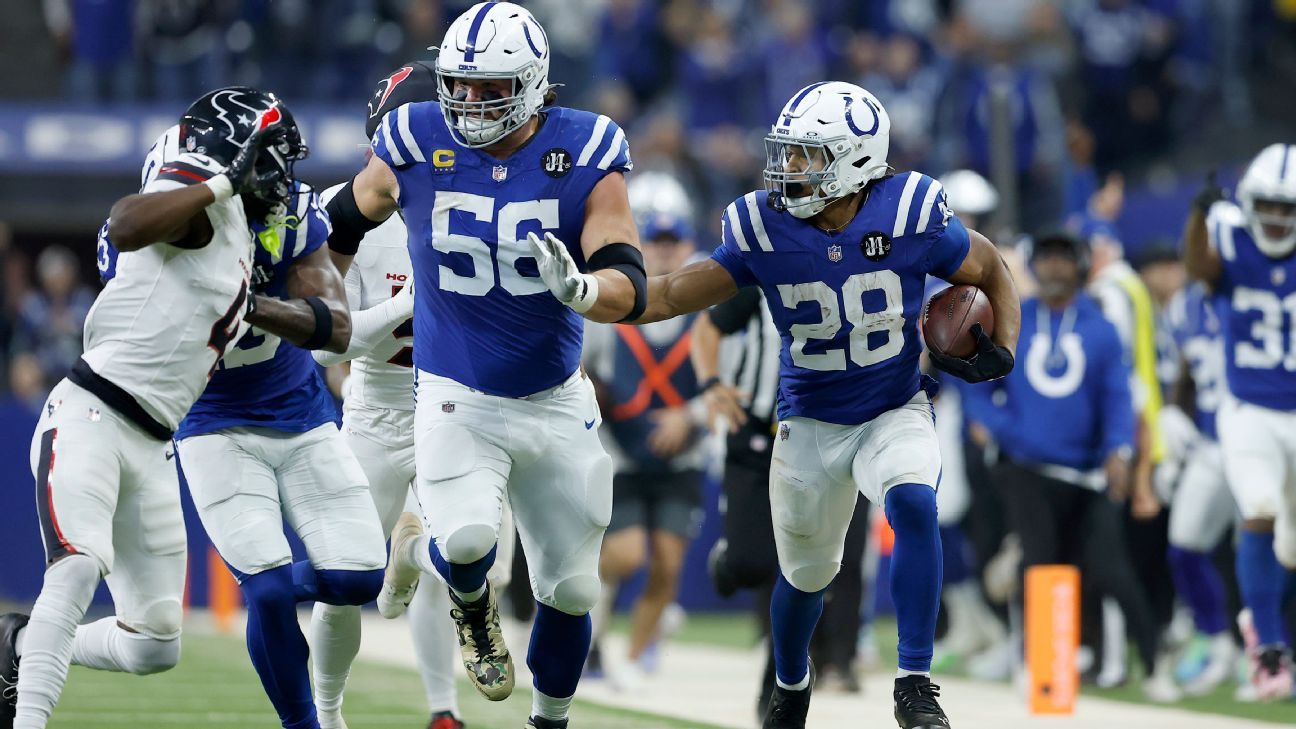
The Indianapolis Colts enter the 2026 season staring down a trio of contract expirations that will reshape their roster construction and immediate salary-cap architecture. Running back Jonathan Taylor, left guard Quenton Nelson, and defensive tackle DeForest Buckner—three foundation-level contributors who've generated $277.9 million in combined career earnings—are each playing the final year of their current agreements. For a franchise that has built around positional excellence in the trenches and at skill positions, managing three concurrent negotiations of this magnitude introduces complexity that extends well beyond the negotiation rooms.
Taylor's leverage position is the most combustible. He's come back from two consecutive injury-plagued seasons to post 1,431 rushing yards in 2024 and 1,585 yards in 2025, adding an NFL-leading 18 rushing touchdowns last season. Those numbers reset the market conversation—Saquon Barkley and De'Von Achane have signed recent deals averaging $20.6 million and $16 million annually, respectively, while Taylor's current contract sits at $14 million per year. But Taylor has already signaled his willingness to weaponize contract leverage; in 2023, he sat out all of training camp and didn't suit up until Week 5 after signing his previous extension. Coach Shane Steichen has made clear he plans to keep feeding Taylor the ball in 2026 (Taylor led the NFL in rushing attempts last season), which either accelerates the wear-and-tear calculus or signals confidence Taylor can handle the workload. The Colts face a fork: pay market value to retain him before free agency, or risk another holdout or, worse, a mid-season negotiation that derails momentum.
Nelson and Buckner present different profiles but carry equal strategic weight. Both players have been elite at their positions for years; both are aging into the later stages of peak performance. The Colts must decide whether to allocate resources to extend them or pivot to younger, cheaper alternatives. The sequence of these decisions matters enormously. If Taylor gets done first at $20-plus million, it consumes cap space and sets a tone for the other two negotiations. If the Colts delay or lowball Taylor, it poisons the well for a locker room that's watched three franchise anchors anchor the defense and protect the quarterback.
For prop purposes, this environment introduces predictable behavioral shifts. When contract years materialize, workload and snap-count patterns often become more volatile as teams manage both performance incentives and injury risk simultaneously. Taylor's receiving-back usage—currently a secondary role but one that surfaces in key moments—may decrease if the Colts lean harder on the run game to showcase his efficiency and justify extension dollars. Conversely, Nelson's ability to stay on the field is now loaded with negotiation subtext; a single injury to a guard in a contract year can sink his value by millions. Buckner's sack totals and quarterback-pressure rates will be monitored closely by both sides as leverage ammunition. The smart angle here isn't to chase the headline: it's to monitor snap counts, carry distribution, and third-down personnel packages over the first few weeks of 2026 to detect whether the Colts are protecting assets or running them into the ground. Early-season workload shifts often persist into totals and per-game prop markets by Week 4 or 5, when market comps finally adjust.