A.J. Brown to New England: Framework Set, but the Patriots' Receiving Math Stays Broken
By Ty Whitney ·
An Eagles-Patriots trade framework for A.J. Brown is in motion, but New England's offensive identity and quarterback situation make him a risky prop play despite his talent.
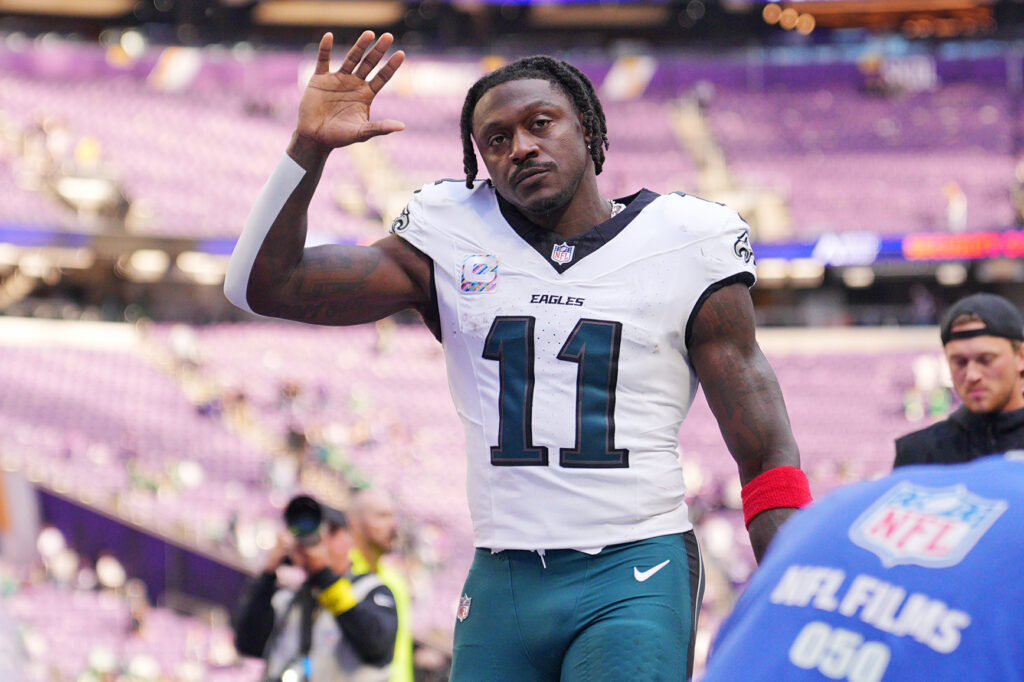
The Eagles and Patriots have established a trade framework for A.J. Brown, with the deal expected to materialize early next week pending post-June 1 accounting mechanics. Per multiple reports, the structure is set; New England is absorbing one of the NFL's premier receivers in his prime, and Philadelphia is finally moving on from a contract that no longer aligns with its cap trajectory.
But here's where the narrative diverges sharply from the prop market's likely reaction. Brown's individual talent is unassailable—1,600-yard seasons, top-five route-tree diversity, elite yards-after-catch production. Those metrics don't evaporate in a uniform change. The problem is context. The Patriots' passing game last season ranked 20th in EPA per play and 18th in yards per attempt. Their quarterback situation remains unsettled: Jacoby Brissett or a rookie developmental arm, neither of whom has demonstrated the ball placement consistency or decision speed that unlocks Brown's full receiving ceiling. When Brown was productive in Philadelphia, he operated in an offense that generated explosive plays at league-leading rates and featured a quarterback (Jalen Hurts pre-injury, or a healthy version) capable of fitting balls into tight windows. New England's offense doesn't operate at that velocity.
The trade timing also matters for prop construction. Brown's receiving-yards line will almost certainly be posted as a "new uniform, new team" number—likely depressed relative to his Philadelphia baseline as a reflexive nod to the transition. The market will price in volatility and system shock. That's partly justified, but it also overshoots the downside risk by treating scheme change as a universal drag. Brown's route-running and body control are system-agnostic; what is system-dependent is volume and efficiency. If the Patriots lean into a vertical, four-and-five-wide look to give Brown space to operate—a reasonable schematic choice given his skill set—his per-game reception and yardage totals could stabilize faster than the initial line suggests. Conversely, if New England defaults to run-heavy, play-action-lite formations to mask quarterback limitations, Brown becomes a situational fade regardless of his talent.
For prop bettors, the angle is structural, not directional. Brown's receiving-yards unders will be tempting early because the market prices pessimism into a "downgrade" narrative. But that bet only wins if the Patriots genuinely underutilize him—which is not a given if offensive coordinator decisions favor spacing and receiver isolation. The real edge is identifying game-by-game volatility: Brown's production will oscillate sharply based on whether New England's gameplan suits his skill set that week, creating + and – games with outsized variance. Single-game props will offer better value than season-long totals for the next four to six weeks as the system stabilizes. Avoid the reflexive "new team = lower ceiling" fade until you see actual snap counts and target distribution over a three-game sample.