The Jefferson Countdown: Why Minnesota's QB Crisis Could Force a Star WR Out by 2028
By PropBetEdge Editorial Team ·
Justin Jefferson's historic receiving arc stalled in 2025 under J.J. McCarthy's dysfunction; the Vikings' quarterback gamble may accelerate a trade timeline that props markets haven't priced yet.
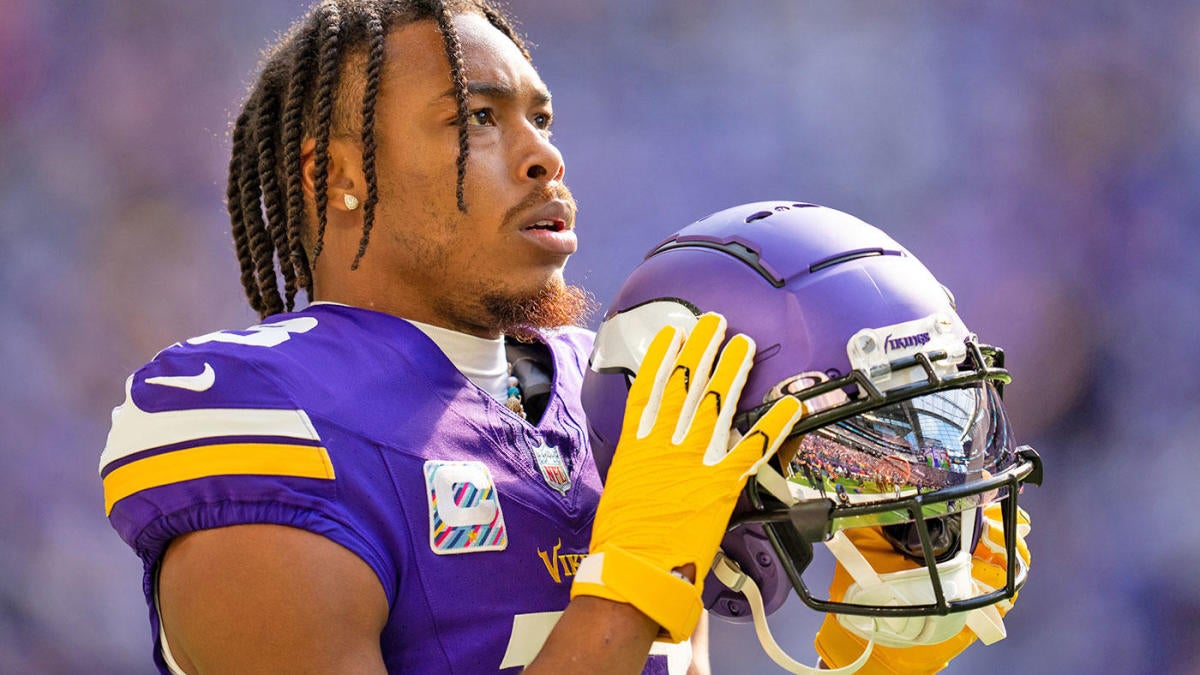
The Vikings made a quarterback bet in April 2024 that has already curdled. After letting Sam Darnold walk, Minnesota drafted J.J. McCarthy 10th overall and committed to him as the future. In 2025, McCarthy ranked last in the NFL in completion percentage (57.6%), passer rating (72.6), and touchdown-to-interception ratio (11:12). Jefferson, a four-time Pro Bowler who averaged 96.5 receiving yards per game across his first five seasons—the highest mark in NFL history—dropped to 90.2 yards per game last season, his second-lowest full-season average since entering the league. His receiving touchdown total fell to 2. That's not age regression. That's a quarterback incapable of executing on schedule.
The Vikings' 2026 solution compounds the problem. Management is now running a competition between McCarthy and Kyler Murray, a two-time Pro Bowl signal-caller whose injury history is a ticking clock. Murray has played 38 of 68 possible games from 2022 through 2025 and averaged just 227 total yards per game across his five 2025 appearances. The bet that either of these two stabilizes Minnesota's passing game—and therefore unlocks Jefferson's ceiling—is a long one. Jefferson enters his contract's final season in 2028 with zero guaranteed money remaining on his four-year, $140 million deal. At 29 years old with a market track record of elite production, he will have every incentive to seek a new home with a functional passing game and a fresh guarantee.
What makes this timeline matter for prop players is the lag between narrative and number. Vegas is not yet pricing a 2028 Jefferson trade as a meaningful outcome; the event horizon is too distant, and the Vikings could still solve quarterback in the 2026 or 2027 draft. But the mechanism is already established: McCarthy cannot throw, Murray cannot stay healthy, and Jefferson's peak earning window is closing. The wider NFL landscape will have shifted by 2028—rookie contracts will reset, draft capital will rebalance—but Jefferson's production surplus over his peers will likely be priced into any trade package. The Patriots gave up a first, fifth, and conditional pick to land A.J. Brown in 2024 when Brown was 26 and entering his prime. Jefferson at 29, post-decline, still commands a first- and third-round package if Minnesota allows a trade.
For bettors tracking long-term player value, this is a futures-oriented angle: teams that acquire Jefferson in 2028 will immediately face a high receiving-yards prop line because they've just traded assets to secure a high-volume target. If Jefferson lands with a competent quarterback—the Raiders with Fernando Mendoza (first overall, 2026 draft) make structural sense—his receiving yards prop at 85-95 per game would represent sharp value in 2028 and 2029. He won't be in his prime, but he will be in an offense designed around him. The inverse is true for Vikings passing-volume props through 2027: Jefferson's per-game receiving yards will likely continue to suppress as long as the McCarthy-Murray carousel spins. Expect Minnesota wide receiver prop lines to skew conservative until the quarterback situation stabilizes or Jefferson forces the issue.