Barkley's First-Play Exit Reshapes Eagles Backfield Math Mid-Game
By PropBetEdge Editorial Team ·
A stinger on Philadelphia's opening snap forces an immediate reset—and Tank Bigsby gets his first real leverage moment as a Saquon surrogate.
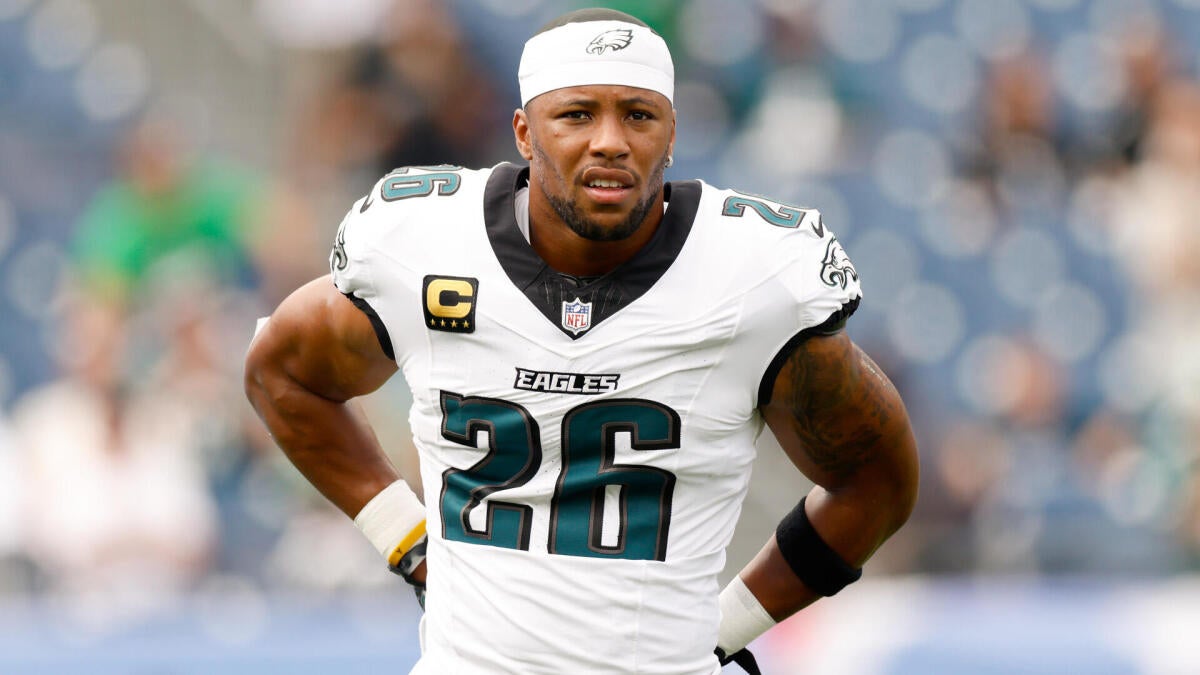
Saquon Barkley departed the Eagles' Week 2 matchup against Tennessee on the opening offensive play, suffering a stinger that sent him to the locker room and forced Philadelphia into an unplanned backfield rotation. The injury arrived at the worst possible juncture: the Eagles had just shuffled their offensive line after left guard Landon Dickerson landed on IR, sliding Cam Jurgens from center to left guard and inserting rookie Drew Kendall at center. Barkley went down running behind those two, compressing a complex situation into minutes.
Tank Bigsby stepped in immediately. The 26-year-old, acquired as a backup after a 5.9 yards-per-carry season with the Eagles last year, got his heaviest workload of the 2026 campaign—10 carries and two catches across the Eagles' first three drives while Barkley sat out in a neck roll. The Eagles also deployed Will Shipley more aggressively (seven carries early), signaling an intent to spread the rushing work rather than hand it wholesale to one back. That distribution matters. Bigsby's 2025 film showed he can handle volume efficiently, but his 2023 rookie year with Jacksonville (2.6 yards per carry) and his single-carry nothing-burger last week suggest he's streaky and limited as a lead back. Meanwhile, Jalen Hurts began threading downfield with precision: 14-for-17 for 141 yards and a TD across the first three possessions, with DeVonta Smith already at five catches and a score. The pass-heavy early environment wasn't coincidental—it was reactive.
Dallas Goedert, Philadelphia's other injury casualty, took a hard knee hit but appeared to return before halftime, as did Barkley. The critical question isn't whether either player suits up for Week 3; it's whether the Eagles' offensive infrastructure can absorb another dislocation. Barkley is the offense's foundation—he averaged 83 yards rushing in Week 1 on 15 carries (42 of those on a single burst) and arrived off a 2025 season of 1,413 yards from scrimmage. A stinger is typically a short-term issue, but stingers repeat if the underlying neck mobility is compromised. The Eagles' scrambled line, untested at center, gives no margin for error in protection.
For prop bettors, the angle crystallizes around Hurts' passing volume and the Eagles' week-to-week backfield deployment. If Barkley is out beyond Week 2, Philadelphia will lean heavily into Hurts' arm and the passing game because neither Bigsby nor Shipley carries the gravitational pull to anchor an offensive identity. Hurts' passing attempts and completion totals stand to spike if Barkley misses even one start—the market hasn't priced that binary fully, because Barkley's return is still uncertain. Watch the injury report by Wednesday: if he's ruled out or limited, Hurts passing yards and attempts props should move up significantly, and the Eagles' team total may compress slightly despite the pass-friendly shift, because a Barkley-less attack is less efficient in the red zone. Bigsby will get his volume, but at sub-replacement efficiency; that makes Eagles running-back prop overs extremely risky without Barkley on the field.