Carter's $152M Deal Signals Eagles' Defensive Anchor—and What It Means for Their Pass Rush Math
By Ty Whitney ·
Philadelphia locks in its interior disruptor through 2031, reshaping how to evaluate the Eagles' defensive efficiency and opponent passing volume for years ahead.
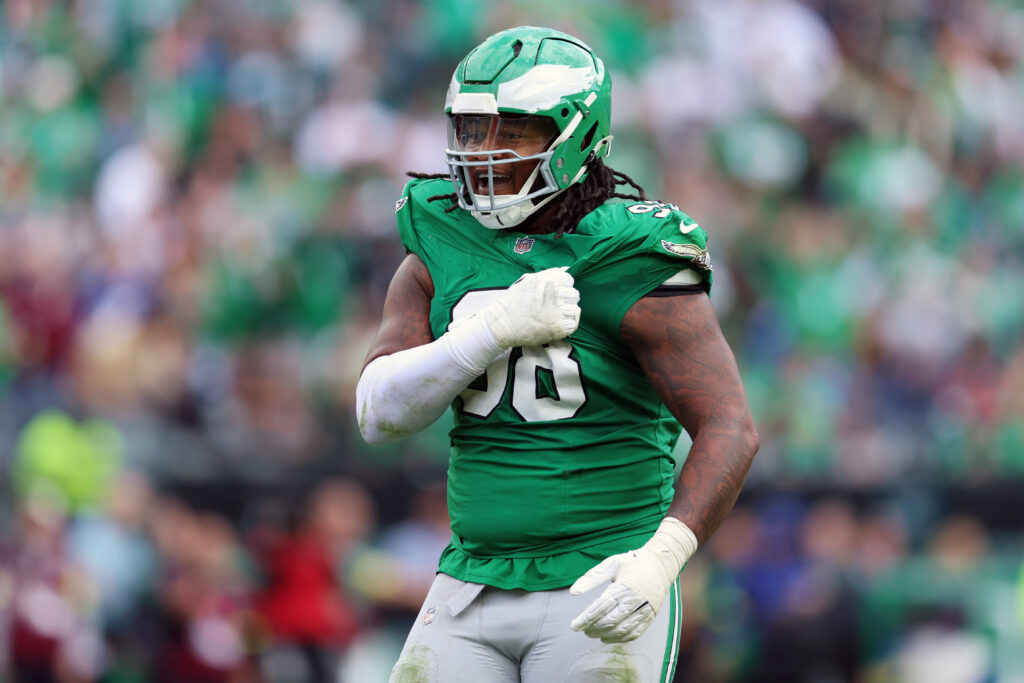
The Eagles and defensive tackle Jalen Carter have agreed to a four-year, $152 million extension with $106 million guaranteed, keeping the 24-year-old disruptor in midnight green through 2031, per ESPN. The deal cements Carter as one of the NFL's highest-paid interior linemen and signals Philadelphia's willingness to build around a player whose impact in the trenches—both as a pass rusher and run defender—has become central to how the defense operates.
Carter's extension is a valuation statement. The Eagles are betting that his production arc hasn't plateaued, and that his presence collapses opposing offensive lines enough to elevate the entire pass rush. A defensive tackle who commands double teams and occupies blocker attention multiplies the efficiency of edge rushers on the perimeter; when those edge men face cleaner lanes, their sack rates and pressure rates both climb. Carter's film shows exactly that multiplier effect. Over the past two seasons, opposing offenses have faced material pressure rate spikes when Carter is on the field, a pattern the Eagles front office clearly believes will persist for the next five years.
From a prop perspective, Carter's long-term commitment reshapes how to model Eagles pass rush volume. Teams facing Philadelphia will have fewer ways to scheme around interior pressure. That translates directly into higher expected sack and tackle numbers for the pass-rush collective, but more importantly, it tilts the expected distribution of opponent passing attempts upward—offenses that face sturdier interior protection schemes often lean run-heavy out of necessity, but against Carter's pressure, they're forced into passing situations more frequently. The Eagles' defensive efficiency benefit compounds when you factor in his two-year deal remaining: he's locked in his prime years.
For prop bettors, the angle is durable and multi-season. Carter's extension doesn't move the needle on a single game; it repositions the Eagles' defensive pressure baseline for the entire 2026 season and beyond. Opponents' team totals should trend slightly lower when facing Philadelphia—not because of Carter alone, but because his presence on a five-year contract reflects the Eagles' commitment to a system that generates pressure up the middle. Lean unders on visiting team passing yards and team totals against the Eagles this season, particularly for opponents without elite pass protection or dynamic receivers who can create separation pre-snap. The market will price Carter's impact across the season; the edge surfaces early in the year when books haven't fully recalibrated opponent game script risk against Philadelphia's interior fortress.