49ers Finally Deploy a Complementary Back—and Rush Attack Shows It
By PropBetEdge Editorial Team ·
Kaelon Black's Week 1 workload signals San Francisco is ready to abandon the McCaffrey-only model that tanked their ground game to 24th in the NFL last season.
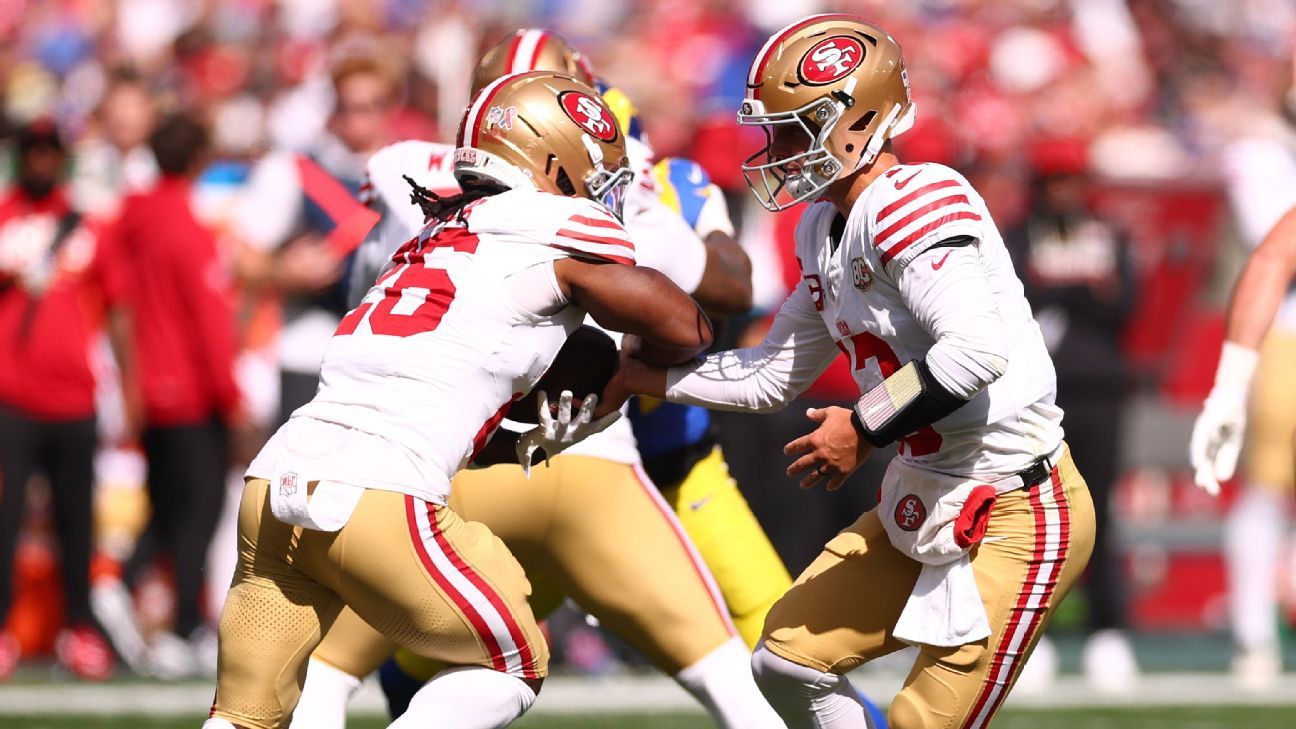
The 49ers averaged 3.8 yards per carry in 2025, their worst mark since Kyle Shanahan arrived in 2017. They finished 30th in rushing yards per game and—most damaging—29th in yards before contact, suggesting the offense itself was the constraint, not just the talent in the backfield. That changed Thursday in Melbourne. Against the Rams in Week 1 of 2026, San Francisco posted 30 rushing attempts for 5.8 yards per carry, a dramatic reversal that started with rookie Kaelon Black taking 14 carries to Christian McCaffrey's 10.
This wasn't an accident or a function of game script. Black missed a chunk of training camp with an adductor injury, yet still earned extensive run assignments by design—a vote of confidence from Shanahan that the 24-year-old third-round pick represents the power complement the 49ers have chased since acquiring McCaffrey in October 2022. McCaffrey himself endorsed the approach postgame, and center Jake Brendel was so convinced by Black's early hard runs that he waved at Shanahan from the field demanding more carries. The two backs finished with identical 15-touch workloads, though McCaffrey (88 yards) out-produced Black (70 yards) when touches were equalized.
What matters for the season arc: the 49ers have been searching for a legitimate RB2 since 2022 and cycling through failed mid-round picks. Black's college tape at Indiana showed power and decisiveness, though he caught only eight passes over two seasons—a clear pass-game limitation that Shanahan's system doesn't require from a secondary runner. If Black can sustain 12-15 carries per game while McCaffrey draws the receiving work, the 49ers' rushing attack gains two things it lacked last year: genuine depth and pace-of-play control. McCaffrey at 10-12 carries per game instead of 18-20 also reduces injury burden.
For prop bettors, the Week 1 sample suggests a structural shift in San Francisco's offensive philosophy, not a one-game fluke tied to McCaffrey's cramps. The 2025 rushing collapse was partly personnel, but the 2.04 yards before contact (29th) pointed to blocking and scheme constraints Shanahan couldn't fix with carry volume alone. Black's arrival and immediate deployment signals Shanahan believes a two-back cadence with defined roles—Black as the north-south runner, McCaffrey as the all-purpose weapon—restores the offensive line's ability to establish momentum. If the 49ers sustain 5.5+ yards per carry over the next three weeks, this isn't regression-proofing; it's a durable coaching adjustment. McCaffrey rushing attempts should settle 10-14 per game, while Black's carries could hold 12-15 if health permits.
The broader edge: 49ers team totals and first-half point spreads have been built on 2025 data (weak rushing, heavy pass reliance). If San Francisco can grind games on the ground, possession efficiency rises and game flow normalizes toward Shanahan's historical mean. The rushing efficiency in Week 1 also suggests the offensive line—much maligned last year—played at or above its talent level, another bullish structural indicator. Fade assumptions that the 49ers remain a pass-first, high-variance offense. The Melbourne game wasn't a statistical anomaly; it was a blueprint.