Deebo Samuel's Return Plugs a 49ers Receiving Crisis—but Don't Expect 2021 Volume
By Ty Whitney ·
San Francisco signs Samuel to a discount deal as injuries gut its wideout depth, creating a roster construction bet with clear prop implications for the offense's distribution.
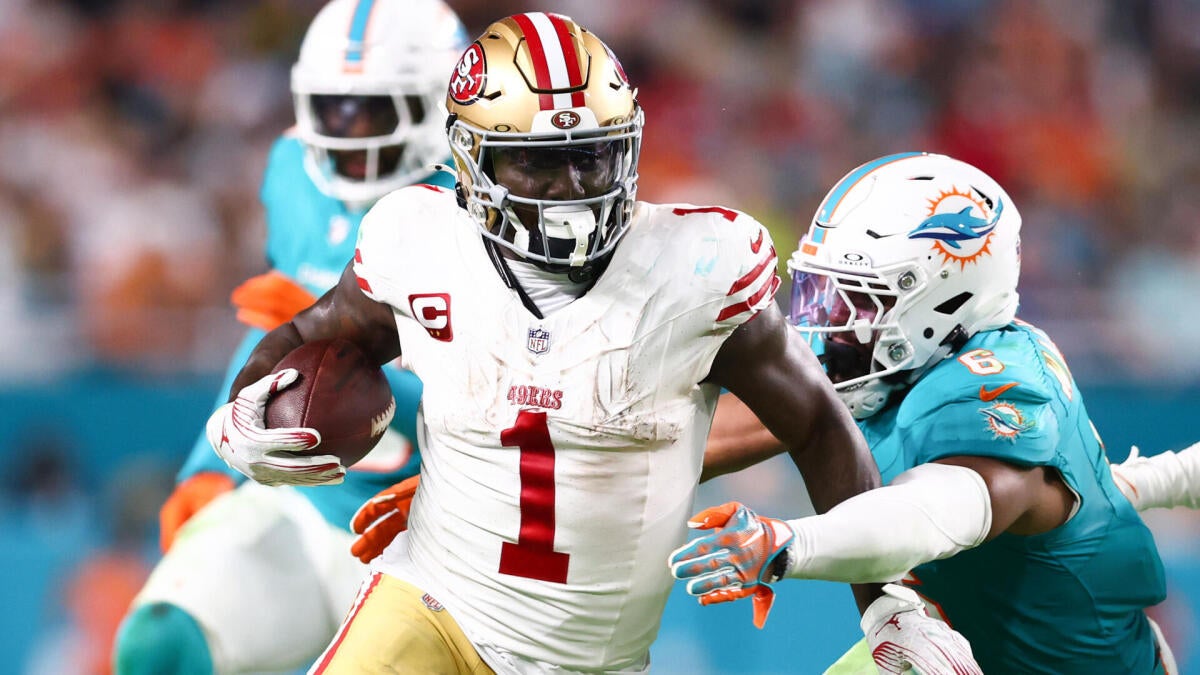
Deebo Samuel is back in San Francisco on a one-year, $7 million contract, reuniting with the 49ers after a season in Washington that reminded the market he still moves the needle as a weapons trader. The move is less a celebration than triage. Ricky Pearsall, the team's 2024 first-round pick, remains limited by PCL swelling from last season and has played in only 20 of 32 possible regular-season games since his arrival. Christian Kirk, acquired this offseason to anchor the slot, went down with a calf injury on the first day of training camp. That leaves Mike Evans, second-round rookie De'Zhaun Stribling, and depth piece Demarcus Robinson as the current primary rotation—a collection that would concern any offensive coordinator running a vertical passing game.
Samuel's 2025 season with Washington proved he hasn't lost the ability to generate yards after the catch and move defenses laterally, the core of his value in Kyle Shanahan's system. He caught 72 passes for 727 yards and five touchdowns, leading the Commanders in all three categories. That's his highest catch total since 2021, when he was a Pro Bowler and All-Pro in San Francisco, posting 1,405 receiving yards plus 365 rushing yards and 14 total scores. The contract price tag—$7 million on a one-year deal—signals the 49ers view him as stopgap depth, not a rebuilding of his 2021 apex. At 30 years old, he's no longer the engine. He's the valve that keeps the system from breaking while the team waits for Kirk and Pearsall to return to form.
For prop bettors, Samuel's insertion changes the math on how San Francisco distributes targets and touches, but not the way nostalgia might suggest. Shanahan will absolutely motion Samuel into the backfield and attack with him in space—that's the structural reason the 49ers brought him back. But he won't command the 19-20 target share or the 100-yard weekly floor he owned in his best years. Evans is still on the roster and will eat deep-ball volume. Stribling, as a second-rounder with upside, will get developmental reps. The receiving corp isn't suddenly Samuel's show; it's a managed committee that's badly understaffed.
The real prop angle sits on the team-total offense side. Samuel's presence lowers injury-replacement volatility and should stabilize target distribution, making San Francisco's weekly passing output more predictable than it would be if the 49ers were forced to lean exclusively on Evans and a developmental rookie. Before Samuel signed, any opponent study of the 49ers' receiving depth would have flagged risk that game scripts could force one-dimensional passing or create artificial ceiling limits when injuries flared. Samuel absorbs role flexibility—receiver, slot crosser, backfield alignment—that forces opposing defenses into schematic stress. The 49ers will pass more reliably in expected volumes now because they have a credible third option who understands the system.
Watch the 49ers' team passing-yards and team-total lines in weeks where both Kirk and Pearsall are still unavailable. Samuel's signing removes a significant injury-discount factor from those opens. The market likely priced in structural penalty for depth earlier this offseason; Samuel's presence should trade that penalty back out over the next 6-8 weeks, until Kirk and Pearsall prove they're fully healthy. That's not a Samuel receiving-yards prop—he won't consistently hit 70 yards or 6+ receptions. It's an offense-stabilization play. The 49ers' passing game gets more floor under it, which means overs on team passing yards become more executable when the market hasn't yet adjusted for the stability Samuel brings.