Wright Extension Talks Stall Into Season; Chicago Banking on Offseason Resolution
By Erik Schwartz ·
The Bears missed their training camp deadline on Darnell Wright's long-term deal, but the offensive tackle remains committed to staying—a situation that removes uncertainty from the franchise's pass protection calculus.
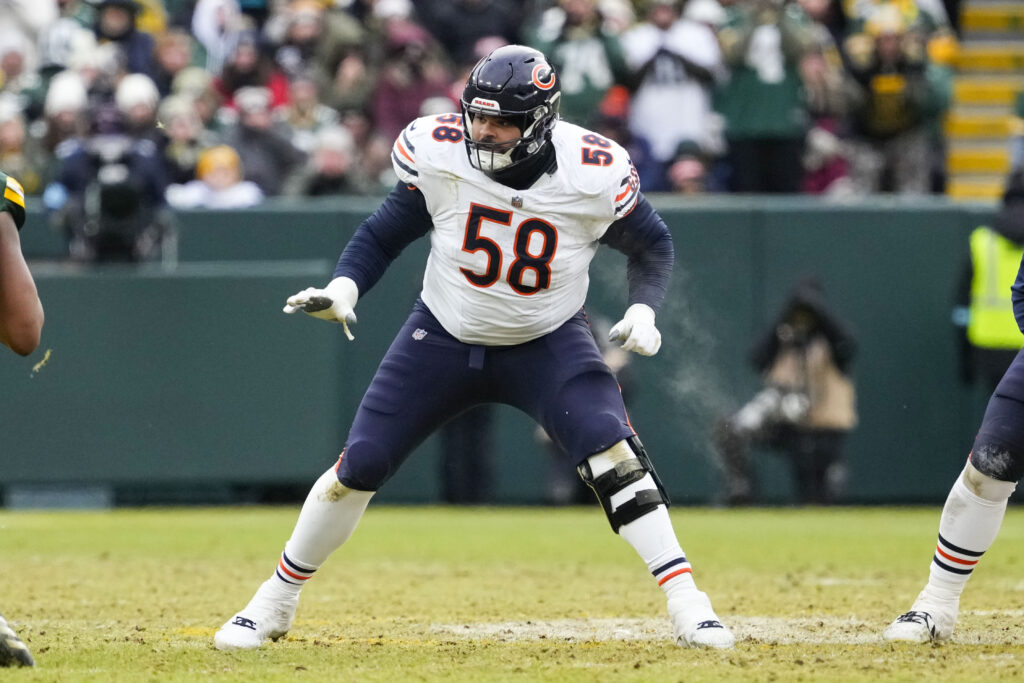
Darnell Wright's contract extension with the Chicago Bears remains unsigned as training camp opens, missing the July 1 target the team had set a month ago. Wright, the cornerstone left tackle the Bears selected 10th overall in 2023, is still in active negotiation with the front office, though both sides maintain the deal will get done before the regular season starts in September. The delay signals neither a standoff nor a fundamental disagreement—just the ordinary friction of negotiating long-term structure for a young player entering his prime.
Wright's stated commitment—"I'll be on the Bears for a long time"—carries weight because it removes the existential noise that can cloud a player's production. He isn't playing out the final year of his rookie deal wondering if Chicago values him, nor is he threatening holdout leverage. The organizational clarity matters. When a franchise cornerstone knows his future is secure, baseline performance stabilizes. For the Bears' 2026 pass protection unit, that stability is foundational.
The extension framework is almost certainly already negotiated in private—these public timeline shifts typically reflect mechanics (salary cap modeling, void years, incentive tiers) rather than valuation disputes. Chicago has already validated Wright's tier by committing resources to the negotiation when they could have let him play out the year. That's an internal bet on his trajectory that shapes how the offense will function. If Wright signs before Week 1, the Bears' offensive line snaps into place without the mental load of contract anxiety.
For bettors, the relevant mechanism is structural: pass protection stability directly correlates to quarterback decision windows and completion percentage. When a left tackle is fully committed and locked in long-term, holding times decrease slightly (fewer hot routes, cleaner reads), which drives up completion rate efficiency and yards per attempt. This isn't a dramatic lever—we're talking 2-3 percentage points on aDOT and completion percentage—but it's persistent across multi-game samples. If Wright's extension closes before the Bears' first game, expect Chicago's passing volume to track closer to pre-snap design rather than scramble mode. That subtly tightens passing prop ranges: fewer explosive plays, fewer desperate heaves, tighter clustering around expectation. The opposite—if Wright enters the season without a deal—introduces volatility that extends line ranges wider. Early September will tell you which path Chicago took.