Kenneth Walker's Integration Signals a Structural Shift in KC's Offensive Design
By Ty Whitney ·
The Chiefs paid for a running back who trains like a receiver and blocks like an edge; what they're actually buying is freedom to run heavier personnel in the red zone.
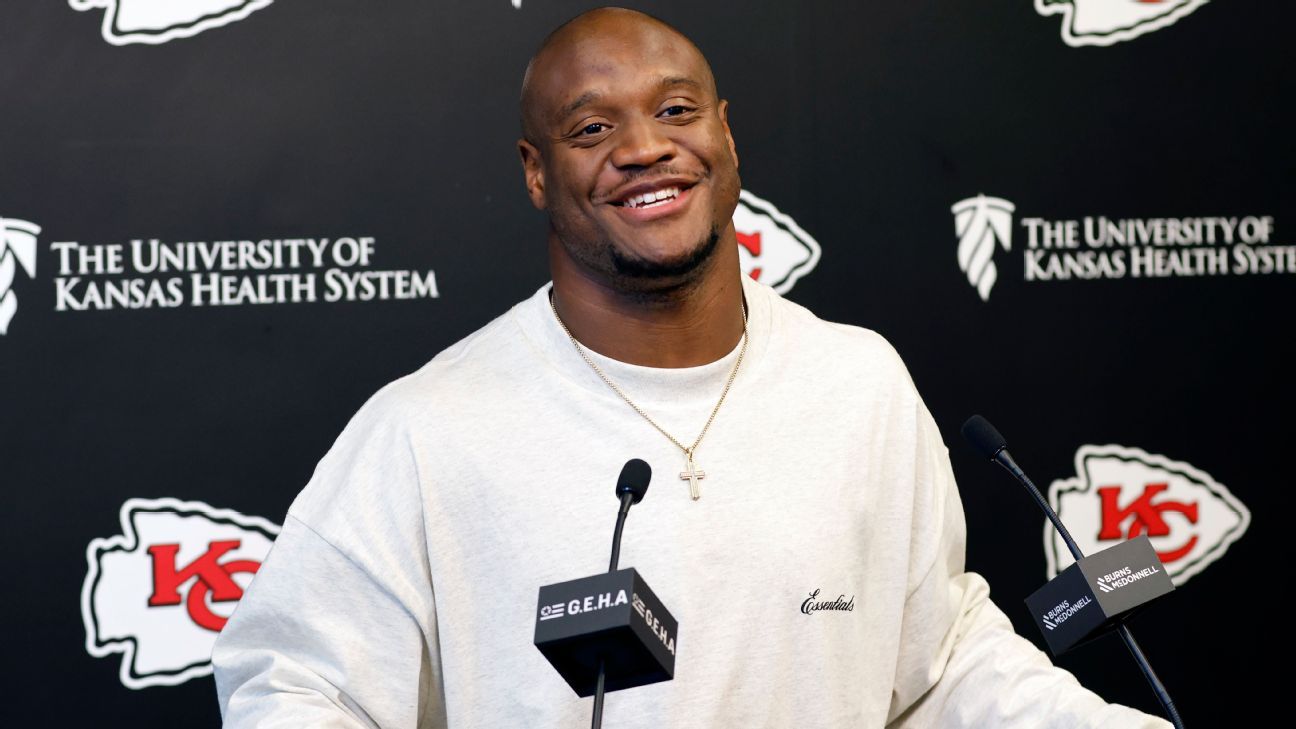
Kenneth Walker III arrived in Kansas City as the offensive centerpiece of this offseason, and five weeks into the team's program—as of early June—his footprint already extends far beyond the backfield. During OTA drills, Walker hasn't merely taken handoffs; he's inserted himself into pass-protection schemes, run routes with slot receivers, and maintained a permanent channel to Patrick Mahomes for pre-snap communication. This visibility is not accidental. It reveals how the Chiefs plan to deploy him: not as a traditional back, but as a hybrid tool that expands their red-zone architecture.
The Chiefs' offense has been structurally constrained in goal-to-go situations throughout the Mahomes era. They've ranked in the bottom third of league-wide rushing attempts inside the 10-yard line relative to their personnel, forcing Mahomes into high-variance passing plays in compressed space. Walker changes that calculus. At 5'10", 210 pounds, he's compact enough to line up in slot or H-back alignment, yet powerful enough to convert short-yardage carries. Trey Smith's visible enthusiasm—a veteran guard doesn't cheer in pass drills without reason—signals that the offensive line views Walker as legitimately capable of winning these carries in traffic. More importantly, Walker's willingness to participate in receiver route work means the Chiefs can keep their top-three receivers (Xavier Worthy, Travis Kelce, Tyquan Thornton) aligned and running full-speed routes while Walker executes checkdowns or quick-hitter passes. That flexibility is gold in the red zone, where defenses compress and play coverage variance spikes.
The mechanism is straightforward: when a team runs more effective ground attacks in the red zone, scoring efficiency climbs and drive completion rates improve. The Chiefs' expected points added (EPA) per play in the 1-10 yard line ranked 18th last season; upgrading that single slice of the field—through a back who can absorb blocks, catch underneath, and convert carries—directly impacts their offensive TD rate without requiring Mahomes to shoulder additional arm stress in congested space. Walker's pre-snap communication routine with Mahomes, visible during OTAs, is not a fluff moment. It's evidence that the team is installing him into audible packages and situational football, meaning his impact isn't confined to early-down carries. He's being written into third-and-4 checks and two-minute operations.
For prop betting, this creates a narrower but durable angle. Mahomes' red-zone passing yards and passing TD rate are the proxies to monitor, not his season-long volume. If Walker's integration genuinely expands KC's ground-game efficiency in the 1-10 yard line, Mahomes' per-drive TD creation should stabilize—fewer desperate heaves, more drive-capping runs. That's a multi-game pattern, not a single-game spike, because it stems from an organizational design choice (deploy Walker in the red zone) rather than game-to-game variance. The market has already priced Mahomes' aggregate passing volume; it has not yet fully adjusted for a scenario where goal-to-go efficiency improves and Mahomes' per-drive passing attempts in the red zone decline. That's the persistent edge. Watch his red-zone EPA per play and his end-zone TD rate specifically. If those metrics shift upward by midseason—and Walker's presence suggests they will—it means the offense is solving a real structural problem, and the short-term lines (which don't yet account for design-level shifts) will be vulnerable.