Slater and Alt Return: How the Chargers' Tackle Rehab Rewires the Herbert Passing Game
By Ty Whitney ·
Los Angeles signals both starting tackles will clear training camp, ending a season-long pass protection crisis that cratered Justin Herbert's efficiency.
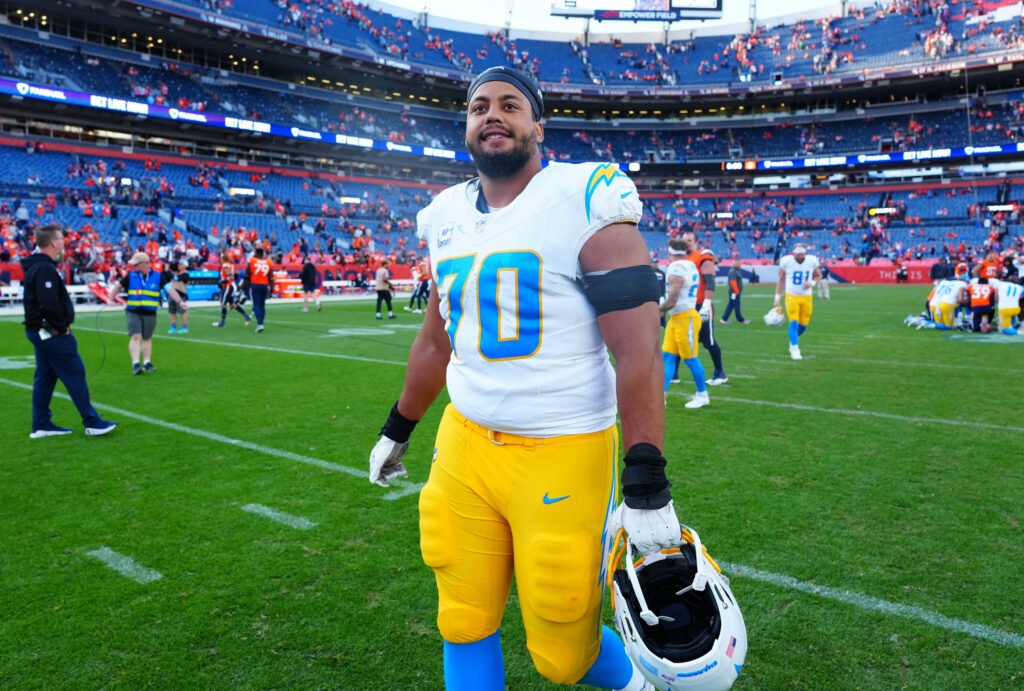
The Chargers are banking on continuity at tackle after a historically disastrous 2025 offensive line season. Per team announcements and head coach Jim Harbaugh's Wednesday comments, both Rashawn Slater and Joe Alt participated in organized team activities and are tracking to be available for training camp. Slater missed the entirety of last season following a patellar tendon tear suffered days after signing a four-year, $114 million extension. Alt managed only six games before a high ankle sprain became chronic, forcing season-ending surgery. Their combined absence left Justin Herbert operating behind a patchwork of understudy and acquired talent—a collapse that registered in real time: Herbert's yards-per-attempt dropped to 6.8 (2023-2024 average: 7.6), and his end-of-season loss to New England exemplified the offense's vulnerability.
The timeline matters. Slater enters his sixth season carrying Pro Bowl credentials from 2024 despite missing all of 2025. Alt, a former fifth-overall pick who moved back to his natural left-tackle position after a rookie year at right tackle, has now missed 12 of 17 games across his first two seasons. This injury density—particularly at the tackle bookends—creates legitimate concern about durability, not just recovery. The Chargers responded by acquiring Austin Deculus and Trevor Penning mid-season, then re-signing Penning to a $3.5 million one-year deal. They also deployed a fourth-round pick on tackle depth (Travis Burke) and promoted second-round center Jake Slaughter into the interior guard competition. The message is clear: management built redundancy into a unit it doesn't yet trust.
Herbert's passing volume and efficiency hinges on edge protection quality. Over the 2023-2024 seasons, when Slater remained healthy, he graded as a consensus top-five NFL tackle. His return—paired with Alt at the recovery stage but improving—creates a ceiling lift for Herbert's completion percentage, yards-per-attempt, and interception avoidance. A healthy tackle duo reduces Herbert's pressure-to-sack ratio and extends the timing windows for intermediate and vertical routes. The Chargers' offense design (zone-heavy, roll-out compatible) benefits disproportionately from elite edge pass-blocking, since the scheme depends on timing and route-tree depth. Conversely, if Slater or Alt suffers early re-injury during camp or preseason—a non-trivial risk given their recent medical history—the offense reverts to last year's crisis mode: short, high-volume checkdowns and elevated interception rates.
For prop bettors, Herbert's passing efficiency markets and Chargers team total overs carry material leverage in 2026. If both tackles clear camp and show no setbacks through preseason, expect Herbert's passing yards and completion percentage props to trend upward as the season approaches. Early-summer numbers will price in reasonable injury risk; convergent medical clearances and participation ramps during OTAs and camp will reset that baseline. The edge exists in tracking rehab participation throughout May and June—weeks when books haven't yet fully recalibrated. A Herbert passing yards under built on 6.8 YPA (last year's depressed mark) becomes vulnerable if his tackle protection matrix stabilizes. Conversely, any re-injury to either Slater or Alt during camp should trigger immediate fades on Herbert overs and team total overs, since the historical data shows his efficiency collapses without both bookends healthy. The durability question is real; act on clearance windows early before the market widens lines to account for it.
Monitor the first two weeks of camp for any limitation reports or practice-rep distribution anomalies. The Chargers' offensive line identity for 2026 won't be settled until both tackles demonstrate consecutive weeks of unrestricted participation. Until then, overs on Herbert efficiency metrics carry modest volatility premium—exploitable for contrarians who believe the medical timelines hold, but a fade for conservative bettors unwilling to absorb the re-injury risk.