Harrison's Injury Hangover Won't Derail 2026 Ceiling, but Timing Matters for Week 1 Volume
By Erik Schwartz ·
Marvin Harrison Jr. confirms he's still ramping up from a brutal injury cascade that wiped out five games in 2025, but doesn't expect carryover limitations—a statement that changes how sharps should calibrate his early-season receiving workload.
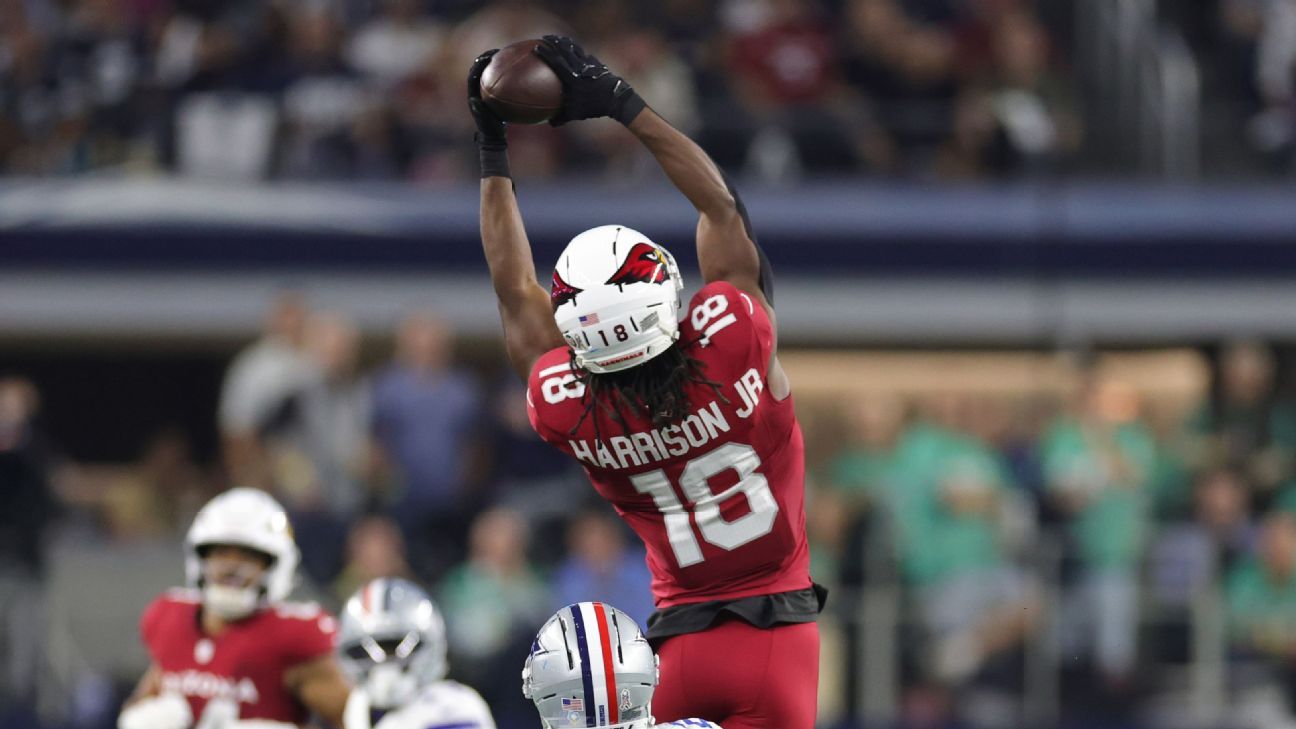
Marvin Harrison Jr. took the podium Tuesday for his first full accounting of the 2025 injury sequence that fractured what should have been his breakout third year. The Cardinals' No. 1 receiver cycled through appendicitis, dual heel injuries, and a concussion across a brutal 11-week window, missing five games total and returning to incomplete health twice before the season ended. Per his own assessment, the physical recovery is incomplete—he's still in a healing process—but he's made a telling distinction: the damage won't spill into 2026.
The specifics matter for the prop market. Harrison didn't hedge his statement with the usual non-committal language. "I don't think it's going to linger into next season, for sure," he said, then pivoted to explain the mechanics: foot injuries extend recovery timelines because you use them constantly, but he's already participating in full-intensity work. That's not the patter of a guy managing expectations downward. It's an affirmation that by Week 1, he'll be operating at baseline capacity. The appendicitis and concussion carry minimal carryover; the heels are the clock he's watching, and he's tracking them independently from his ability to cut, accelerate, and produce.
What makes this material for sharp bettors is the divergence between public perception and his stated reality. The general market will price caution into Harrison's early September lines—targets, receiving yards, touchdown probability—because a wide receiver who missed five games doesn't typically explode out of the gates. Volume often trails for returning players, especially those dealing with lower-body injuries that require confidence-building reps. But Harrison is telegraphing that he will NOT be eased in. He says he's "going 100%" in practice and has no restrictions. The Cardinals, who need receiver production badly with their QB situation unsettled, have little incentive to coddle him if he's medically cleared. That asymmetry between market caution (low volume, conservative early-season props) and his own signaling (ready for full deployment) is the edge.
The ceiling for Harrison in Week 1 likely prices in 6-7 targets and 55-65 receiving yards—reasonable for a ramped-up return. But if he's truly unrestricted and the Cardinals treat him as such in training camp and preseason, those numbers will test higher. A target share in the 8-10 range is plausible if he's the offense's primary option and gets worked early to build timing with his QB. The injury narrative has a half-life; once he logs full-participation practices and doesn't reaggravate anything, sharps will reprrice. The prop advantage exists in the next 4-6 weeks, before the market fully discounts the recovery timeline and adjusts to his actual role.
Longer-term, Harrison's durability enters the conversation differently now. A third-year receiver with appendicitis, dual heel injuries, and a concussion in one season is a volatility flag—not a talent flag, but a concern for consistency bets over 17 games. Sharps should treat Week 1-4 numbers as possibly depressed (due to injury recency) but should also build in a modest durability discount for the full-season slate. He'll likely be overvalued in early-season props and undervalued in full-season receiving yards or anytime TD odds once the initial recovery premium fades. The strategic window is narrow: buy the dip on Week 1-2 props, then reassess after he logs 4-5 healthy games.