Brissett's Contract Standoff Creates Volatility in Cardinals QB Room
By Erik Schwartz ·
A holdout over starter money threatens offensive continuity heading into the season, and sportsbooks have yet to fully price the disruption risk.
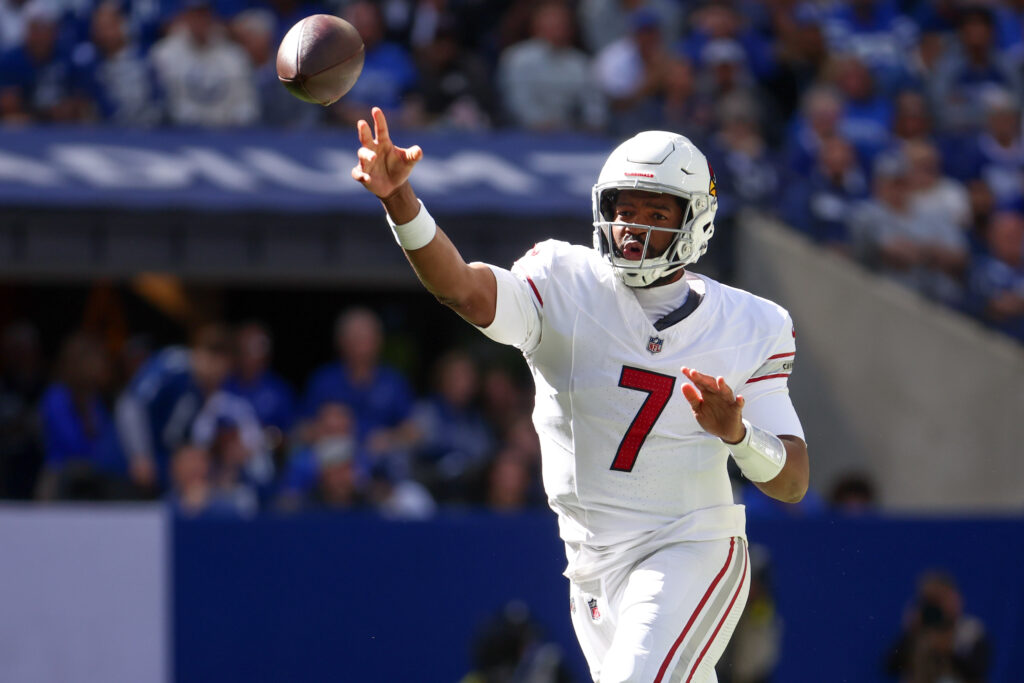
Jacoby Brissett has extended his contract holdout into Arizona's third week of organized team activities, seeking an adjustment to reflect his status as the Cardinals' starting quarterback for 2026. The team has shown no willingness to renegotiate mid-deal, leaving Brissett sidelined from early summer work as the two sides remain deadlocked over compensation.
The leverage calculus here is asymmetrical. Brissett signed his current deal under the assumption he'd be a backup; his emergence as a starter changes the value proposition, but Arizona owns the roster control. Missing OTAs carries minimal risk for a veteran—fundamentals don't erode over three weeks—but the messaging matters. When a starting quarterback publicly wages a contract dispute, it signals internal friction and raises uncertainty about his full commitment to the season. The Cardinals' passing attack can't operate with a fractured signal-caller.
OTA absence for a known commodity like Brissett is operationally manageable. He's not a young QB learning a new system; he's played in eight NFL offenses and knows how to manage information asymmetrically. But team continuity compounds over the summer. Timing-based precision with receivers, audible chemistry, and red-zone coordination all tighten through these reps. The Cardinals' receiving corps doesn't get those live snaps with their starter. When the team finally gets on the field for camp—if this resolves by then—they'll be executing fundamentals in compressed time.
For prop purposes, this creates a window of information advantage around Cardinals passing volume and efficiency. If Brissett's holdout extends into training camp or preseason, his completion percentage and yards-per-attempt should drift lower in early-season games as timing with receivers resets. Books will price Brissett's passing totals assuming normal offseason prep; the market hasn't fully absorbed the ramp-up cost. His over on passing attempts might look attractive early—Arizona will need volume to compensate for precision lag—but his passing yards and completion percentage lines carry elevated downside if the holdout lingers. A compressed buildup typically reduces efficiency before volume normalizes.
The secondary angle: Arizona's defense gets fewer live reps against its own passing attack, which could depress their early-season coverage discipline. Defensive prop lines on Cardinals games (sacks, interceptions) may be artificially inflated relative to what an undercooked offense can actually execute. Lean toward overs on passing yards for opposing QBs facing Arizona in weeks 1-3 if this remains unresolved; the cardinals secondary will have fewer live looks at precision passing timing.