NFL · injury
Cam Little's 70-Yard Attempt Redefines the Kicker Economy—and What It Means for Your Props
The Jaguars kicker came inches from NFL history on Sunday, and the new K-ball rule is about to upend how you value field goal volume and kicker scoring props.
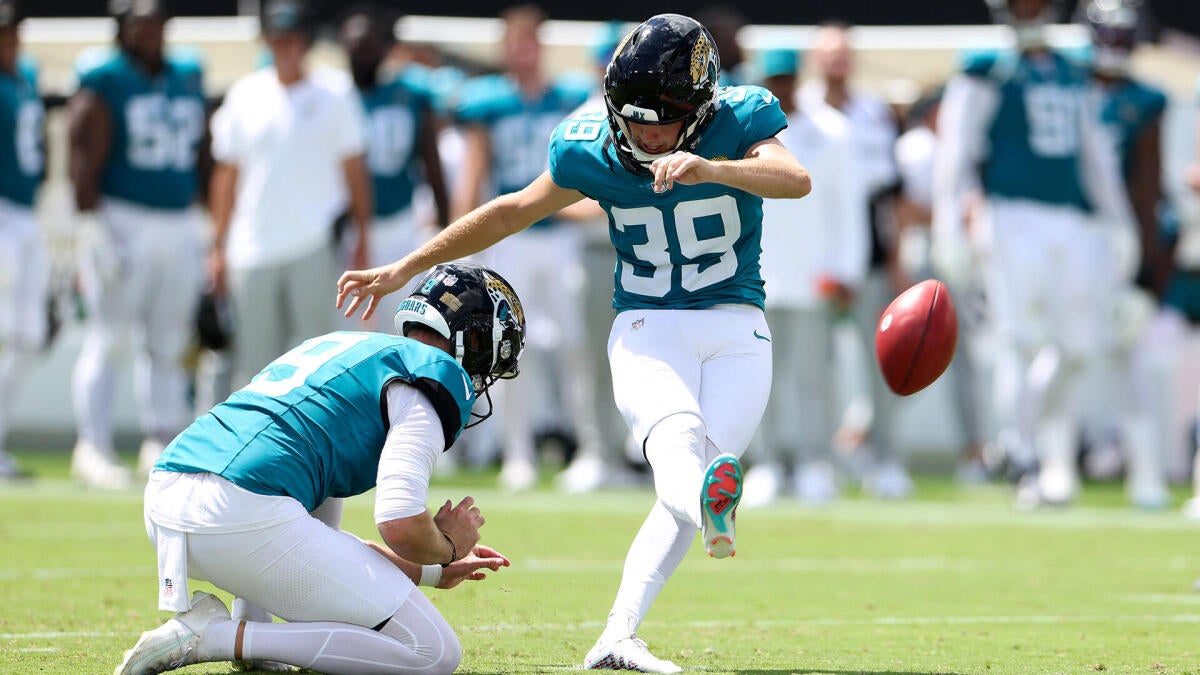
Cam Little lined up for a 70-yard field goal attempt with three seconds left in the first half against the Patriots on Sunday, and the ball sailed so close to the crossbar that it needed a video review to confirm the miss. Little didn't convert, but he came within inches—close enough that the distinction between history and heartbreak was measured in millimeters. The attempt itself was audacious enough, but what made Coen's call notable was that it wasn't desperation; it was calculation. Little already owns the two longest field goals in NFL history at 68 and 67 yards, both kicked last season. When your kicker has demonstrated repeatability at that distance, sending him out with three seconds on the clock becomes a rational gamble.
The real catalyst here isn't Little's talent alone—it's the K-ball rule the league implemented last season. Under the new framework, each team receives 60 pre-broken-in kicking footballs at the start of the season. Kickers can practice with these balls, softening them up and reducing surface friction. Teams can also brush down the ball's microtexture, creating cleaner contact surfaces. The effect is measurable: a ball that's been conditioned plays differently in game conditions than a virgin one does. Little already proved the distance is achievable in preseason when he hit a 70-yarder last year. Harrison Butker hit a 69-yarder in preseason, and both kicks flew further than the ball physics of previous eras would have allowed. The technology isn't making the leg stronger—it's eliminating friction variables that historically capped distance.
What's changed is consistency. Before the K-ball rule, a 60-yarder was the practical ceiling for a field goal attempt in a meaningful game situation because the margin of error was too high to justify the risk. Now, with conditioned balls and smoother surfaces, that practical ceiling has shifted north. Little's 68-yarder last November broke Justin Tucker's 66-yard record that had stood for over a decade. That it came in a conventional game situation, not a desperation heave, matters. The 70-yard attempt Sunday was only the ninth such kick ever attempted in NFL history, but the fact that it happened at all—and came so close—signals that the industry is converging on a new normal. As Little himself suggested this offseason, a 75-yarder isn't a fantasy; it's a five-to-ten-year problem for the books to solve.
For prop bettors, this creates a short-term pricing inefficiency. Kicker field goal volume props and "kicker scoring over" lines were calibrated on historical distance data. If Little or any elite-leg kicker now gets +1.5 to +2 additional expected points per game because balls are flying an extra 5-10 yards on average, the market hasn't fully repriced that edge yet. The sportsbooks set 2026-2027 kicker props based on 2025 data, not anticipating the compounding effect of a second season under K-ball conditions. Little's 68 and 67-yard makes last season were treated as outliers; the props were built assuming regression. Instead, they're previews. A second data point—Little's 70-yard miss, which would have been good—isn't regression; it's the new floor.
The angle is simple but durable: kicker scoring and field goal volume overs for elite-leg kickers (Little, Butker, Justin Tucker, Harrison Butker, others with 65+ yard ability) are underpriced for the 2026-2027 season because the market hasn't fully priced the K-ball conditioning effect. This isn't a single-game spike that corrects in 48 hours. It's a structural rule change that persists all season. Little may not hit another 70-yarder, but his expected value per game has shifted up because the conditioning removes the variance tax that used to kill long attempts. If Little averages 25-28 points per game instead of 22-24 (a three-to-four point bump driven by ball conditioning and distance normalization), the over on his kicker scoring line carries edge all season. Watch the books' adjustment carefully: if the lines don't move by 2-3 points Week 2, the edge remains.
NFL Intelligence — Football intelligence beyond the final score. Open NFL Intelligence →