Patriots Commit to Campbell at LT, Positioning Lomu as Right-Tackle Bridge to Future
By PropBetEdge Editorial Team ·
New England's refusal to move Will Campbell despite his rough rookie season locks in a swing-tackle role for first-round pick Caleb Lomu—and signals organizational patience that shapes both offensive line durability and quarterback protection patterns.
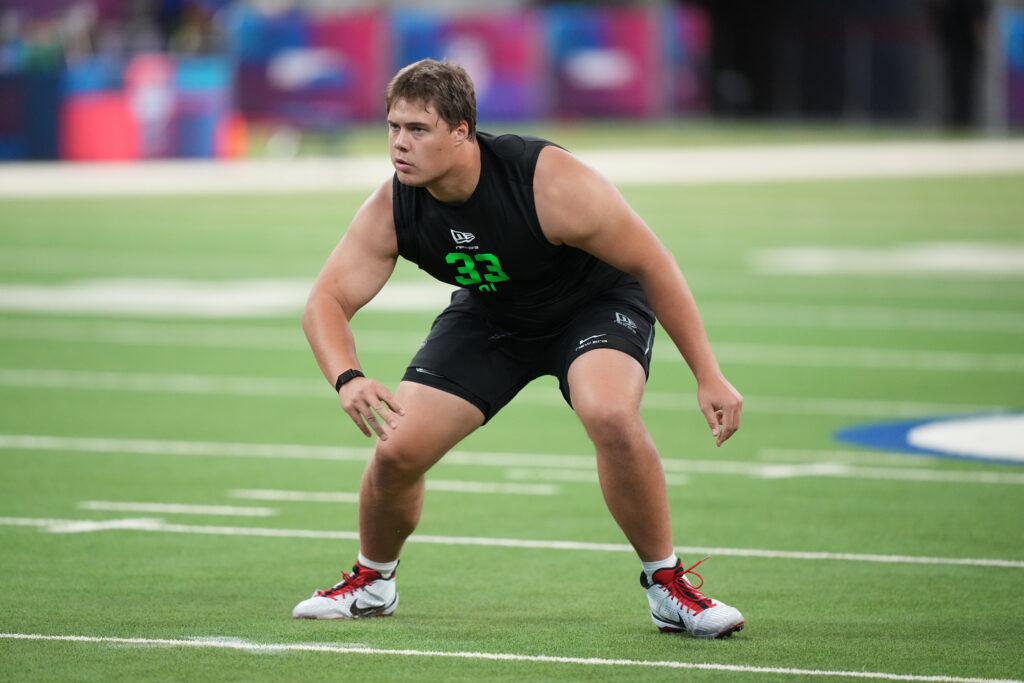
The Patriots are doubling down on Will Campbell at left tackle despite an uneven 2025 campaign, including a difficult Super Bowl showing. Per ESPN's Mike Reiss, first-round pick Caleb Lomu will function as the team's primary swing tackle, handling reps at both right tackle and left tackle during training camp while Morgan Moses anchors the right side. This structural choice carries significant implications for New England's offensive identity heading into 2026.
Campbell's retention at left tackle—a position where he was drafted fourth overall last year—reflects organizational conviction over empirical 2025 tape. The Patriots are banking on a second-year jump rather than pivoting to their new first-rounder. That commitment matters because it determines Lomu's usage pattern. The 21-year-old made all 24 college starts at Utah at left tackle, but New England sees him as a position-agnostic blocker. Lomu himself framed the shift at minicamp: he views himself as "a tackle in general" and spent pre-draft time working the right side. His willingness to flex between positions, combined with the team's explicit plan to rotate him as Moses's backup, suggests the Patriots view him as the long-term right-tackle successor. Moses, now 35 with no guaranteed money beyond 2026, is on a one-year runway.
From a line-stability standpoint, this three-level hierarchy—Campbell left, Moses right, Lomu swing—reduces volatility in quarterback protection. Drake Maye will face fewer re-learning curves if either Campbell or Moses misses time; Lomu can slide in without a wholesale scheme reset. That consistency should translate to measurable passing-play coherence: fewer negative plays, more time in structure, higher completion rates on intermediate throws. The Patriots' offense in 2025 (Maye's rookie year) experienced significant variance in line execution. A clearer depth chart with a proven swing option typically narrows that band.
The betting angle tracks through passing volume and efficiency. If Lomu's versatility and Moses's stability reduce sack rates and create more "clean pocket" snaps for Maye, the quarterback's completion percentage and yards-per-attempt should benefit. Conversely, if Campbell's year-two improvement fails to materialize and Lomu must spell him more frequently than anticipated, Maye's passing TD rate could contract—not because of a new skill issue, but because of time-in-pocket compression. Early-season Patriots passing lines (Maye completions, passing yards, passing TDs) will likely open soft if the market hasn't priced in this continuity play. Watch for line movement once preseason tape confirms whether Campbell has genuinely improved or whether the Patriots' faith is misplaced; the former supports slight overs on Maye's efficiency metrics, the latter argues for under exposure until clarity arrives.