Mayfield's Durability Defense Masks a Deeper Contract Standoff
By PropBetEdge Editorial Team ·
Baker Mayfield rejected injury-concern narratives Tuesday while signaling zero movement on contract talks through July—a hardline that could reshape his betting profile in the stretch run.
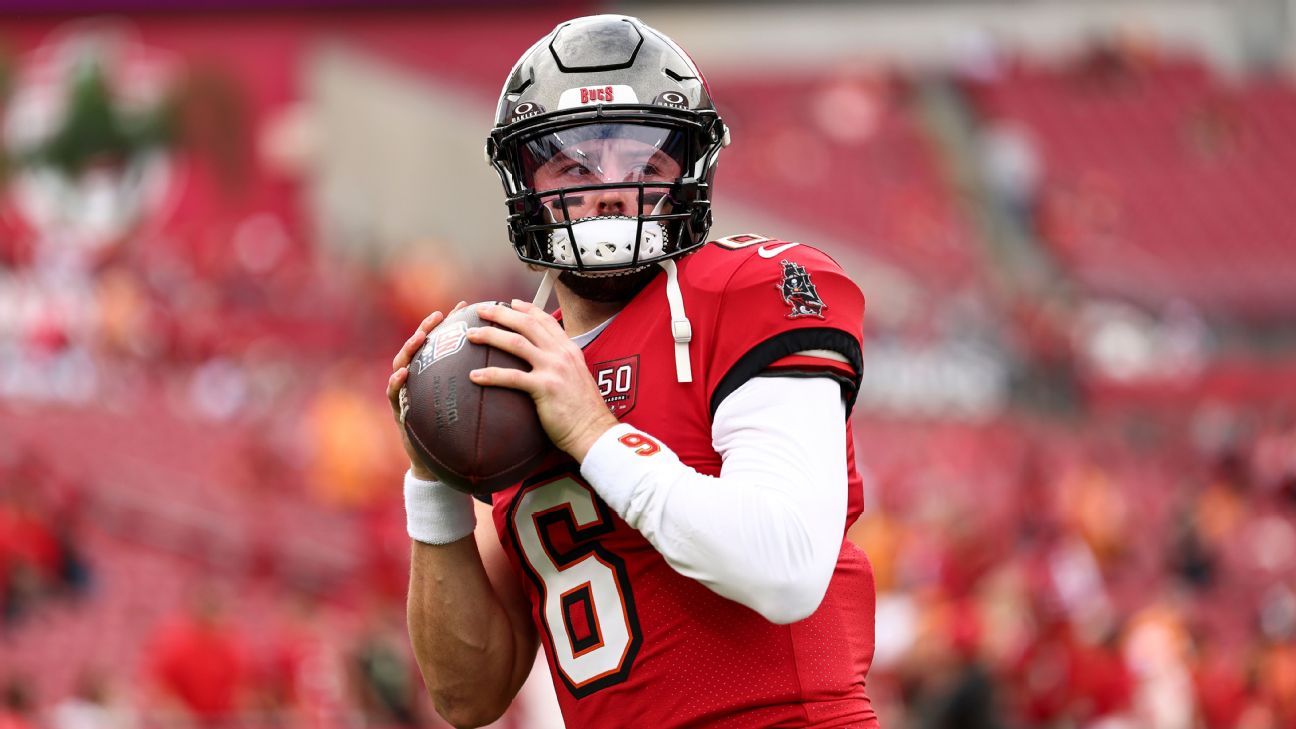
Baker Mayfield pushed back hard Tuesday against Tampa Bay's public concern that he neglects his body during contract negotiations, citing his starts in three consecutive seasons as proof of durability. The statement came two weeks after Mayfield declared himself and the organization "not anywhere close" on a new deal, and he reiterated that tone again Monday, saying negotiation will halt once training camp begins at the end of July. That's roughly 45 days of stasis—an unusually long runway for a franchise quarterback to sit unsigned in the final year of his deal.
The underlying tension is real. Mayfield is chasing a raise from his current position as the 16th highest-paid QB in the league, leveraging two division titles in three years to argue his compensation lags his production. But last season complicated that pitch. After a 6-2 start that included a statement road win over eventual Super Bowl champion Seattle, Tampa Bay lost seven of nine games down the stretch. Head coach Todd Bowles singled out turnover rate and decision-making outside the pocket as the primary drag—not durability, not missed games. That distinction matters.
The organization's public messaging around Mayfield's health reads as leverage, not genuine concern. He started every game for three straight seasons; that's durability by definition. What Bowles actually flagged was risk-taking, the reckless scramble drills and fourth-quarter hero-ball moments that either create explosive plays or lead to sacks and interceptions. If Bowles had wanted to critique Mayfield's physical conditioning or injury proneness, he would have said so. Instead, he isolated decision-making, which is correctable through technique and film work, not medical intervention.
For prop bettors, this contract standoff injects uncertainty into Mayfield's target share and volume over the next 45 days. A QB negotiating in the final year without agreement has two competing motivations: prove his worth on film (which argues for high-volume play-calling and showcase moments) or protect himself from catastrophic injury (which argues for conservative decision trees and fewer scramble attempts). Mayfield's defiant tone—"I don't know if that should ever be a question"—suggests he'll lean into the former, betting on explosive tape. But Bowles' public focus on risk management suggests the coaching staff won't enable pure air-it-out baseball anymore. Expect a narrower window for Mayfield to rack up passing volume; his 272 yards per game last season ranked 17th in the league, and tight officiating plus a conservative offensive philosophy will likely keep him in that range rather than push him toward a 300+ YDS floor. The contract noise also creates scheduling variance—some weeks Bowles might lean run-heavy to protect his QB and reduce negotiation-stage leverage concerns, other weeks he might lean pass to pad the resume.
In practical betting terms, Mayfield's passing yard props (currently trading around 268–275 range) carry execution risk because his game script and volume are subject to both offense design and the ambient contract anxiety. The over at these levels is not a fade, but it's vulnerable to game-flow variance. Any prop tied to decision-making outside the pocket—scramble-drill sacks, yards on unscheduled plays, fourth-quarter passing yards—should be capped conservatively until Mayfield and the Buccaneers either bridge the gap or hit the training camp deadline and force a resolution.