Irving's Shoulder Delay Opens Tampa Bay's Backfield to Gainwell's Pass-Game Edge
By Erik Schwartz ·
Bucky Irving will miss spring and minicamp due to offseason shoulder surgery, handing Kenneth Gainwell first-team reps in a Buccaneers backfield where receiving volume may be the most reliable prop target.
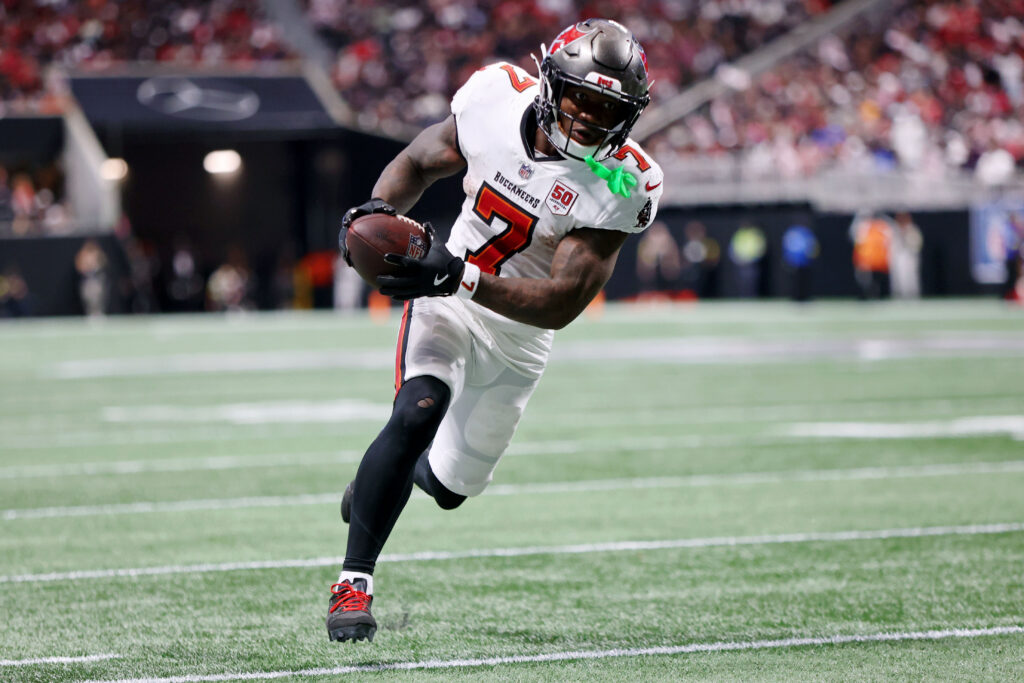
Buccaneers running back Bucky Irving will not participate in OTAs or mandatory minicamp as he recovers from offseason shoulder surgery, per ESPN's Adam Schefter, pushing his return to sometime during training camp at the earliest. The 23-year-old played just 10 games last season—a foot injury early, followed by a shoulder sprain that lingered through the second half—and his production suffered accordingly. He averaged 3.4 yards per carry and scored once, a sharp decline from his 5.4-yard rookie year and eight-touchdown campaign in 2024.
The extended absence reshapes Tampa Bay's spring depth chart and, more importantly, the competitive texture of the backfield heading into September. Kenneth Gainwell, signed in free agency after a career-year in Pittsburgh, gets first-team reps and lead work in the pass game. Last season, Gainwell caught 73 of 85 targets for 486 yards and three scores—all career-highs—and averaged 4.7 yards per carry on 114 rushing attempts. Sean Tucker, who struggled filling Irving's role last year with 3.7 yards per carry, will compete for touches but figures to occupy a secondary lane. Josh Williams (PED suspension cloud) and undrafted rookie Kadarius Calloway round out the depth, neither carrying the snap-count equity that Gainwell's free-agent price tag and receiving track record signal.
The prop angle hinges on Gainwell's receiving volume in a system now guaranteed first-team repetition through at least the preseason. In Pittsburgh, Gainwell operated as a core target in the underneath and short-crossing game—his 85 targets ranked him in the top 12 among NFL running backs. Tampa Bay's offense, though different in scheme, will deploy him similarly: third-down flex, red-zone safety valve, screen-game anchor. Irving's absence removes not just a snap-count competitor, but the player who would normally eat goal-line work and short-yardage carries—the roles that deflate receiving receptions and total yards for a pass-catching back. Gainwell's target share and yards will benefit from a lighter box, fewer defenders keyed to him in the flat, and a larger allotment of the offense's passing volume.
If Irving doesn't return until late August or September, Gainwell could carry a 50-55% snap count into Week 1, with 4-5 targets per game a reasonable floor given his Pittsburgh workload and the Buccaneers' commitment to him in free agency. Gainwell's receiving yards over (implied 30-35 yards per game) should carry edge through the preseason and into early-season prop cards. The risk: if Irving returns healthy by mid-August, he could reclaim enough volume to suppress Gainwell's ceiling in games where both are active. But for the next 6-8 weeks of available prop markets, Gainwell's receiving floor is elevated relative to projections built on typical Buccaneers backfield split.