Mayfield's Tag Acceptance Signals Stalemate, Not Resolution
By PropBetEdge Editorial Team ·
Baker Mayfield's willingness to play under the franchise tag in 2026 suggests contract negotiations with Tampa Bay have hit a wall—and bettors should expect continuity, not upheaval, in the Buccaneers' passing attack.
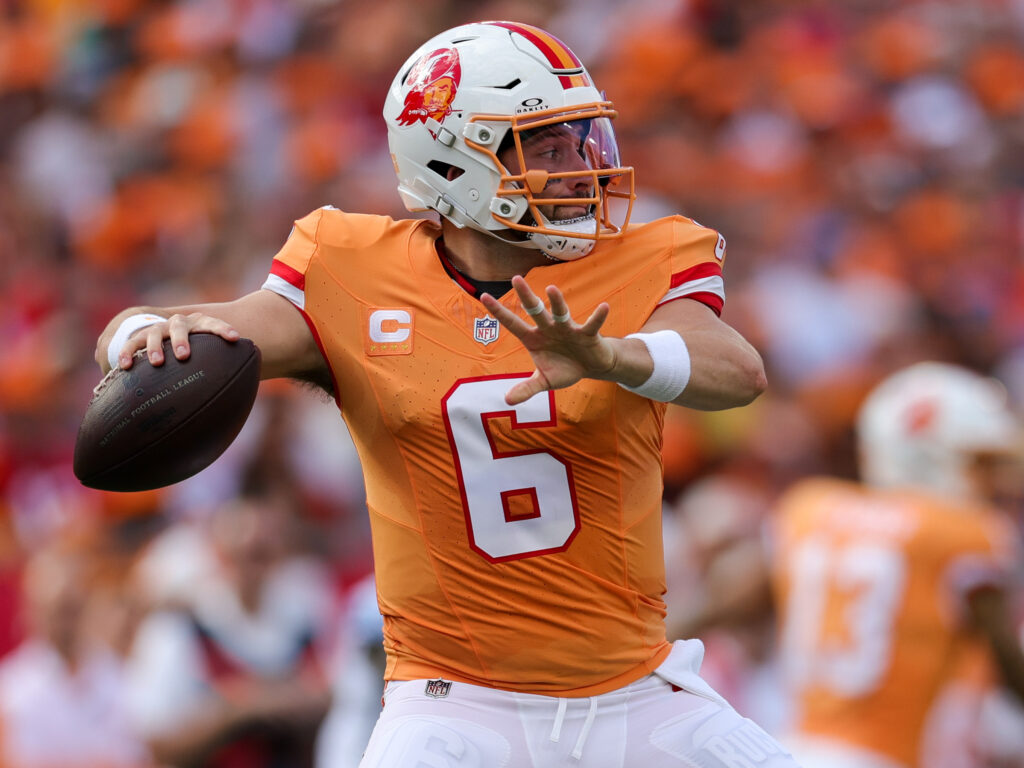
Baker Mayfield has signaled his acceptance of playing the 2026 season under Tampa Bay's franchise tag, effectively calling the Buccaneers' bluff after his July 24 deadline for a long-term extension passed without agreement. The move doesn't represent a breakthrough; it's a negotiating posture that acknowledges a hard truth: neither side is moving far enough to close the gap before training camp opens in two days. Mayfield wanted certainty before the season began. The Buccaneers want to defer money. Both are now locked into a holding pattern that will almost certainly extend into 2027.
This stalemate has immediate operational implications for Tampa Bay's offense. A quarterback playing on a one-year deal tends to operate within tighter constraints—teams generally don't hand franchise-tagged passers the green light for high-variance play calls or volume in the fourth quarter when the outcome is decided. The Buccaneers' coaching staff, already comfortable with Mayfield's decision-making after three seasons together, will likely dial in conservative play-calling on early downs and lean harder on the run game in close contests. Mayfield's interception rate and deep-ball attempt frequency could both decline as Tampa Bay maximizes win-probability through ball security rather than explosive upside.
The franchise tag also sets a financial ceiling on what the Buccaneers will spend elsewhere. With roughly $35 million committed to Mayfield's 2026 cap hit, the team has limited flexibility to retain or acquire pass-catchers at premium rates. Mike Evans is locked in, but supporting wide receiver rotation and tight end usage will likely tighten. This isn't a dramatic reshaping—Mayfield threw for 4,694 yards in 2025 despite the uncertainty—but it's a measurable compression of target distribution and red-zone volume compared to a scenario where he signs a five-year deal and plays with full organizational commitment.
For prop bettors, the tag acceptance is a fade signal for Mayfield's passing volume and touchdown ceiling during the 2026 season. His pass attempts will likely range 570–600 (down from historical ranges of 600+) because conservative script management and increased run commitment reduce his attempt share. Interceptions thrown should stay in the 12–16 range, a floor-to-floor outcome reflecting fewer high-leverage decisions late in one-score games. His season passing yard total sits around 4,500, a number that reflects both his talent and the volume constraints imposed by a team playing for a one-year prove-it window. The real edge isn't in the direction—any sharp book has already priced this as a lower-variance season—but in fading overs on his weekly passing attempts and passing touchdown props when they spike on one-game outliers. The franchise tag has made Mayfield's output predictable rather than explosive.