Browns Trade Up for McNeil-Warren, Bet the Secondary Depth Play
By Ty Whitney ·
Cleveland's midround safety investment signals defensive confidence that props into early secondary depth and turnover opportunity.
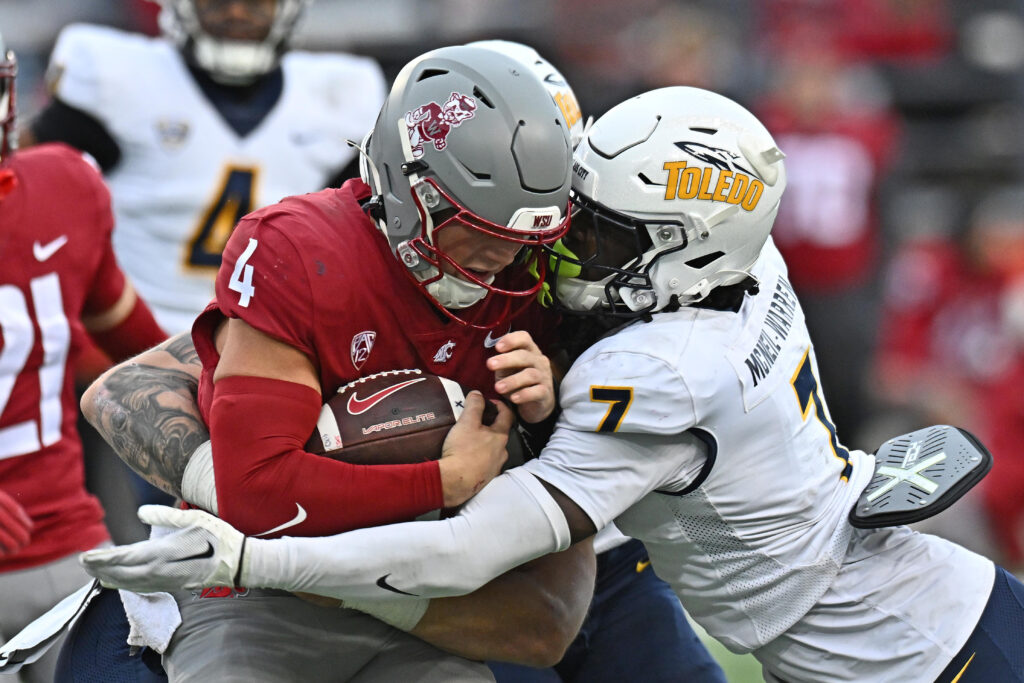
The Browns traded up 12 spots to secure Toledo safety Emmanuel McNeil-Warren at No. 58, moving ahead of 32 other teams to lock in a player scouts had penciled as a first-round prospect months earlier. McNeil-Warren's fall—he was ranked as high as 15th overall on some boards—left value on the table for a Cleveland front office that moved capital to keep him in-state. He signed his four-year rookie deal Thursday, becoming the ninth of the Browns' 10 2026 draft class to ink their contracts.
The calculus here is transparent. Grant Delpit and Ronnie Hickman—Cleveland's incumbent safety duo—are both in contract years. Delpit locked in an extension, but Hickman drew only a second-round RFA tender, creating a clear departure window by 2027. McNeil-Warren, a 6-foot-3 rangy ballhawk who intercepted five passes and forced nine fumbles with the Toledo Rockets, enters a secondary already debugged by the Eagles' Quinyon Mitchell (McNeil-Warren's former teammate). That Mitchell made a seamless jump from a Group of Five program to NFL impact is the template Cleveland is banking on—and Andrew Berry's twin brother Adam (an Eagles executive) was positioned to observe it firsthand. A fourth-round safety in the 2026 class, McNeil-Warren clocked 4.52 seconds in the 40-yard dash; his coverage was sticky enough to earn third-team All-American honors.
What matters for betting is the confidence signal baked into that trade-up. The Browns didn't wait; they moved resources to forecast secondary depth. That's not noise about draft theory—it's an organizational valuation call. When a front office pays trade capital for a prospect it believes can step into a starting role within two seasons, it typically means the defense is positioned to survive near-term attrition and stay competitive in the secondary. Delpit and Hickman will likely command the snaps early, but McNeil-Warren's pre-draft buzz (he was projected Round 1) combined with Cleveland's willingness to leap forward suggests the secondary will remain a strength relative to the division.
For prop angles, the immediate impact arrives in defensive scoring and turnover opportunity. Secondaries that turn the ball over at elevated rates tend to generate sack opportunities for pass-rush units operating with confidence. The Browns' edge rushers—already anchored by a veteran front seven—now inherit a secondary expected to create stops and force incompletions at a higher volume than a unit relying purely on veterans in contract years. Watch sack totals for Cleveland's defensive line in 2026 and 2027; a younger, deeper secondary is a pressure multiplier. Additionally, interception props for the Browns defense as a whole should rise as McNeil-Warren competes and eventually earns snaps. A high-upside coverage safety with ball-hawking ability in a scheme designed to create turnovers will naturally push team defensive interception lines upward over the next two seasons.