Watson's Injury History vs. Sanders' Youth: How Cleveland's QB Decision Reshapes Passing Volume Bets
By Ty Whitney ·
Two preseason auditions will determine Cleveland's starter, but the health trajectory of each QB—not the wins—tells the real prop story.
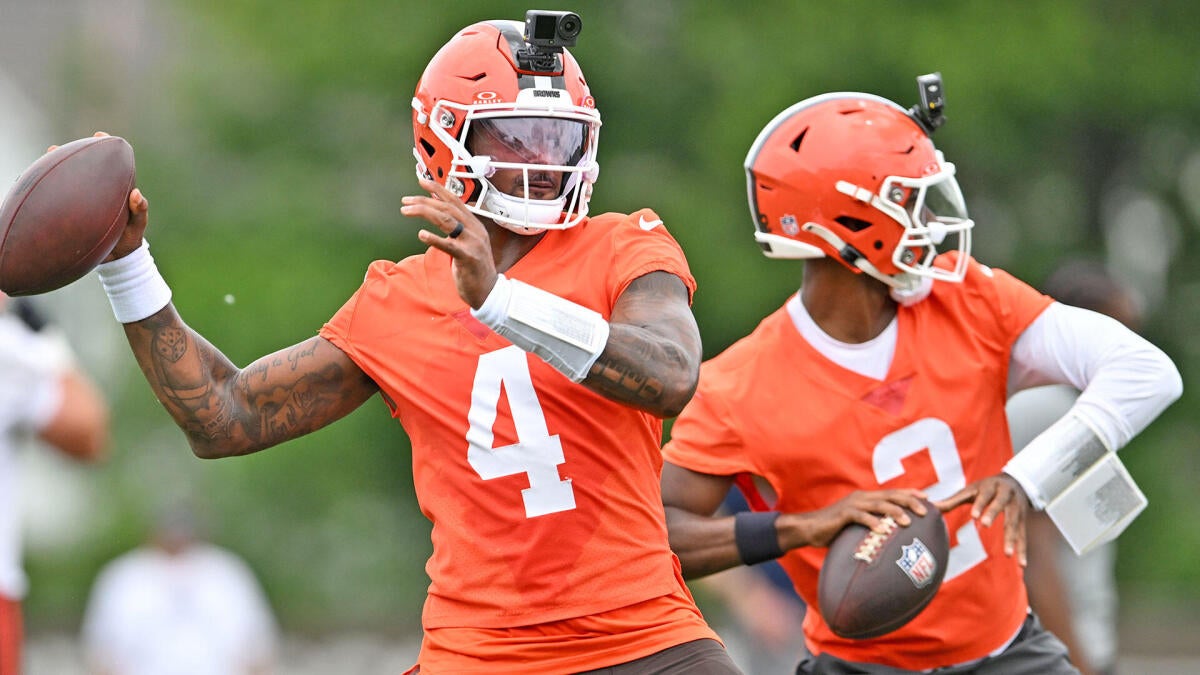
Todd Monken will hand Deshaun Watson and Shedeur Sanders one preseason start each before the third exhibition game, using performance over the next three weeks to narrow his QB1 decision. Watson plays the Chicago Bears on August 15; Sanders faces Buffalo on August 22; the winner of that informal audition starts the finale against New England on August 27. The decision won't be locked until Week 1 against Jacksonville on September 7, but these three games are the proving ground.
The narrative framing—youth and unproven confidence versus veteran stability—masks a sharper underlying tension. Watson has logged 19 games in a Browns uniform since his 2022 arrival. A torn Achilles in October 2024 ended his season. Five months later, a second Achilles tear required surgery in January 2025. At 30 years old, with a history that also includes an ACL tear in 2017, Watson's durability profile is fractured. Sanders, by contrast, is 24 and untested—but he's upright. He started seven games last season after Cleveland cycled through Joe Flacco (four starts) and Dillon Gabriel (injured, benched). Sanders won his debut, a feat no Browns QB had managed in two decades. His raw numbers were thin: 1,400 yards, 7 TDs, 10 INTs over seven games. But he carried the team through September and into October before the offense hit inevitable walls.
Watson's adjusted 17-game pace projects to 4,169 passing yards and 29 TDs against 11 INTs based on his 73-game NFL history. Sanders' adjusted pace sits at 2,975 yards and 15 TDs against 21 INTs. That 1,200-yard gulf and 14-INT variance should terrify bet-builders relying on volume. But volume assumes health. If Watson's Achilles holds through training camp and preseason, he's the higher-ceiling arm. If he re-injures or is limited to a snap count, Cleveland pivots to Sanders, and passing totals crater. The downside risk on Watson-centric passing props is asymmetric: he either plays, or he doesn't. There's little middle ground with a player on his third major lower-body injury in four years.
For prop bettors, this decision tree matters immediately. Any passing-yard or TD total pegged to Watson's full participation carries hidden injury premium—the market will price it as if Watson is healthy, because that's the presumption at season-start. But preseason will reveal conditioning and load tolerance. If Watson takes heavy reps in the August 15 game and logs clean practices afterward, the health risk subsides. If he's limited, rotated, or shows mechanical breakdown, the market hasn't yet discounted that outcome. Sanders' ceiling is lower, but his floor is known: a kid who managed 2,975 adjusted yards with a ragged 56.6% completion rate. Betting unders on Cleveland team passing yards makes strategic sense only if you're confident Watson's Achilles is structurally sound. If there's any doubt, that's the angle—fade overs on Browns QB passing props until Monken confirms health.
Monken's preseason strategy—two isolated auditions plus a tie-breaker game—also means the Week 1 starter may not be the QB who logged the most reps in August. He's signaling that decision quality matters more than sample size. That restraint is unusual, and it reads as risk management. If either QB shows injury concern during the exhibitions, Monken reserves the right to pivot. Sanders is the safe default; Watson is the upside lottery ticket with rust and durability questions baked in.