Payton's Broncos Turn to Hill as Backup Plan for Late Offseason Depth
By Erik Schwartz ·
With Taysom Hill now officially off the Saints' 2026 roster, Denver is exploring a deal for the versatile tight end—a move that reshapes the math on both team and individual prop values.
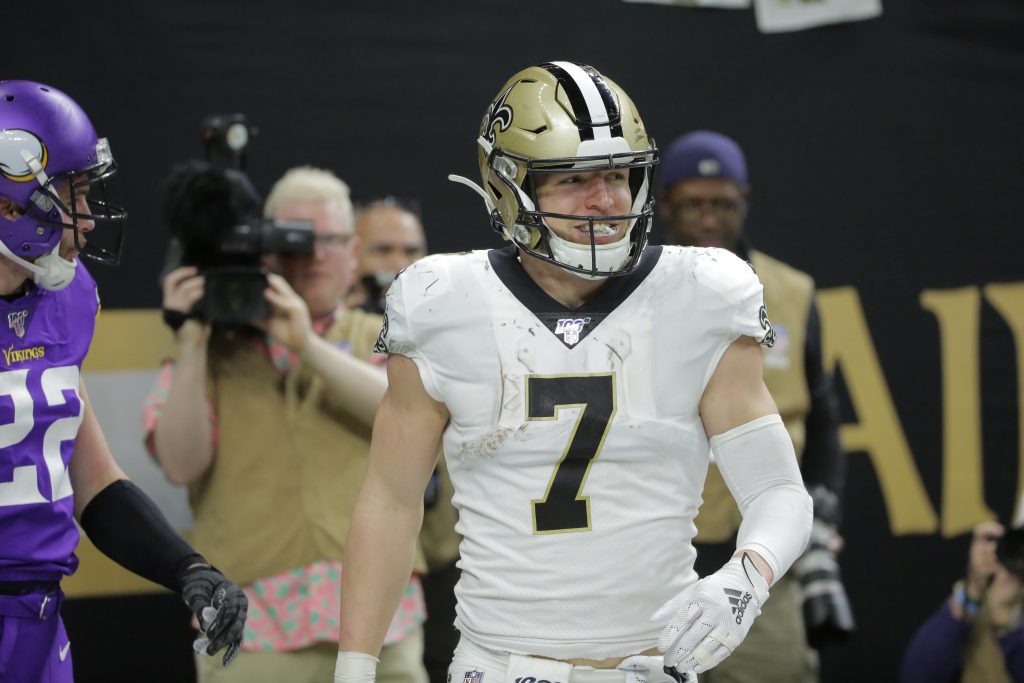
Taysom Hill has officially closed the door on New Orleans, and Sean Payton's Broncos are now actively considering bringing him to Denver on a free agent deal, according to the head coach's recent remarks on NFL Network. Hill, released by the Saints after eight seasons, remains unsigned and available—a rare mid-offseason vulnerability for a player capable of lining up as tight end, fullback, and occasional rusher. Payton, who coached Hill in New Orleans and understands his skill set intimately, sees value in adding a Swiss Army knife option to a roster still calibrating its offensive depth.
The timing matters. Denver's roster is set at the position level, but Hill's arrival would signal a shift in offensive philosophy away from pure three-receiver efficiency and toward heavier packages that leverage play-action and misdirection—hallmarks of Payton's system. Hill's presence alone doesn't move the needle on star receivers like Courtland Sutton or Tim Patrick, but it does create a marginal claim on targets and scoring opportunities that weren't available before. In 2025, Hill caught 35 passes and 4 touchdowns; he was a volume-dependent role player, not a prime target. In Payton's scheme, however, he functions as a decoy and red-zone weapon simultaneously, which can suppress the per-snap efficiency of traditional tight ends while increasing his own touchdown probability in the low-yardage situations he frequents.
From a depth standpoint, Hill's addition suggests the Broncos viewed their current tight end group as incomplete for playoff scenarios. This is critical context for tight end prop bettors. If Denver commits to Hill on a multi-year deal, weekly snap counts become harder to predict, and ceiling projections on whoever the primary tight end option is (whether it's a retained veteran or a younger prospect) will carry more variance. Single-game prop lines will widen. Multi-week totals will become less reliable as the offense experiments with personnel.
The prop angle crystallizes around team total offense and field goal volume. Payton's playbook historically produces higher field goal attempts and lower touchdown-per-trip efficiency than pure spread offenses; Hill's role as a fullback in goal-line situations and his middling receiving upside creates scenarios where the Broncos move the ball, stall near the red zone, and kick. Denver's team total overs for games featuring heavy Hill usage should be faded in the 3-4 weeks immediately after his signing, before the market can fully price the scheme shift. Similarly, Broncos passing yards may contract slightly if Hill takes snaps that would otherwise go to a receiver; watch for Sutton's receptions line to tighten if Hill becomes a weekly 8-12 snap option. The edge here is asymmetric: early-week overs on Denver's offensive total are vulnerable to repositioning risk, while single-player receiving props for the WR core should be treated with caution until snap share stabilizes.