Bears Banking on Jones as LT Bridge While Trapilo Rehabs: What It Means for Chicago's Pass Protection
By Ty Whitney ·
Braxton Jones gets another starting shot at left tackle for Chicago, but the injury roulette at the position threatens to disrupt quarterback stability all season.
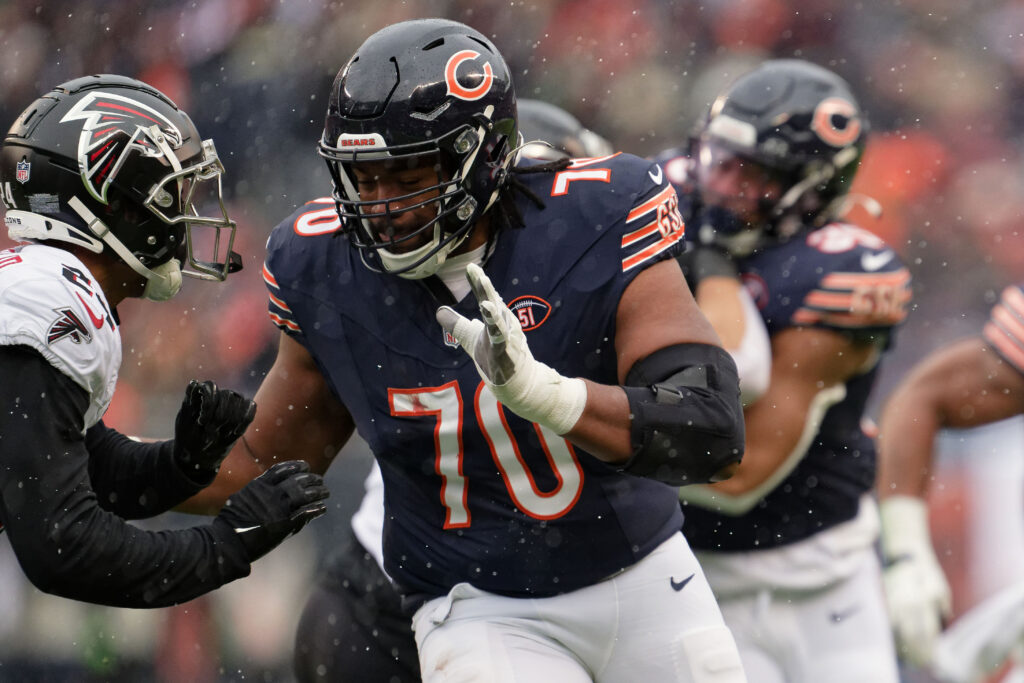
The Chicago Bears are handing Braxton Jones the keys to their Week 1 left tackle job, banking on the fifth-year blocker to provide stopgap continuity while second-round pick Ozzy Trapilo rehabs from a patellar tendon tear suffered in January's wild-card loss to Green Bay. As Kevin Fishbain reported, Jones won the spring competition despite being benched four games into last season and landing on injured reserve with an ankle injury. The Bears cycled through Joe Thuney, Theo Benedet, and a rookie Trapilo before the season imploded at the position—a carousel that left Chicago starting four different left tackles in one year.
Jones, a fifth-round pick from Southern Utah, has remained the organizational continuity play at the position since 2022. He opened four straight seasons as the Bears' starter before the 2025 campaign derailed him, but he's coming off his first genuinely healthy offseason since 2023, when he suffered a neck injury. His one-year, $5MM deal (up to $10MM) with the Bears signals the team views him as tradeable depth, not a franchise anchor—a financial constraint that underscores the urgency to get Trapilo back healthy. The Bears' offensive line otherwise stabilizes around Joe Thuney (returning to left guard after an All-Pro season at LT), Jonah Jackson at right guard, and Darnell Wright at right tackle, though Drew Dalman's retirement departure at center adds another variable.
The real cost of this instability flows downfield to the quarterback and the passing game. When left tackle protection breaks down, the pocket collapses faster and coverage windows shrivel. Jones has graded top-25 by Pro Football Focus in two of the past three seasons (2022, 2024) but slipped to 34th in 2023 after his neck injury. That volatility matters. If Jones holds his 2024-2022 tier form—roughly a league-average to slightly-above-average starter—the Bears' pass protection should remain functional. If he regresses to his 2023 level or re-aggravates one of his recurring soft-tissue injuries, the entire offensive system tightens. Bears quarterbacks will have less time to climb the ladder, scramble, or extend plays downfield. Targets will skew shorter and underneath, and turnover risk spikes when the pocket pressure arrives faster than progressions develop.
For bettors, this shapes the contours of Bears passing props all season. If Jones stays healthy and performs at his 2024 baseline, Bears QB passing yards and passing TD lines should track near preseason projections—the market will price in functional protection. But any Jones setback (re-injury, performance dip, or early replacement by Benedet or Jedrick Wills) will narrow passing windows and compress yardage totals faster than Vegas adjusts. The leverage isn't in backing the Bears' pass volume outright; it's in fading aggregate passing output during any Jones downside moment or when Trapilo nears return and the organization begins transitioning. The market will lag on downward adjustments to Bears QB yardage lines if Jones limps through August camp or Week 1-2 games reveal pocket erosion. That's where the edge lives—anticipating the volatility Jones' injury history and proven game-to-game volatility introduce to an otherwise stabilizing offensive line.