Herbert's Release Overhaul Under McDaniel Could Reshape Chargers Passing Volume
By PropBetEdge Editorial Team ·
Justin Herbert is rewriting his mechanics this offseason, trading his natural arm strength for anticipatory timing—a shift that carries real consequences for his passing efficiency and downfield completion rates.
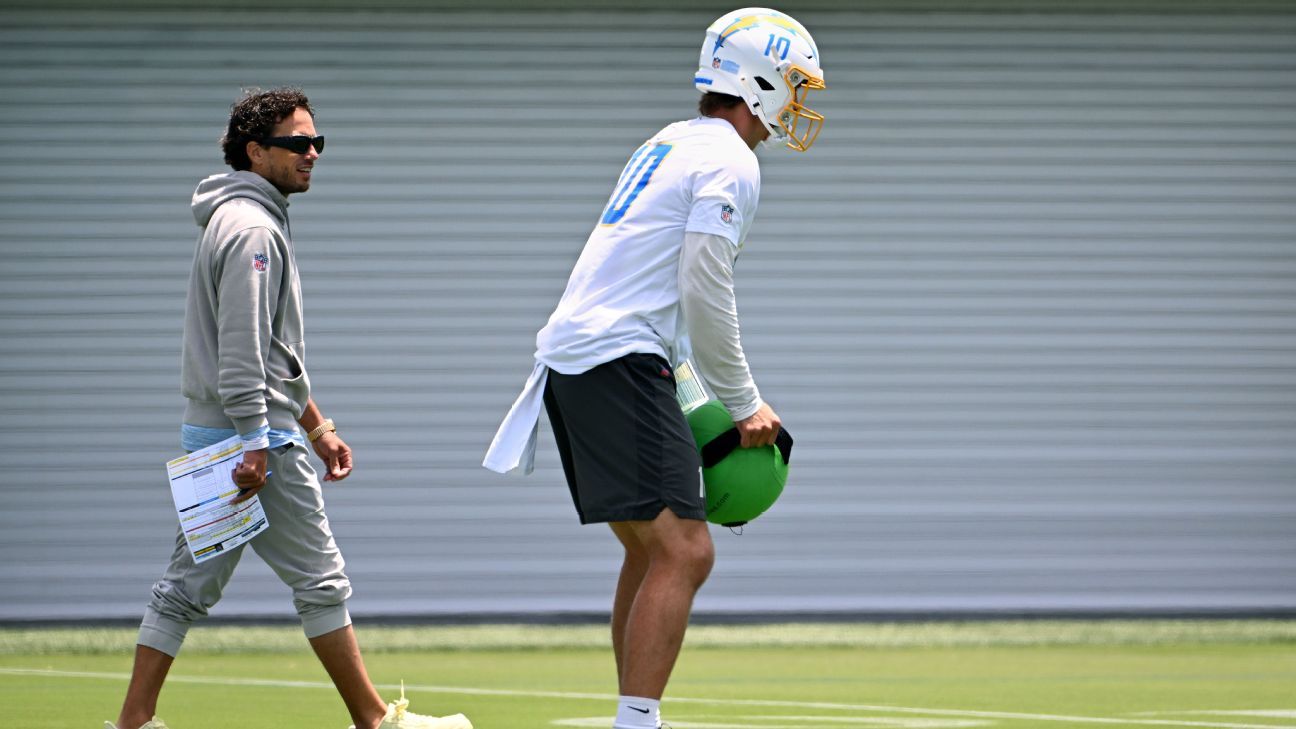
Justin Herbert spent Tuesday's OTA working with weighted balls instead of live footballs, grinding footwork drills at the Chargers facility in El Segundo. The message from new offensive coordinator Mike McDaniel is unmistakable: Herbert's arm talent is a given; what the Chargers need now is velocity of decision. Per the team's announcement, McDaniel has been overhauling Herbert's mechanics with an explicit mandate—get the ball out earlier, before receivers complete their breaks, forcing them to adjust mid-route instead of settling into clean windows.
This is a calculated departure from Herbert's college-to-NFL foundation. Herbert built his reputation on extended processing—a step-back pocket presence that allowed him to work through progressions and rely on his elite arm to fit balls into tight windows. McDaniel, an architect of efficient San Francisco and Miami passing schemes, has diagnosed a different priority: separation creation through tempo. The fewer steps Herbert takes, the earlier a receiver gains vertical real estate, and the harder it is for a defender to close the gap. It's a trade—less time for the ideal read in exchange for better yards after the catch and explosive completion angles.
Herbert acknowledged the mechanical shift in his own words: McDaniel emphasized anticipation over arm strength, asking him to release throws when receivers haven't yet turned to look for the ball. That's a high-wire act. It requires near-perfect timing between Herbert's release and receiver route depth, and it compounds the penalty for miscalculation—an earlier throw to a receiver still in breaking motion is far more likely to be off-target. Herbert's career completion percentage sits at 63.4%; if McDaniel's tempo system pushes him toward sub-63% for a full season, the market will interpret that as decline, even if yards per attempt and touchdown rate improve.
The prop angle hinges on this timing risk. Over/under lines on Herbert's passing yards for the 2026 season are built on historical volume—he's averaged 4,200+ yards per season in full-year starts. But an earlier release, paired with receivers adjusting to faster timing, could reduce his average depth of target (aDOT). If aDOT drops from 8.2 yards (his 2024 mark) to 7.5 yards or lower, his total yardage output could fall 200-300 yards despite similar attempt volumes. Conversely, if the system clicks and yards after catch swell, the over could cash despite lower aDOT. The early weeks of the 2026 season will be volatile on this front—McDaniel's system typically takes 4-6 games to show its true rhythm. Sharp bettors tracking Herbert's aDOT, yards after catch, and first-week receiver alignment will have a window to exploit market overconfidence in the over before correction sets in.
The Chargers' offensive line quality and receiver health become secondary variables now. A year ago, Herbert's protection and target talent were the binding constraints. Under McDaniel, timing is the new constraint. If Herbert and his receivers aren't synchronized, incompletions spike regardless of arm talent. If they are, explosive plays follow. The offseason work with weighted balls and footwork drills is foundational trust-building—a mutual adjustment that won't fully reveal itself until live coverage and pressure enter the equation.