Kincaid's Conservative Gamble: Why the Bills TE's Knee Surgery Dodge Creates Sneaky Leverage in 2026
By Erik Schwartz ·
Dalton Kincaid has twice rejected PCL surgery and claims he's never felt better heading into a contract year—but his snap share collapse and the Bills' aggressive receiver overhaul tell a different story.
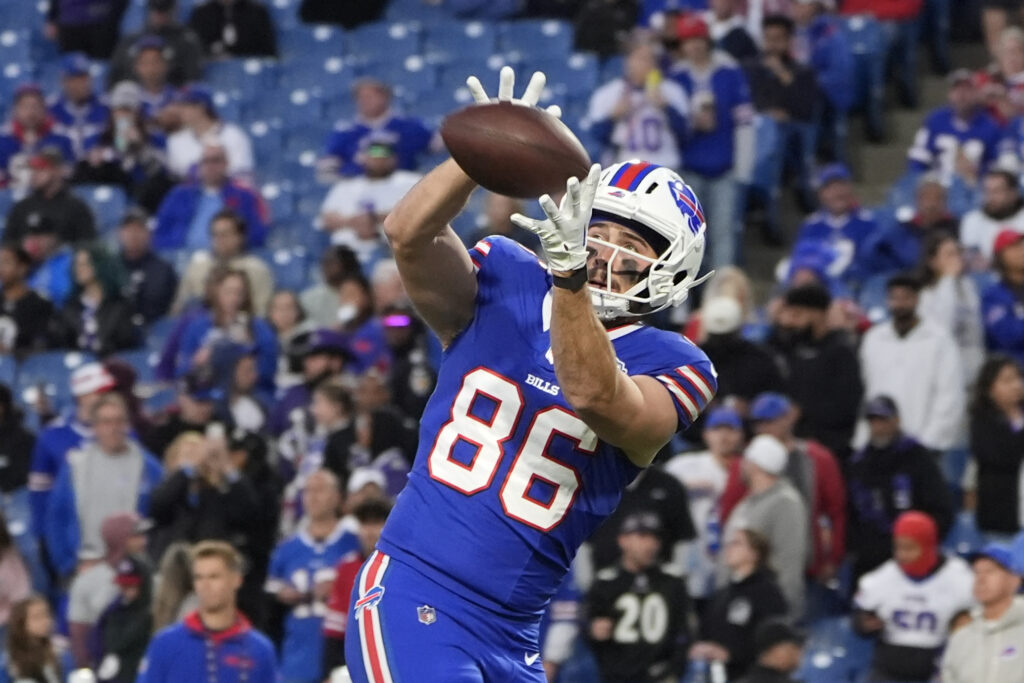
Dalton Kincaid is betting his contract future on conservative medicine. The Bills tight end declined PCL surgery for a second consecutive offseason, citing physician advice that strength-building around the knee would outperform a procedure. He's now in 2026—a contract-year runway before a potential extension—claiming he feels better than any point in his career. The timing is convenient. It's also suspicious.
Context matters here. Kincaid's rookie season (73 receptions, 673 yards, 2 TDs) positioned him as a foundational pass-catcher. But injury management has been the defining variable since. Last season he played only 38% of snaps and drew 49 targets—a cliff-dive from his 132 targets in 2024 despite being on the field for half the work. The Bills' front office exercised his fifth-year option anyway, guaranteeing $8.16 million in 2027. That's faith or insurance; probably both. But the team simultaneously traded for D.J. Moore, drafted Skylar Bell in the fourth round, and cut Curtis Samuel. The message is unambiguous: Buffalo doesn't trust Kincaid's durability to anchor the passing game.
This creates the prop angle. Kincaid will enter 2026 as a second-option tight end with reduced target share relative to his draft capital. The Bills need him healthy; he needs volume to pad his extension case. If his knee holds, touches will follow. If it doesn't—if he hits the injury reporting matrix in August or September—his snap share and target floor drop below last year's already-depressed 49. The market hasn't priced the asymmetry yet. Season-long receiving yards props for Kincaid are being set as if his 2024 workload repeats. It won't. Either he plays 55%+ of snaps on a thin knee and logs 65+ targets, or the Bills lean harder on their new receiver crop and Kincaid operates below 45 targets. There's almost no middle ground in a contract year where the team is actively hedging him.
The operative tell is his own quote: he's not thinking about the knee anymore. That's exactly what players say when they've made peace with an uncertain recovery, not when they've solved it. Kincaid's health statement is hope, not evidence. For prop bettors, that distinction is the entire edge. Target volume under 65 for the season is the play—it hedges against both persistent knee limitations and the front office's clear preference to distribute work across Moore, Coleman, Bell, and the tight end rotation. The snap share floor of 38% suggests Buffalo is prepared to manage him as a role player if preservation becomes necessary. At contract-year stakes and with the organizational drift visible in the receiver trades, Kincaid's workload ceiling is lower than his rookie-season comps justify.