Steelers' Quarterback Reset Reshapes 2026 Win Total Math
By Ty Whitney ·
Aaron Rodgers returns for what may be his final season under new head coach Mike McCarthy, but a revamped offensive staff and division regression create steeper odds for Pittsburgh to sustain its decade-long consistency.
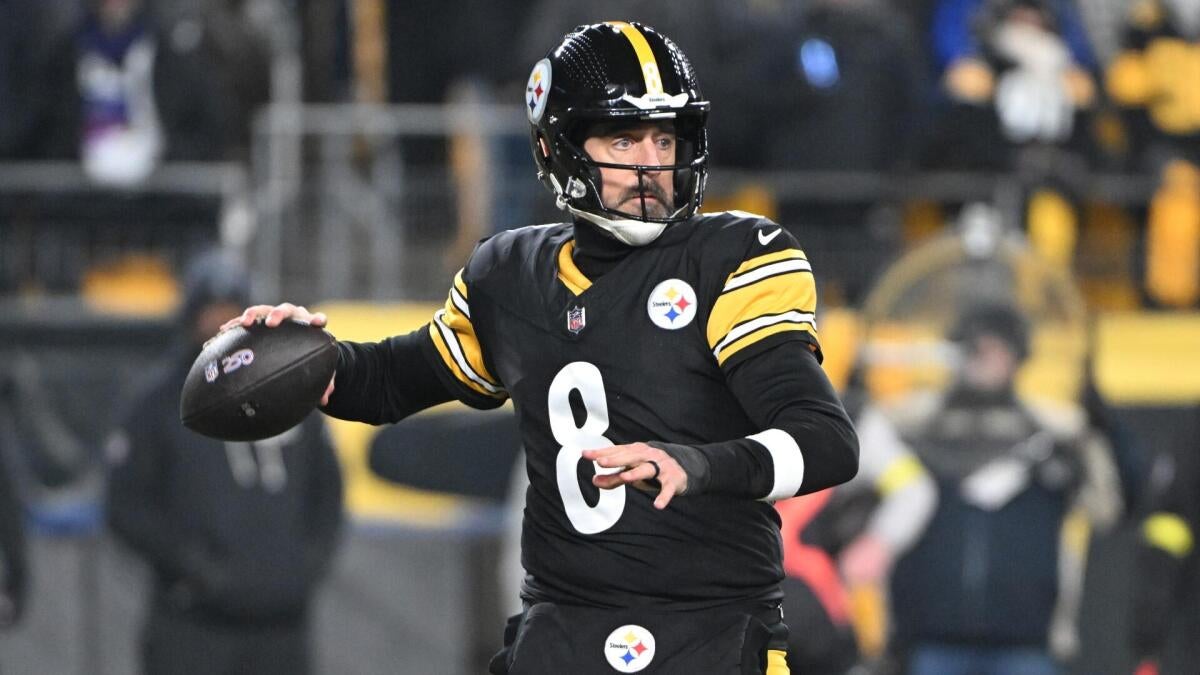
Mike Tomlin's departure after 16 seasons leaves the Steelers in uncharted territory: a new head coach for the first time since 1969. Mike McCarthy arrives with a Super Bowl pedigree—ironically earned by dismantling the Steelers in their last championship game appearance—and immediately inherits a roster built for a legendary final run by Aaron Rodgers. The four-time MVP's decision to return for 2026 provided a temporary market spike, but the numbers tell a more complicated story. Pittsburgh's win total sits at 8.5, exactly where it landed in February, and the July repricing toward the under signals public doubt about whether the quarterback-plus-new-regime combination can repeat the Steelers' six-year streak of outperforming preseason expectations.
The Steelers' recent track record creates a powerful counter-narrative to current odds. They've cashed the over on their win total in six consecutive seasons, won at least nine games in 11 of the last 12 years, and maintained winning records since 2003. Last season's 10-7 finish exceeded an 8.5 total despite an offense that ranked 23rd in yards per pass play and a defense that struggled in coverage. That consistency typically commands a premium in sophisticated markets, yet the Steelers sit at +510 to repeat as AFC North champions—a steep enough price to suggest the market has already written off their divisional window.
But the structural shifts warrant pause. Brian Angelichio arrives as the first-time offensive coordinator after a career spent coaching tight ends; his scheme remains an unknown variable at the NFL's most complex position. The Steelers revamped their receiving corps (adding Michael Pittman and A.T. Perry, losing Marquez Valdes-Scantling and Calvin Austin), their rushing attack (Rico Dowdle and Travis Homer in, Kenneth Gainwell out), and their interior offensive line. On defense, new coordinator Patrick Graham replaces Teryl Austin, while the secondary absorbed Jaquan Brisker at safety—a defensive investment that signals concern about pass coverage.
For prop purposes, the question crystallizes around Rodgers' workload and efficiency. If Angelichio leans on Pittman's red-zone presence and play-action designs familiar to Rodgers' Green Bay years, passing touchdowns could spike relative to the 2025 average. The Steelers threw 22 passing TDs last season in a 17-game slate (1.29 per game). Rodgers' historical rate sits around 1.5–1.65 TDs per game across his peak seasons. However, that uplift assumes seamless integration in year one of a new system. Early-season volatility in scoring efficiency is real; the Steelers may land between 7 and 9 wins before the market adjusts to McCarthy's actual capability and Angelichio's play-calling tendencies.
The smart positioning enters this roster as a fade on division chalk and a conditional lean on the under in September. The +510 to win the AFC North is legitimately overbaked for a team shuffling its coaching staff while its quarterback ages into 41 preseason. The 8.5 win total itself remains fair value once you strip away the Rodgers comeback narrative—the Steelers will likely win 8 or 9 games, which lands squarely on the total. But the early-season uncertainty, combined with a Ravens team that just hired John Harbaugh's brother and a Bengals offense built to compete, creates seasonal division props that reward fading optimism on day one.