The Steelers' Win-Total Mirage: Why Pittsburgh's Overachievement Streak Ends in 2026
By PropBetEdge Editorial Team ·
Mike Tomlin's departure and Aaron Rodgers' age collide with a history of market miscalculation—but this time, the books may finally be right.
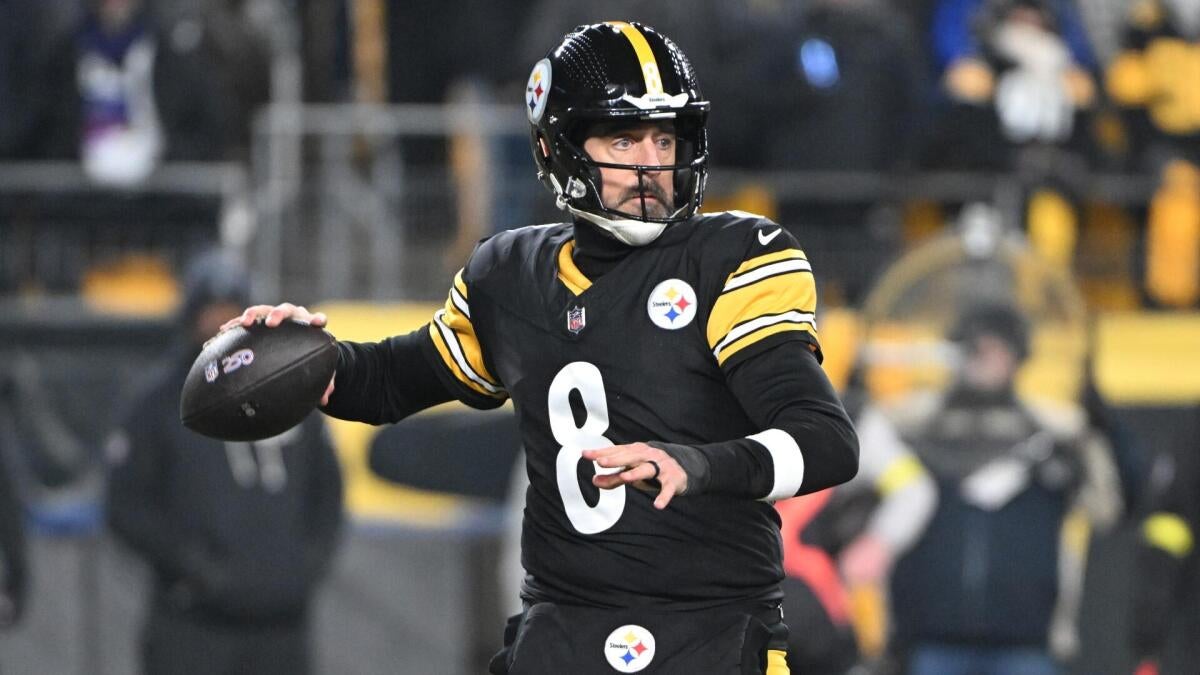
The Pittsburgh Steelers have spent six consecutive seasons beating their preseason win total. That run ends in 2026, and the betting market appears to be catching up to structural reality rather than indulging in another round of Tomlin-era optimism.
Tomlin's exit—after winning the AFC North with a 10-win roster that ranked 17th in yards per play and 12th in DVOA—removes the single greatest coaching variable in franchise calculations. Mike McCarthy arrives with a Super Bowl ring and Aaron Rodgers, a four-time MVP in what the organization is billing as his final season. On paper, quarterback talent improves dramatically. In practice, Rodgers turns 42 in December, arriving at a franchise with a bottom-tier passing game (23rd in yards per pass attempt last season) and a converted tight-end coach, Brian Angelichio, running the offense for the first time. The supporting cast addition of Michael Pittman and Germie Bernard addresses receiver depth, but offensive line continuity fractured with the departures of five starters, replaced by free-agent pickups and mid-round draft choices. Defensively, the team lost James Pierre, Miles Killebrew, Kyle Dugger, and Chuck Clark—four defensive backs from a secondary that already ranked in the bottom half of the league. Jaquan Brisker arrives as a partial offset, but the overall turnover compounds the offensive transition burden.
The win-total market opened at 8.5 in February, sitting at -120 under and +100 over as of early June. The books are pricing this as a .500-to-slightly-above team, anchored to Rodgers' individual arm talent and McCarthy's pedigree rather than roster construction or offensive system fit. The Steelers have posted nine or more wins in 11 of the last 12 seasons and haven't posted a losing record since 2003—metrics that create anchoring bias in futures markets. But those records came with Tomlin's structural advantages: culture stability, consistent in-season adjustments, and a defense that consistently overperformed its talent tier. McCarthy's first year in a new organization with a rebuilt secondary and an untested offensive coordinator, paired with a 42-year-old quarterback in an unfamiliar system, breaks that pattern. The addition of Pittman and Bernard improves passing-game volatility upward, but the offensive line degradation (Max Iheanachor is a first-round pick, but the rest are day-three additions and journeymen) creates sack probability that compounds Rodgers' interception risk in a high-pressure season.
The smart angle here is not contrarianism for its own sake. It's recognizing that the market is anchoring to Steelers durability history while ignoring that durability was Tomlin-dependent. Rodgers' individual performance will matter more than it ever has in Pittsburgh because McCarthy's system and Angelichio's coordination are unproven at this level. If Rodgers plays at an MVP level (5,000+ yards, 35+ TDs, sub-6% INT rate), the Steelers clear 9 wins. If he plays at his age-typical level (declining mobility, higher pressure impact, veteran regression), they finish 7-10. The wind-total under at 8.5 (-120) reflects that the market still hasn't fully priced the coaching transition and secondary loss. The under survives line movement because it's anchored to a specific mechanism: Rodgers' age interacting with an unfamiliar offensive structure and a porous secondary that forces more aggressive play-calling and higher mistake rates.
Pittsburgh's playoff odds sit at +144 to make the postseason—respectable for a 0.500 team with Rodgers, but the structure of that +144 is doing heavy work. A team that wins 8 games has roughly a 35-40% playoff probability given AFC strength (assuming +2-3 seed variance). The Steelers are priced closer to 40% at current odds, which suggests the market assigns 60% probability to winning 9+ games. That's not justified by offensive line durability, secondary continuity, or McCarthy-system integration speed. Under at 8.5 (-120) is the position. The line will likely move toward -140 to -160 by Week 1 as injury reports, preseason performance, and McCarthy's early scheme adjustments filter into public consciousness. The edge exists now.