Ravens Favored to Bounce Back, But Minter's Debut Masks Deeper Offensive Questions
By Ty Whitney ·
Baltimore's Super Bowl odds improved to +1000 despite last year's 8-9 collapse, but the real vulnerability sits in pass protection and red-zone execution.
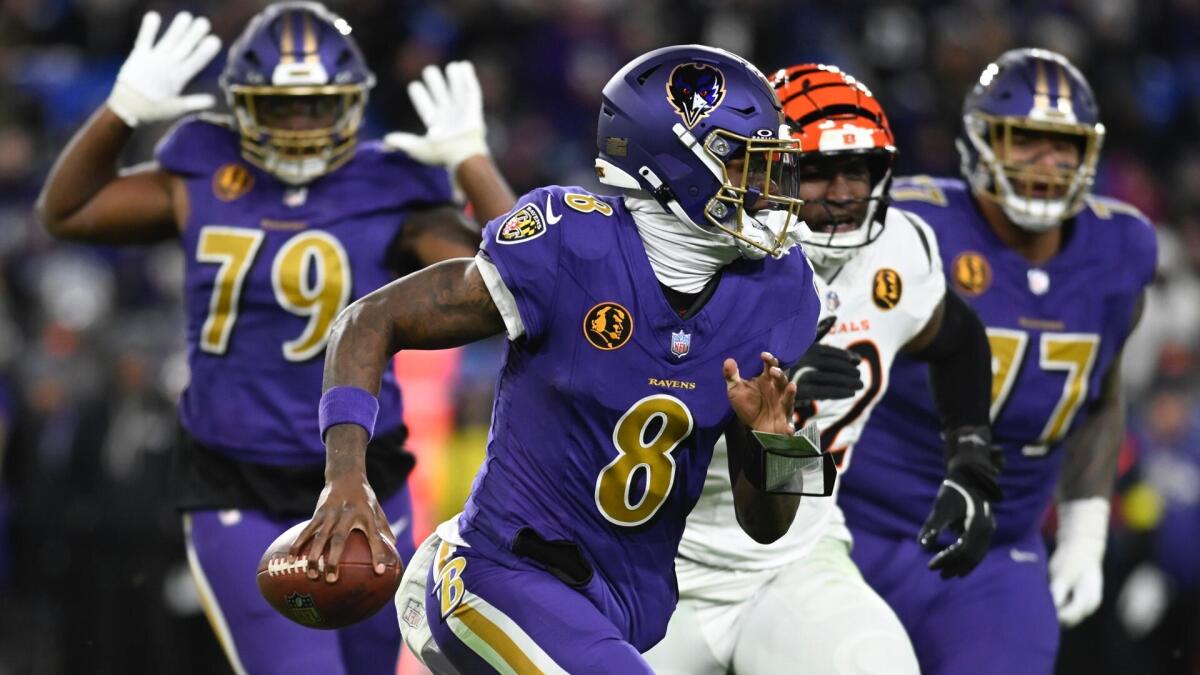
The Ravens are -390 to make the playoffs in 2026—the tightest lock in the AFC—despite finishing 8-9 last year and losing John Harbaugh for the first time since 2007. Jesse Minter arrives as the new head coach inheriting a perennial MVP candidate in Lamar Jackson, but the market's confidence rests on historical momentum rather than structural repair. Baltimore's defense ranked 31st in sacks per pass attempt; the offense ranked 29th. That's not a defense problem and an offense problem operating in separate silos. That's a collision course.
Last season exposed a peculiar fragility: the Ravens led the league in yards per rush (5.80, ranked 7th) yet ranked 29th in offensive sacks allowed. Jackson finished 6-7 in starts—his worst mark since becoming the full-time starter in 2018—after entering 2025 with a 70-24 career record. The cause wasn't declining arm talent or decision-making volatility. It was protection. Tyler Linderbaum and Joseph Noteboom departed; John Simpson returns from his Jets stint, but interior line depth remains a vulnerability masquerading as a strength. The Ravens' offense moves through power rushing concepts that work beautifully in space and brutally when the pocket collapses. Minter's first test: whether his new offensive coordinator (Declan Doyle, replacing Todd Monken) can maintain that rushing identity while reducing negative plays.
On the other side, Trey Hendrickson's addition at edge addresses the most glaring statistical void, but Dre'Mont Jones and Kyle Van Noy are also gone. The Ravens' pass rush was bottom-three last season; a single star addition doesn't erase scheme or execution depth. The defense allowed 37+ points in four of the first five games last year, then settled into a more manageable cadence. That volatility—defensive breakdowns early, tightening late—suggests scheme adjustment lag, not talent insufficiency. A new defensive coordinator (Anthony Weaver, replacing Zach Orr) compounds that risk. New systems take time.
The win total sits at 11.5, unchanged since June 1, suggesting the market has already priced in the coaching transition and sees the Ravens as 11-win-caliber. That's a reasonable midpoint given Jackson's historical floor and the AFC North's weakness, but the distribution risk skews toward the under. The Ravens face multiple path-dependent variables: Minter establishing a clear identity, Simpson and the reconstructed line holding up, Hendrickson validating his $100M+ contract value immediately, and Jackson shaking off a 6-7 season psychologically. Simultaneously breaking through on all four fronts is harder than the -140 juice on the under suggests. The line implies roughly 65% probability of 12+ wins. Last year's 8-9 finish and this year's coordinator turnover (both sides) argue for more conservatism.
The prop angle: Jackson's passing yards per game. His mobility and schematic reliance on run-first play-calling keep his volume lower than raw talent suggests—he averaged 252 pass yards per game last year despite the MVP-caliber arm. Expect Doyle to lean harder into short, decision-efficient passes early while the pass protection stabilizes. Taking the under on Jackson's weekly passing yards props (likely in the 245–260 range depending on opponent) captures the cautious early-season adjustment without betting against his arm. This edge is temporary—it fades once the line chemistry settles, likely by Week 5–6. Market efficiency will reprrice individual game props faster than season totals. The Super Bowl odds at +1000 assume everything breaks right; single-game props give you entry on pessimism that's more justified.