Luther Burden's Per-Route Efficiency Signals Year 2 Volume Spike—And Real Receiving Yard Upside
By Ty Whitney ·
The Bears second-year wideout's elite efficiency metrics on limited opportunity suggest his receiving totals are about to move sharply upward.
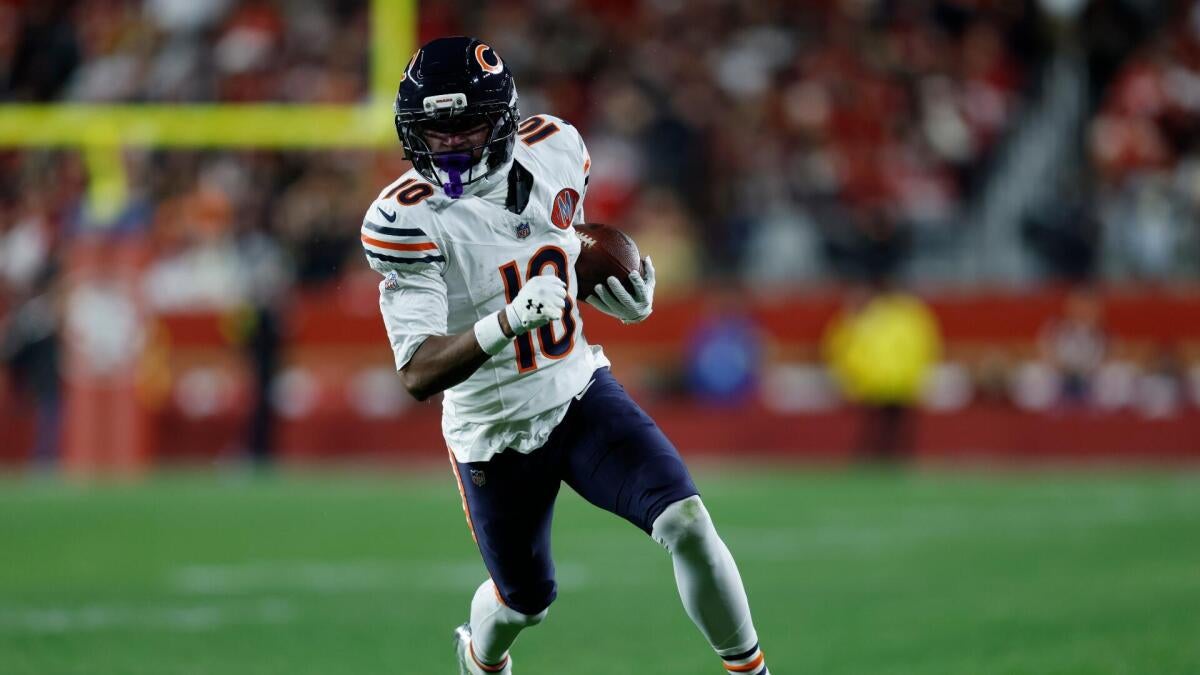
Luther Burden is walking into 2026 with the clearest pathway of his NFL career. D.J. Moore's trade to Buffalo and Olamide Zaccheaus's free-agency departure to Atlanta have vaporized the snap-share competition that limited the second-round receiver to 40% of Chicago's offensive plays as a rookie. Bears coach Ben Johnson now controls offensive design for a QB-needy roster, and he's publicly signaling confidence: "I'm buying Luther Burden stock right now," Johnson said, citing Burden's offseason preparation. That enthusiasm isn't unfounded retail cheerleading—it's rooted in something specific that the volume stats initially buried.
Burden caught 47 passes for 652 yards and 2 TDs in Year 1, a line that reads as competent but unremarkable. Dig into the per-play productivity, though, and the picture inverts. He averaged 2.71 yards per route run, which ranked third among 152 receivers with 100-plus routes. More striking: on short targets (his primary diet at 7.67 yards average depth), he succeeded on 58.3% of plays and generated explosive 15-plus yard gains on 26.7% of them. With the ball in space, Burden manufactures yards. He's compact—6 feet, 210 pounds—but electric with his pads low and his hips free. On the 12 targets he received 15 yards downfield, he caught 9 for 309 yards and both of his touchdown scores. That's nearly half his season receiving yardage on just 20% of his target share.
The obvious next step is volume. Johnson's scheme leans into spacing and short-to-intermediate rhythm throws, but the infrastructure to move Burden deeper into progressions is already there. His 5-catch-for-75-yard, 1-TD floor on a 40% snap share becomes a drastically different prop target when that baseline climbs to 65-75% of snaps and he retains his 2.71 yards-per-route efficiency. CBS Sports is projecting 72 catches for 1,007 yards and 6 TDs for 2026—a near-doubling of his production on what amounts to a realistic snap-share and target-allocation bump. That projection isn't forward-looking optimism; it's mechanical.
For prop bettors, the receiving yards line is the key angle. If Burden opens at 850-900 yards for 2026, that number is exploitable to the upside. The market will likely price him conservatively—rookies with pedestrian absolute numbers get modest Year 2 bumps in the books' base projections, even when efficiency screams volume lift. Burden's per-route run rate and successful-play percentage are top-20 caliber. Add 25-30% more snap share and target opportunity (a conservative estimate given Moore's departure), and 1,000 yards is the median outcome, not the ceiling. Take overs on his receiving yards total if the line reflects only incremental growth from his 652-yard rookie floor. The mechanism is clean: elite efficiency plus clear path to opportunity equals production inflation that the market hasn't fully priced because the rookie sample was small.
Rome Odunze remains the volume threat at wideout, but Burden's role is no longer rotational. Johnson's purchasing power over the offense design means Burden gets real snaps and real targets. The efficiency edge has runway left to show up in box scores.