Mayfield's Walk Year Begins With Leverage Evaporated
By Erik Schwartz ·
A subpar 2026 salary structure and a disappointing 2025 season leave the Buccaneers quarterback negotiating from weakness as free agency approaches.
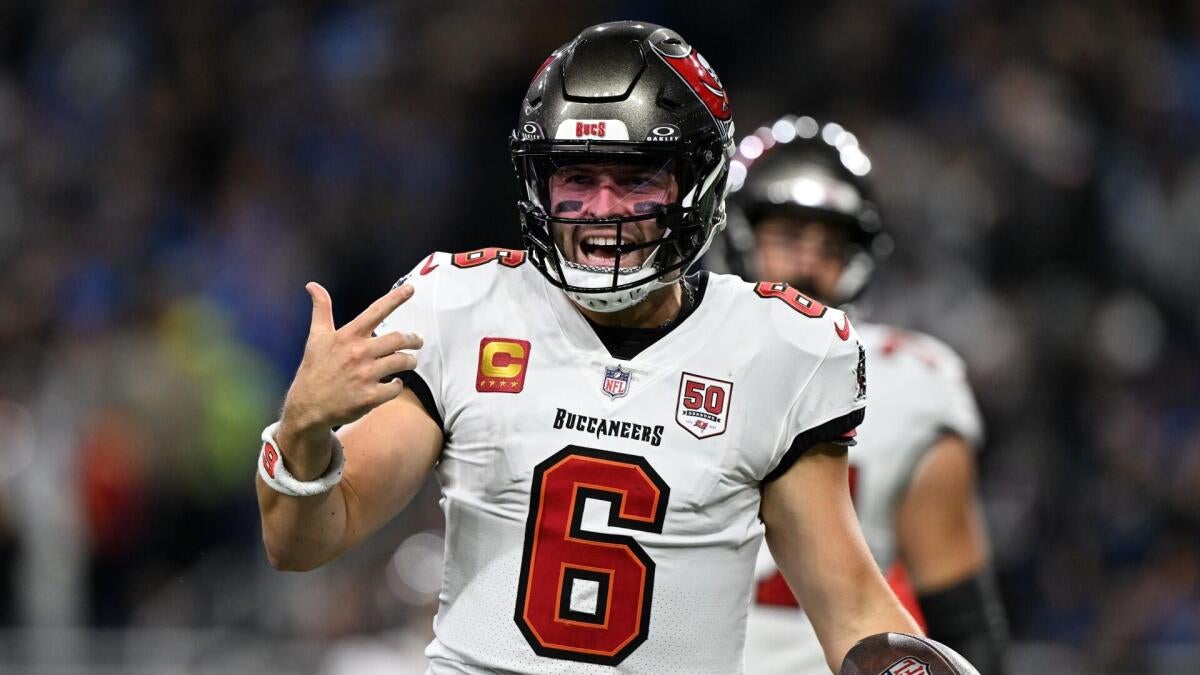
Baker Mayfield enters the final year of his contract with the Tampa Bay Buccaneers in a position he didn't anticipate six months ago. The team restructured his compensation in April 2025—a move designed to grease the wheels for an extension—but the 2025 season itself became the wrecking ball. After a 6-2 start and legitimate MVP consideration, Mayfield and the Buccaneers collapsed to 8-9 and missed the playoffs for the first time since 2019. A shoulder injury in Week 12 provides some mitigation for his statistical decline, but the damage to his negotiating position is done: he now carries the burden of his worst season as a Buccaneer into talks when his contract structure suggests urgency.
The mechanics of Mayfield's deal tell the story. His base salary was trimmed to $10 million for 2026, with $30 million converted to a roster bonus due March 20—nearly three months ago. Of that $30 million, $17 million became fully guaranteed on March 15 (just two weeks before the league year deadline), but the Buccaneers lose the ability to prorate the remainder once the tenth day passes. The structure was clearly designed to push negotiations forward, but instead it has given Mayfield less leverage at a critical juncture. General manager Jason Licht's recent comments at the NFL Scouting Combine—"everything's on the table right now" and "all plans revolve around Baker"—sound supportive in isolation. In context, they read like placeholder language from an organization that hoped for a different 2025 season before locking in an extension.
The broader market has also shifted against Mayfield's interests. Daniel Jones, coming off an Achilles tear and a far worse statistical profile, just signed a two-year, $88 million deal with the Colts. That Jones received $50 million fully guaranteed at signing—despite injury concerns and a catastrophic 2025 performance—illustrates what a QB contract looks like when both sides are motivated to close it. Mayfield's 2024 campaign (4,500 passing yards, 41 TDs, 71.4% completion, 106.8 passer rating) suggested he was operating at an elite level. His 2025 tape undermined that narrative substantially. The year he needs to negotiate from strength, he's negotiating from vulnerability.
For bettors tracking the Buccaneers, this contract uncertainty matters more than the headline suggests. An unsigned, walk-year quarterback operating in a defanged offense (the team collapsed to 2-7 after Week 9) is not the engine for high-volume passing stats. If Mayfield does get extended before Week 1 of the 2026 season, expect a modest bump in confidence and play-calling aggression. If he enters the season unsigned—which is becoming more likely given the gap between his market value and the team's willingness to move at premium rates—his passing volume could track below his 2024 baseline. The Buccaneers face a choice: pay now for a QB who disappointed in year three, or let his walk year play out and risk losing him in free agency. Neither option screams confidence.
The most actionable takeaway for prop bettors: watch the extension signing date. If Mayfield gets a deal done before training camp (typically late July), his passing yards and TD prop lines should tick upward on the assumption that a newly secured QB will operate in a more aggressive scheme. If negotiations drag into the regular season or collapse entirely, fade his volume-based props in early weeks. A walk-year QB in limbo tends to produce conservative tape, especially in a run-first system like Tampa Bay's. Mayfield's 2024 season bought him credibility; his 2025 season spent it. The contract dance will determine whether the Buccaneers believe there's enough left to bet on.