NFL · transaction
Breece Hall's Jets Deal Signals Durability Bet, Not Volume Spike
The Jets locked in Hall at $14.5M AAV with full 2027 guarantees, but the contract structure reveals organizational confidence in his workload sustainability—not a green light for touchdown variance plays.
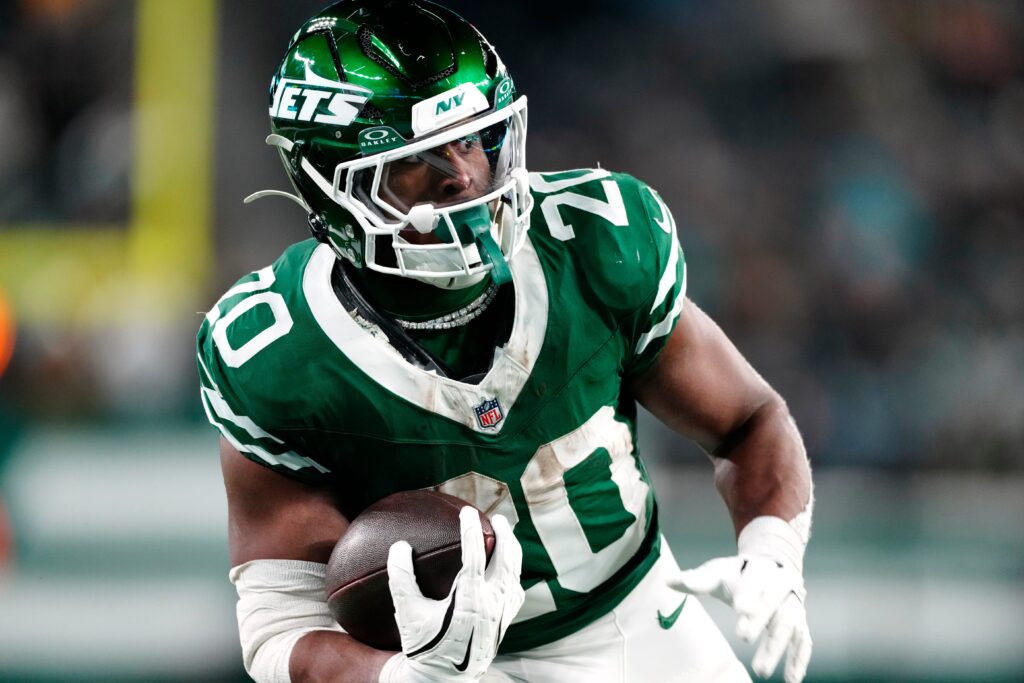
The Jets have finalized the details of Breece Hall's three-year, $43.5 million extension, and the architecture tells a specific story about how the franchise views its running back's role. Hall collected a $5 million signing bonus, $5.16 million fully guaranteed for 2026, and another fully guaranteed $5 million roster bonus in Year 1. Critically, his $13.16 million base salary for 2027 is also locked in—a structural choice that matters more than the headline AAV.
Hall's $14.5 million annual value ranks fifth among running backs, positioning him in the durability tier rather than the elite workload class. The contract includes per-game roster bonuses (up to $340K annually), which function as attendance incentives rather than performance escalators. Year 3 ($14.16M) carries no guarantee, a standard out-clause for declining productivity. This framing—heavy front-end guarantees, light-touch incentive structure—typically signals a team betting on consistent touch volume and health over explosive output variance.
The broader Jets context reinforces that read. Owner Woody Johnson's hands-on role in gutting the coaching staff (firing defensive coordinator Steve Wilks, pushing out offensive coordinator Tanner Engstrand in favor of veteran Frank Reich, and hiring first-timer Brian Duker at DC while controlling play-calling) suggests organizational instability at the top. A franchise in structural flux does not typically overinvest in back-end incentive escalators; it builds deals around baseline usage assumptions. Johnson's penny-pinching on Martindale's coordinator price tag—he's still eating $3 million of Wilks's salary—adds another layer: the team is operating with tighter margins and fewer backup plans.
For prop bettors, this contract shape creates a trap and an opportunity. The trap: Hall's touchdown lines will likely spike on name-brand momentum, especially after a full offseason of positive Jets narrative. His historical TD rate does not justify overbetting that volatility. The opportunity lies in receiving volume and rushing-attempt stability. A running back extended with 2027 fully guaranteed money, absent explosive incentive clauses, is being slotted for 240–270 touches per season—the mid-tier workhorse range. That predictability (Hall averaging 18–20 carries and 3–4 targets per game) should trade at a discount relative to touchdown-driven variance lines, because books will shade pricing toward touchdown upside following the contract ink.
Reach for Hall's season rushing-attempt total, anytime-TD markets when they spike post-news, and receiving-yardage props in game-by-game markets that haven't fully normalized his usage pattern. Fade the touchdown props as standalone plays over the next 2–3 weeks; the line movement will price in injury-risk reduction, but not the organizational chaos swirling around quarterback decision-making and play-caller identity.
NFL Intelligence — Football intelligence beyond the final score. Open NFL Intelligence →