Rodgers Signs One-Year Deal With Steelers; Contract Structure Signals Confidence in McCarthy Partnership
By Erik Schwartz ·
Aaron Rodgers agreed to a $22MM guaranteed, $25MM maximum contract with Pittsburgh, clearing the path for a second season with Mike McCarthy and eliminating QB uncertainty before OTAs.
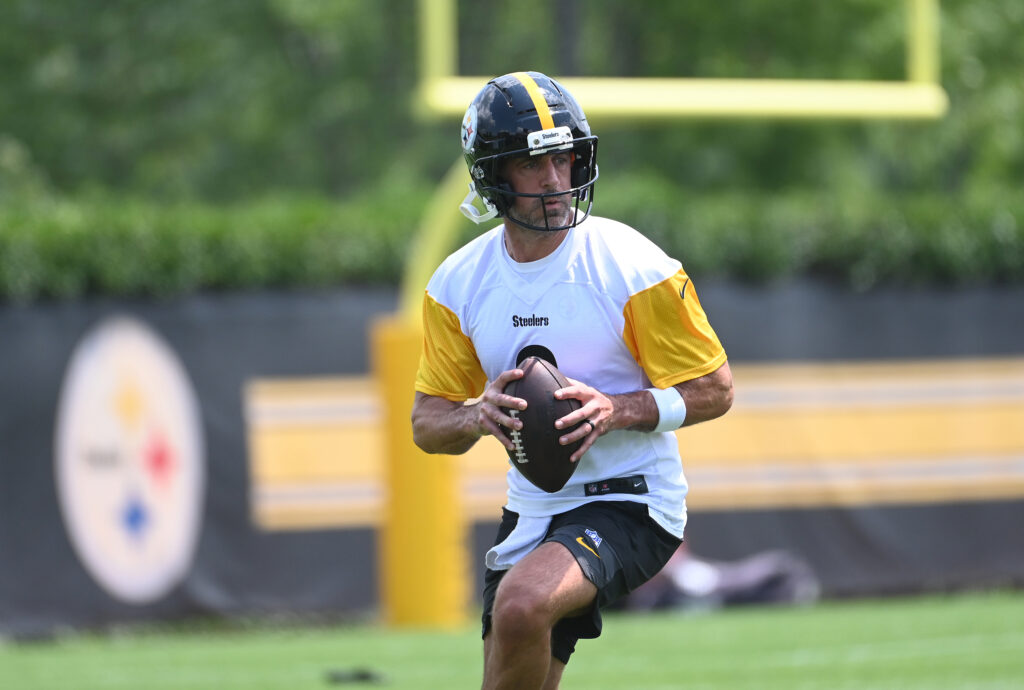
Aaron Rodgers reported to the Steelers' facility Monday morning after agreeing to a one-year deal over the weekend. The timing—hitting before the start of organized team activities—was deliberate. Pittsburgh needed clarity on its QB1 before spring practices began, and Rodgers needed assurance he'd remain the starter rather than split reps with Mason Rudolph, Will Howard, or Drew Allar. Both sides got what they wanted.
The contract itself tells a story worth parsing. Rodgers secured $22MM guaranteed with a path to $25MM through incentives, representing a raise from the roughly $15MM UFA tender baseline but nowhere near the top of the quarterback market. That gap matters. A 42-year-old returning for his 22nd season could have chased a short-term top-dollar deal elsewhere or demanded premium guarantees from Pittsburgh. He didn't. Instead, the structure—a modest raise anchored in performance incentives—reflects a negotiation where both team and player moved toward alignment rather than maximum leverage. Per Gerry Dulac of the Pittsburgh Post-Gazette, a "ballpark figure" was reached at least a month before the official signing, suggesting this was never truly a high-tension standoff. The uncertainty that lingered after the draft was more procedural theater than genuine impasse.
What matters for the 2026 season is what this deal enables: McCarthy has a stable QB ecosystem. Rodgers spent 2025 acclimating to McCarthy's system after their last collaboration ended in 2018—an eight-year gap that required ramp-up. This second year removes that friction. No new playbook. No new coaching philosophy. Just an offense that can build continuity from Day One of OTAs through training camp. That efficiency compounds through the season, particularly in autumn when defenses exploit timing issues and route communication breakdowns. The Steelers' passing game volume and efficiency should both improve relative to Year One, assuming Rodgers' health holds.
For betting purposes, this clarity cascades into quarterbacks stats and team totals. Rodgers' 2025 passing-yards output will likely see a measurable lift in 2026—not because his arm talent changed, but because his comfort with McCarthy's concepts and personnel distributes the ball faster and into higher-leverage spots. Teams don't pay aging QBs a raise based on declining physical talent; they pay them when the system fit is maturing. The Steelers moved from "will Rodgers even show up to camp" territory into "what's his ceiling in Year Two of this system" territory. That's a marginal but persistent efficiency gain. On the team-total side, the elimination of QB roulette also removes contingency planning overhead—fewer defensive reps spent on backup packages, more first-team precision work. The Steelers entered 2026 with roster continuity; this deal locked in system continuity. Expect their passing volume and efficiency marks to approach the McCarthy standard rather than remain depressed by transition friction.