Gibbs' Contract Year and Bell-Cow Role Set Up Offensive Player of the Year Run
By Erik Schwartz ·
Detroit's running back enters a make-or-break extension window with 75% snap-share projection and the heaviest futures money in the market.
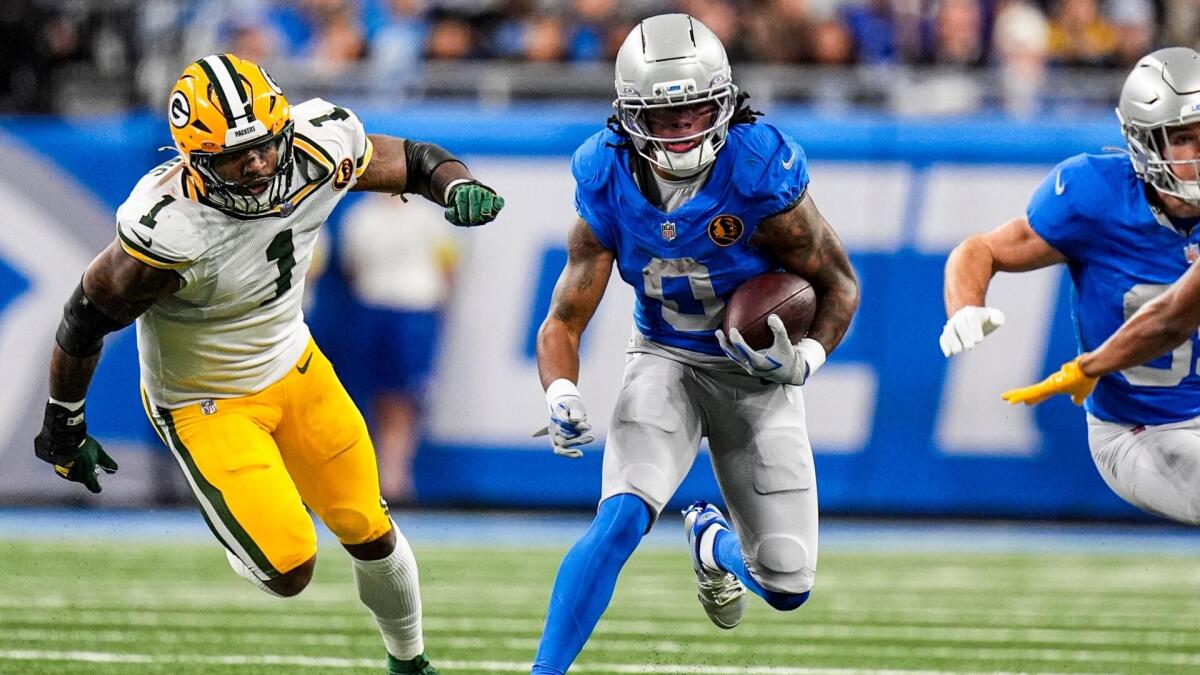
Jahmyr Gibbs is +700 to win NFL Offensive Player of the Year at DraftKings, leading all players in both ticket volume and handle, per the book's latest odds release. The Lions back carries genuine leverage into the offseason: as a 2023 first-round pick now eligible for an extension, he sits in the exact contractual sweet spot where individual performance directly translates to eight-figure APY. Saquon Barkley's two-year, $20.6M-per-year extension with Philadelphia in March 2025 reset the running back market. Gibbs and Atlanta's Bijan Robinson—taken four spots apart in 2023 and both unsigned—are in a standoff neither wants to blink first. That dynamic fuels motivation.
Gibbs' 2025 season cemented his case for volume and efficiency. He rushed for 1,223 yards with 13 TDs while adding 77 receptions for 616 yards and five more scores—18 total touchdowns, second in the NFL. His receiving totals set career highs. Over his first three seasons, Gibbs has 49 total touchdowns, an NFL record for the span. He ranks second in average yards per carry across three seasons (5.0 minimum), tied for second in yards per touch at 5.9 for backs in their first three years since 1970 merger (minimum 750 touches), and leads the entire league in scrimmage touchdowns (38) over the past two seasons. The volume trajectory is about to spike: Detroit traded David Montgomery to Houston in March, clearing 172 touches that will flow directly to Gibbs. Lions head coach Dan Campbell made the positioning explicit to reporters: "He's going to be our bell cow now... we're going to hang our hat on him quite a bit." Gibbs took 67% of offensive snaps in 2025 after 56% and 57% in his prior two seasons; beat writers project he'll hit 75% this year.
The market has already recognized the setup. Robinson sits at +850 for OPOY, second-favorite but trailing Gibbs by 150 basis points despite taking comparable draft capital and facing a similar extension clock. The difference: Gibbs' supporting cast towers over Robinson's. Detroit features Calvin Johnson's heir apparent in a reshaped receiving corps, stable line continuity, and an offense whose coordinator hire (if relevant this offseason) will likely lean on what Gibbs does best—getting touches in space. Robinson operates in a thinner Falcons ecosystem. The snap-share projection matters for season-long prop value too: Gibbs is at Over/Under 1,199.5 rushing yards and 12.5 rushing TDs. If he genuinely hits 75% of snaps—a 16-game jump from his 2025 usage—and maintains his 4.2 yards-per-carry average, he clears 1,344 rushing yards almost mechanically, even accounting for game script variance. His receiving line sits at 449 yards and 4.5 TDs; 77 receptions on 75% snap share extrapolates closer to 95-100, meaning the receiving yardage floor is durable. The OPOY award itself is functionally a running-back award now, with no quarterback having won since 2016 (Cam Newton). Gibbs' edge isn't just individual production—it's the marriage of contract-year motivation, a coordinator-shuffle refresh that will load touches in his direction, and the clearest bell-cow mandate in football.
The handle concentration Gibbs is seeing tells you smart money already positioned early. DraftKings released updated trends precisely because liability clustered there. The line is absorbing action efficiently, but the mechanical rushing-yard and touchdown overs remain vulnerable to underpricing because they're tied to snap-share assumptions the market may still treat as blue-sky. Gibbs averaged 5.0 yards per carry last season; Montgomery's 172 touches last year at 3.2 yards per carry are a direct substitution gain. That's not projection—it's replacement math. If he hits 75% of snaps and carries 280-290 times, the 1,199.5 rushing-yard line becomes a lay-down. Similarly, his scrimmage-touchdown efficiency (38 in two seasons) is a two-year average that doesn't require heroic per-game pace; at his current run rate, 12.5 rushing TDs alone is conservative relative to his career arc.
The prop angles bifurcate cleanly. Gibbs' season-long rushing-yard and rushing-touchdown overs carry positive expected value given the snap-share trajectory and the receivable rushing-load bounce. The OPOY futures, by contrast, are fairly priced and liquidity is high; the early-action premium has already been absorbed. Play the season-long touch-dependent props before week one; monitor OPOY closer to the deadline for potential +200 or wider as other contenders (Henry, possibly a WR breakout) gain credibility.