Middleton's Return to Washington Reshuffles Backcourt Depth—and Playoff Leverage
By Erik Schwartz ·
The Wizards reclaim a proven postseason scorer in a six-team sign-and-trade, sending D'Angelo Russell to Memphis and reshaping their path to October.
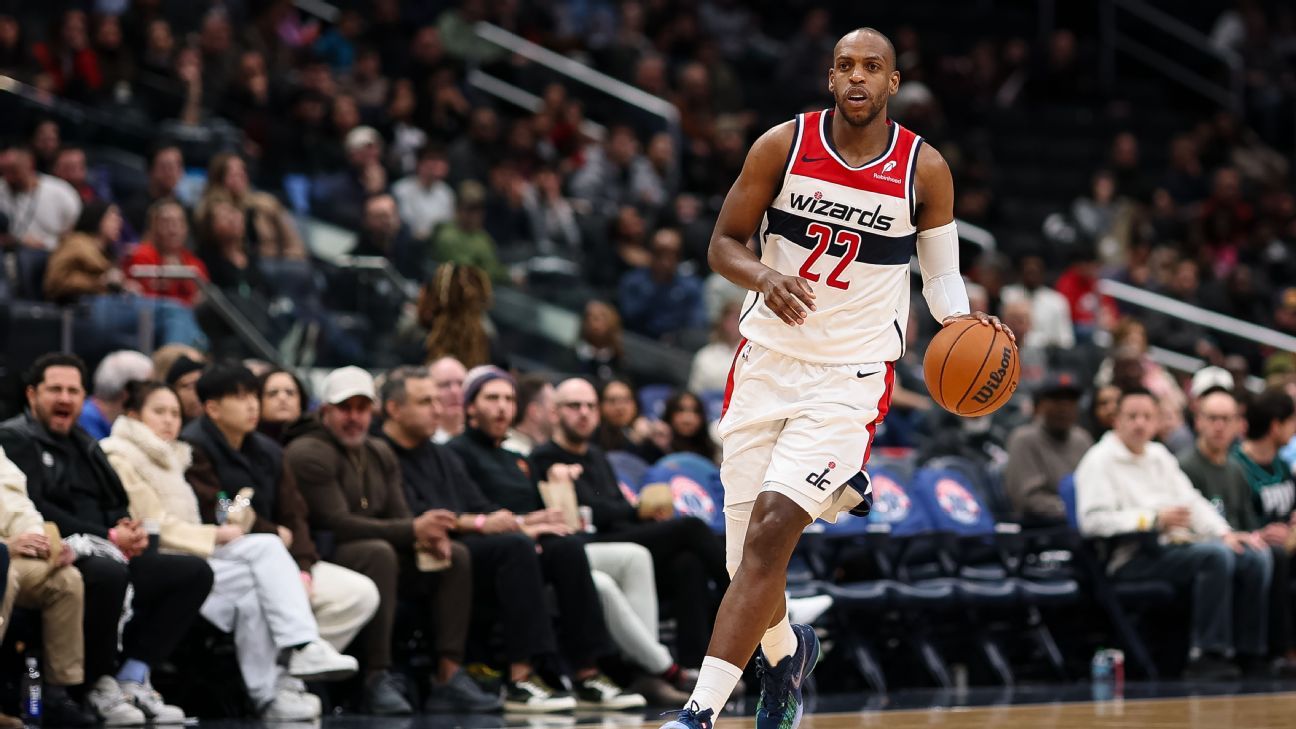
The Washington Wizards have acquired Khris Middleton on a three-year, $17.6 million contract via sign-and-trade from Dallas, reclaiming the 34-year-old wing in a six-team orchestration that also involves the Mavericks, Clippers, Pistons, Bucks, and Grizzlies. The deal sends D'Angelo Russell, two future second-round assets, and swap rights to Memphis, tilting the Wizards' roster composition toward veteran playoff experience and away from youth development at the point-guard position.
Middleton's return to Washington marks his second stint with the franchise after Dallas acquired him from Milwaukee at the February 2025 deadline. He spent 12 years with the Bucks, compiling three All-Star selections and a 2021 championship alongside Giannis Antetokounmpo. Last season, playing in 63 games across two teams, he averaged 10.2 points, 3.7 rebounds, and 2.8 assists—a noticeable dip from his Milwaukee baseline. The offensive decline reflects both age (Middleton is now 34) and reduced usage in Dallas, where he shared offensive load with Luka Doncic and Kyrie Irving.
Yet the calculus for Washington isn't about regular-season scoring volume; it's about what Middleton does when the stakes elevate. His playoff numbers sit at 20.6 points, 6.5 rebounds, and 4.8 assists—meaningful separations from his regular-season marks and a clear signal that his game is contextual. He's a shooter who tightens his efficiency in the playoffs (career 46.8% from the field in postseason play) and a decision-maker who limits turnovers when the margin narrows. The Wizards, a team with championship aspirations anchored to their core, are betting that Middleton's proven October performance justifies both his contract size and the loss of Russell's playmaking and spacing.
From a betting standpoint, Middleton's reduced regular-season usage creates a prop opportunity tied to game state and matchup. His assists line (currently projected around 2.8-3.2 per game based on last season's rate) is vulnerable to underpricing because his playoff assist rate (4.8) suggests he's a secondary-ball-handler in high-leverage situations. When the Wizards face deep playoff rotations or close fourth-quarter games, Middleton's touch will likely increase materially—his usage has historically jumped from 17-18% in the regular season to 21-23% in the postseason. The market will price him as a 10.2-point scorer on flat volume; savvy bettors should track games where Washington trails by 5+ points in the fourth quarter and target Middleton assists overs against smaller, switching-heavy defenses, where his midrange game opens driving lanes for secondary playmaking.
The Russell exit signals another shift: Washington is pivoting from a backcourt built on shot-creation range toward one anchored to two-way reliability and veteran poise. Russell's 6.8 assists per game depart with him; Middleton's 2.8 remain, but his ceiling in clutch moments—when he becomes a de-facto secondary playmaker—is substantially higher than his season-long rate suggests. For prop purposes, that asymmetry between regular-season usage and October workload is the edge.