Towns' Offensive Rebounding Surfaces a Finals Mismatch for Knicks Against Spurs
By Ty Whitney ·
Karl-Anthony Towns' ability to finish through contact and crash the glass in Game 1 reveals a structural weakness San Antonio cannot afford to repeat.
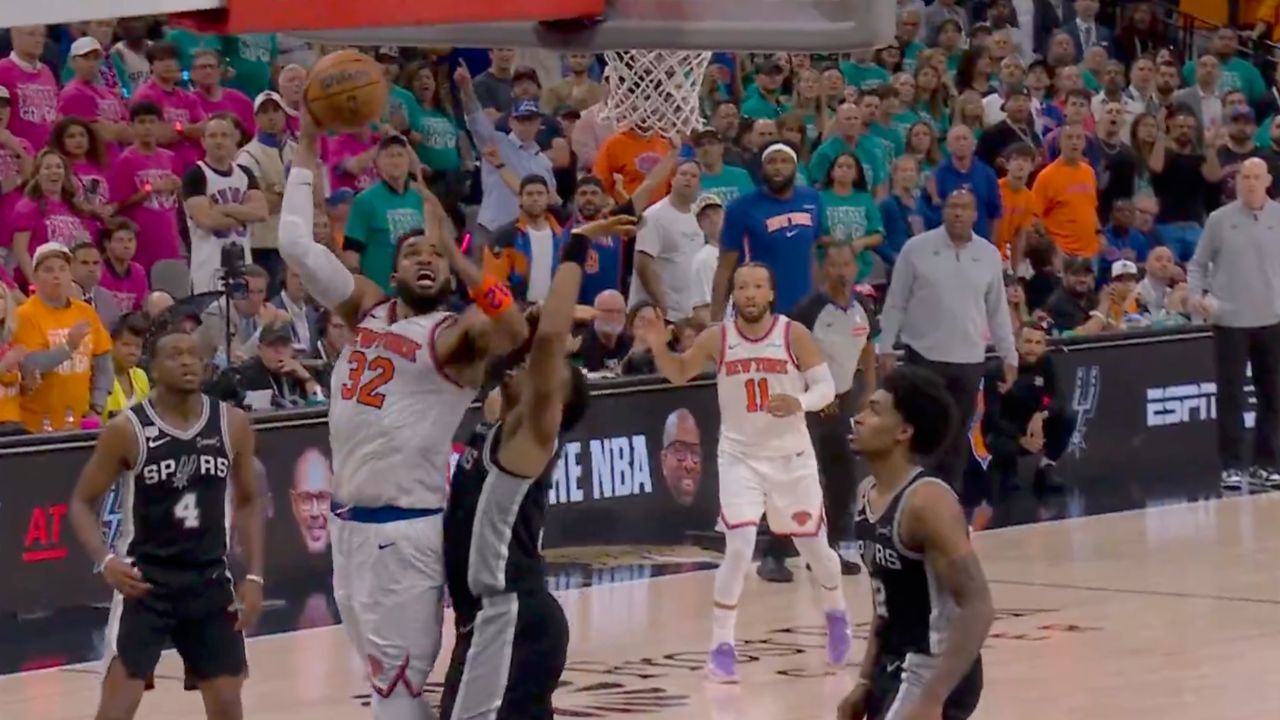
Karl-Anthony Towns converted an and-one late in Game 1 of the NBA Finals after securing an offensive rebound against Keldon Johnson, cutting the Spurs' lead to two points. The play itself—a straightforward offensive glass opportunity converted in traffic—matters far less than what it exposed about San Antonio's interior defense and rim protection strategy.
Towns has never been a high-volume offensive rebounder by necessity; his role in New York's system revolves around floor spacing and midrange creation. But when he does attack the glass, the Spurs lack a credible answer. San Antonio's frontcourt rotation relies on positional continuity and switching versatility, not traditional shot-blocking or box-out discipline. Against a 7-foot sharpshooter who can finish through traffic and generate his own second chances, that scheme fractures. The and-one didn't just cut the deficit—it signaled a structural adjustment the Knicks can weaponize across the series.
Game 1 context matters here: the Spurs entered as the lower seed and slower-paced team, yet they controlled the first half despite the Knicks' offensive threats. Towns' rebounding play came in a tight window where momentum swung. If the Spurs can't tighten their interior assignments or improve rim-out recovery, Towns' production splits shift dramatically—especially his efficiency when he's allowed to operate in second-chance situations or out of offensive rebounds. His effective field-goal percentage on putbacks and follow-ups typically runs 8–10 percentage points higher than his overall eFG%, meaning every offensive board he secures against San Antonio carries outsized value.
For prop bettors, this single play catalyzes a larger edge: Towns' offensive rebounds and putback opportunities should expand as the series continues if San Antonio doesn't adjust. His next-game rebounding rate will likely tick up, and his points-per-game floor gains a new source of volume. Track whether the Spurs deploy box-out adjustments or rotate their interior defenders earlier in Game 2; if they don't, Towns' offensive rebounding line becomes a contrarian lean. A Knicks team that can manufacture second-chance points while maintaining their three-point volume effectively neutralizes San Antonio's pace-control strategy.
The angle is durable beyond Game 1 because it rests on a structural mismatch—how San Antonio's roster is built—rather than a single outlier performance. Towns is shooting his game; the Spurs' weakness is systemic.