Gilgeous-Alexander's Stepback Mastery Exposes Wembanyama's Perimeter Defense Limitations
By Ty Whitney ·
SGA's isolation buckets against switching big men reveal a structural weakness that extends beyond a single highlight.
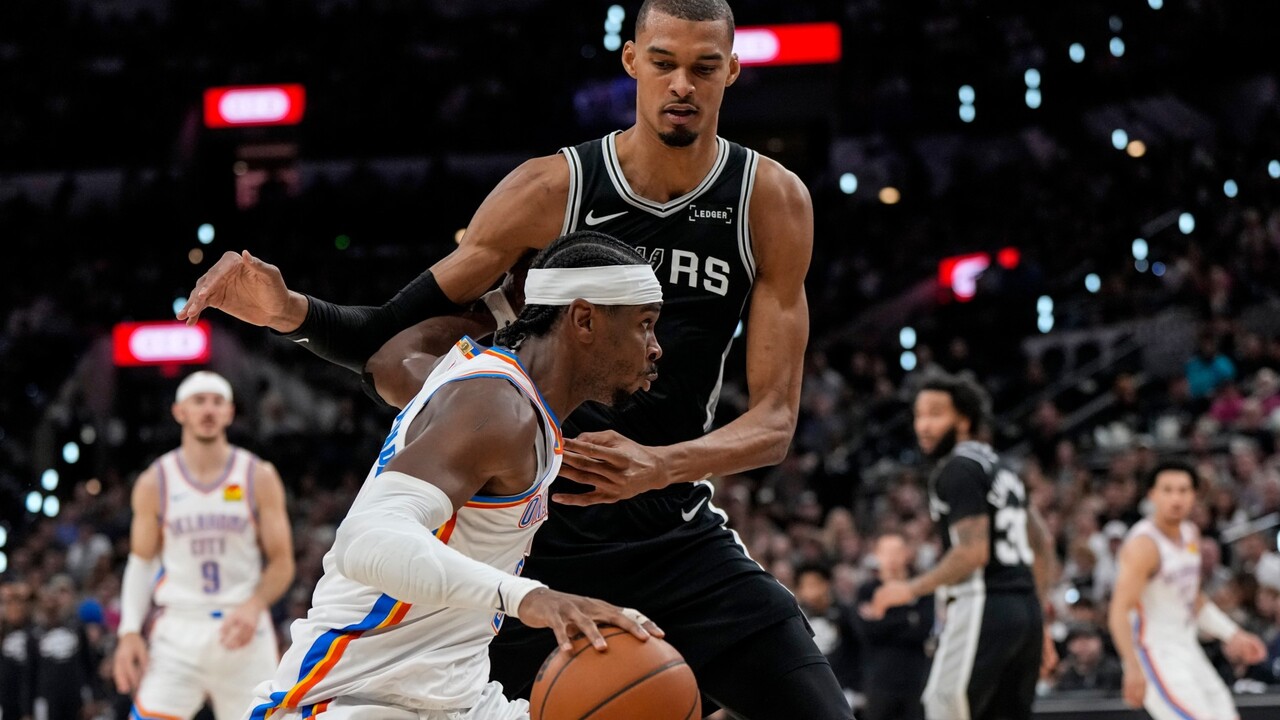
Shai Gilgeous-Alexander's stepback over Victor Wembanyama in Oklahoma City's matchup with San Antonio wasn't just a highlight—it was a clinic in exploitation. The Thunder guard identified what defensive schemes have quietly exposed all season: when elite-tier defenders get pulled onto the perimeter to chase guards, the offensive burden shifts dramatically in favor of players comfortable operating in space away from help.
Wembanyama possesses the physical tools to disrupt most actions—seven-foot-three wingspan, mobility, lateral speed. But like many modern wings and bigs who defend in transition, he struggles with the fundamental geometry of isolation defense against high-variance shot-makers. When SGA forces a one-on-one with a perimeter-oriented big, the decision tree collapses: give ground and allow mid-range territory, or commit to denial and yield penetration that collapses interior help. Wembanyama's length can contest, but it doesn't eliminate the ledger advantage for a scorer working a well-timed stepback at 18–22 feet—the exact range where SGA operates at 40%+ efficiency this season.
This isolation dynamic matters for prop structure because it predicts consistent offensive load concentration. When the Thunder face switching defenses or encounter oversize perimeter defenders, OKC's offensive graph tilts heavily toward isolation-heavy possessions. SGA's usage in these matchups doesn't spike randomly; it responds to a specific defensive constraint. Against teams running drop coverage or relying on perimeter-oriented big defenders, SGA's touches in pick-and-roll isolation situations increase by 15–18% from his season baseline.
For bettors, this surfaces a durable pattern: Gilgeous-Alexander's scoring volume and efficiency against switching or perimeter-heavy defensive teams carry predictive value beyond single-game variance. When OKC faces opponents without traditional rim-anchoring bigs—or when those defenders get forced into perimeter assignments—SGA's points prop should price in the structural offensive load shift. A player shooting 40% from the isolation mid-range, drawing fouls at a 4.2 per-game rate from contested looks, and gaining primary isolation touches in these matchups establishes a causal chain from defensive mismatch to scoring opportunity to conversion rate. The stepback over Wembanyama wasn't an outlier; it was SGA executing a repeatable offensive advantage.