Thunder Lock In Dort Through 2026-27, Validate Role Player Stability as Championship Window Tightens
By Erik Schwartz ·
Oklahoma City's decision to exercise Lu Dort's $17.7M option signals organizational confidence in continuity around Shai Gilgeous-Alexander, but the mechanics of his role—and his scoring ceiling—matter more than the contract headlines suggest.
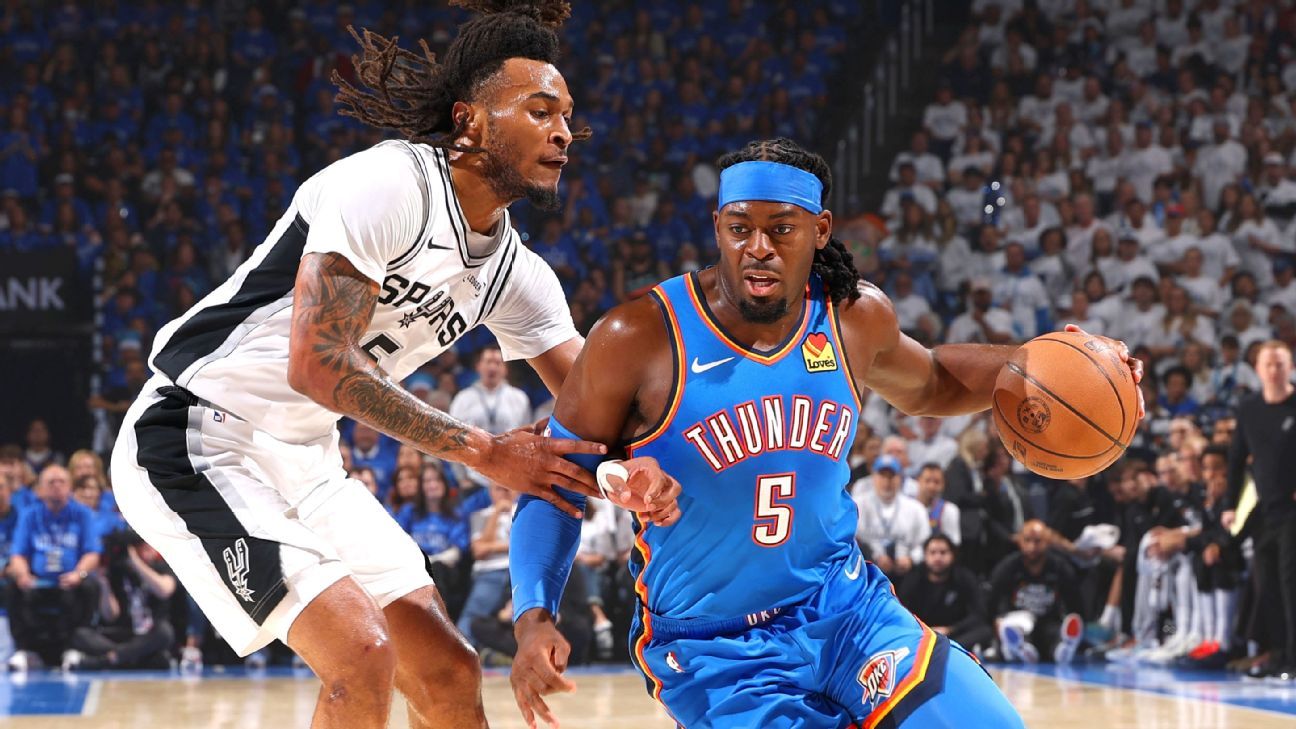
The Oklahoma City Thunder exercised Lu Dort's $17.7 million player option for the 2026-27 season on Monday, keeping the 27-year-old forward in uniform alongside Shai Gilgeous-Alexander, the longest-tenured duo on a roster built to compete now. Dort has spent all seven seasons of his career in Oklahoma City, climbing from undrafted two-way contract to one of the league's most reliable perimeter defenders and a critical piece of the league's top-ranked defense the past two seasons.
The strategic subtext here is about continuity, not cap flexibility. Thunder management could have let Dort test free agency or negotiate a longer-term deal at near-market rate; instead, they locked him in at a reasonable number that keeps payroll predictable while preserving optionality. For a team with championship aspirations, roster stability around your two best perimeter defenders—Gilgeous-Alexander and Dort—is a non-negotiable. Dort's on-ball defense, particularly his ability to take opposing best scorers, is irreplaceable in a playoff grind. He earned a first-team All-Defensive selection in 2024-25 and has functioned as the Thunder's security blanket on that end of the floor.
What makes this decision relevant to prop construction is Dort's role within the Thunder's offensive architecture. Over the past three seasons, he's shot 38.4% from three on 5.4 attempts per game—a genuine leap from his early career—while averaging 11.6 points across his entire tenure. That trajectory matters because it defines what Dort is: a catch-and-shoot wing who's carved out a legitimate outside threat identity, not a primary creator or high-volume scorer. His baseline is low-to-mid double digits with heavy variance based on shot diet and whether he's being hunted on the defensive end in a given matchup.
For bettors, the prop implications hinge on recognizing that Dort's scoring is a function of offensive spacing and ball movement, not shot volume or usage rights. When the Thunder face teams with elite perimeter defenses that force more isolation play, Dort's touches shrink and his scoring dips below 9-10 points. Conversely, against defenses that play more drop coverage and give the Thunder's guards space to operate, Dort's off-ball movement creates open threes and he trends toward 13-15 points. The option exercise doesn't change his role—it confirms it. He remains a 10-12 points per game prop target with meaningful sensitivity to opponent defensive scheme. The edge on Dort's scoring props isn't in his talent level; it's in recognizing that his range is narrower than the midpoint suggests, and that live defensive data (switching frequency, drop/hard-show percentages) will tell you which end of that range is live on any given night.