Wembanyama's 41-Point Game 1 Masterclass Exposes Thunder's Shooting Vulnerability—Here's What Game 2 Demands
By PropBetEdge Editorial Team ·
Victor Wembanyama put on a historic performance to steal Game 1 from Oklahoma City, but the Thunder's cold shooting and San Antonio's turnover discipline mask a fragile Game 2 script that favors sharp bettors who understand shooting reversion.
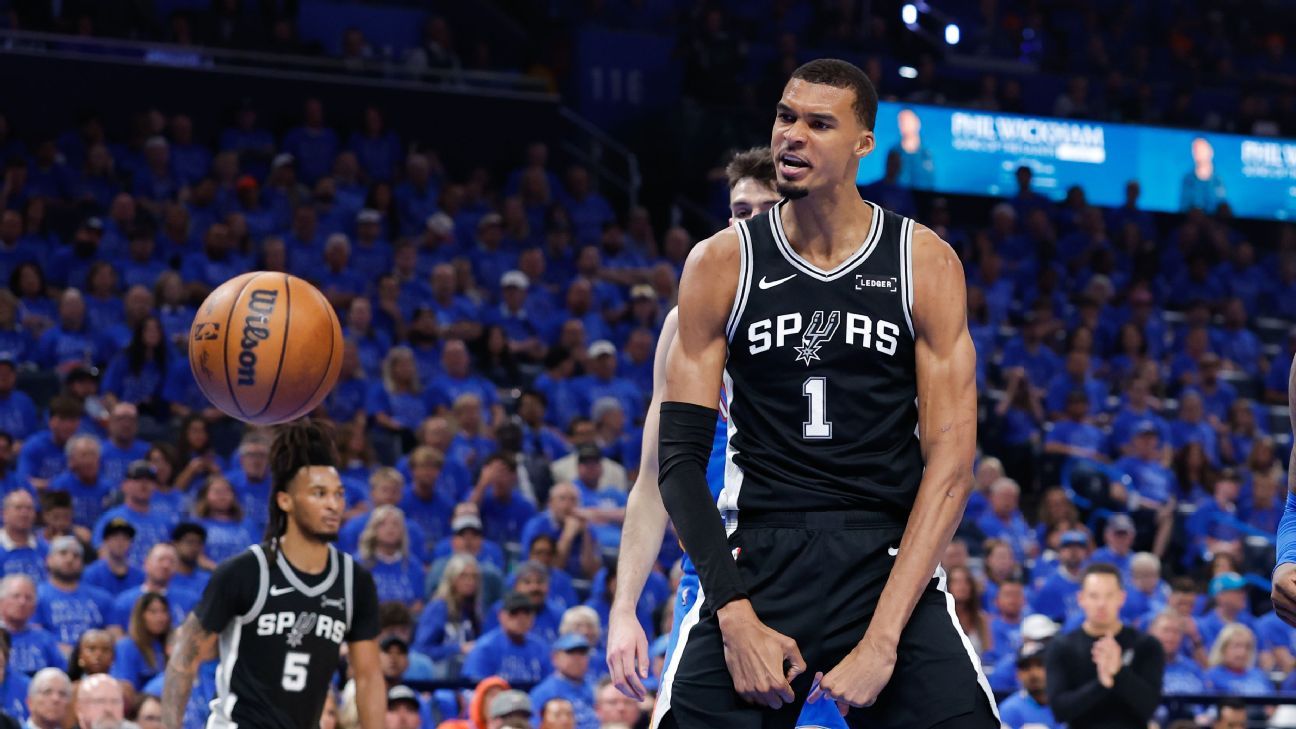
San Antonio stole Game 1 of the Western Conference Finals in overtime, 122–115, behind Victor Wembanyama's 41-point, 24-rebound, 3-block eruption that left no margin for error in the fourth quarter or OT. The defending champion Thunder had their chances—they trailed by double digits early, clawed back into the game, and watched Chet Holmgren block what could have been a series-altering Wembanyama game-winner in regulation—but couldn't finish when it mattered. Shai Gilgeous-Alexander, fresh off his MVP ceremony, struggled as an offensive force, particularly from three-point range, as San Antonio deployed deliberate double teams in the paint that left open perimeter looks the Thunder simply didn't make.
The shooting disparity tells the real story. Oklahoma City made just 37.2% from the field and 27.3% from three over the first two quarters, a shocking collapse for a team ranked third in postseason three-point shooting at 38.4% through their first two playoff rounds. Meanwhile, San Antonio's ballhandling—Stephon Castle's 11 turnovers notwithstanding—created enough chaos that OKC couldn't establish rhythm despite generating clean looks. The Thunder scored only 17 points on 18 possessions where Gilgeous-Alexander was doubled, a sign that San Antonio's scheme is working, but also that Oklahoma City's role players and secondary creators need to punish it. De'Aaron Fox's late scratch (high right ankle sprain) forced the Spurs to deploy a historically young starting five (average age 22 years, 346 days), yet they didn't fold in the Paycom Center environment—a signal that San Antonio's structural advantages may outweigh raw experience.
Game 2 is where the market correction happens. The Thunder's 27.3% three-point shooting in the first half of Game 1 sits near the bottom 1% of their season range; regression toward their 38.4% postseason baseline is mathematical certainty, not prediction. Gilgeous-Alexander faced heavy perimeter coverage but will see single-layer defense more often once OKC adjusts their spacing and movement. The prop market has already absorbed the narrative that Wembanyama is the series' alpha scorer—his 41 points in Game 1 will have spiked his Game 2 point total line upward—but Gilgeous-Alexander's historical efficiency against similar defensive schemes (he averaged 29.4 PPG on 58% true shooting in last year's playoffs against top-5 defenses) suggests the MVP is due for a recalibration game. San Antonio's turnover issues, specifically Castle's 11 giveaways with five coming in the fourth quarter and OT, create a floor on OKC's scoring opportunity. The Thunder generated 17 points on just 18 doubled SGA possessions; extrapolate that efficiency to a full game where San Antonio's perimeter players are forced to defend more and handle the ball less, and OKC's total offense inches closer to 115–120 range.
For prop players, Gilgeous-Alexander's points line at Game 2 is the sharpest angle. The market will price him down slightly from his season average (29.8 PPG) due to Game 1's shooting struggles, but that discount doesn't account for San Antonio's likely adjustment: fewer double teams in the paint once Holmgren and Derrick Jones Jr. space the floor more aggressively. Castle's assist and turnover totals also warrant attention; his 11 TOs forced Dylan Harper into rotation minutes alongside him, but if Harper's presence in Game 1 was a one-off starter experiment, Castle's volume on both sides of the ball changes. Watch OKC's bench shooting in Game 2; if they hit 35%+ from three, the Thunder cover spreads down to -2. If they stay under 32%, San Antonio's defensive scheme holds, and the Spurs pull away in the second half.
The biggest mismatch to exploit: Wembanyama's Game 2 point total will likely open inflated based on his 41-point Game 1, but Holmgren's elite rim protection (he blocked the potential series-clincher in regulation) and San Antonio's reliance on Fox's absence with a young lineup suggest Wembanyama faces more physical, less finesse-oriented defense in Game 2. The Spurs' youth may backfire on them if OKC exploits Wembanyama in pick-and-roll situations where youth can't anchor a defense. Fade his inflated total; lean on OKC team total overs in the 112–115 range if the line settles there, because shooting reversion is a law, not a hope.