Cavaliers' Conference Finals Collapse Reshapes Offseason Calculus and Mitchell's Long-Term Value
By Ty Whitney ·
Cleveland's fourth-quarter implosion against New York exposes fundamental fit problems that a midseason Harden trade failed to solve, forcing hard decisions on both the star and the franchise's direction.
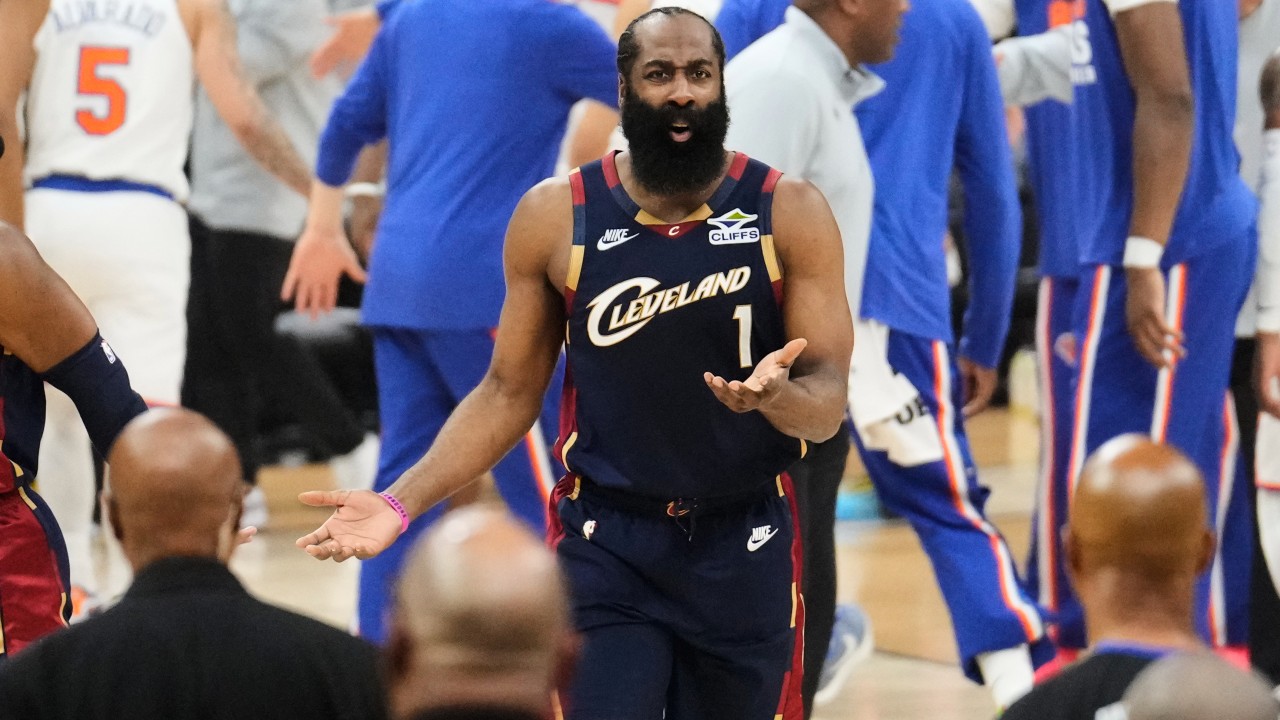
The Cavaliers' season ended not with a whimper but a 37-point beatdown. The Knicks rolled through Game 4 with Karl-Anthony Towns anchoring a 130-93 demolition that completed a sweep and sent Cleveland home to contemplate what went wrong. A team that fired on all cylinders through the regular season and survived two grueling series against Toronto and Detroit simply ran out of answers when it mattered most. The second-round exits had already taken a toll—fatigue, momentum loss, confidence erosion—but the Eastern Conference Finals exposed something deeper: the Harden trade didn't solve the spacing crisis, and the team's 28.9% three-point shooting in the series became a death sentence against an elite Knicks defense.
The February deadline blockbuster—shipping Darius Garland to Los Angeles for a past-his-prime James Harden—was supposed to lighten the load on Donovan Mitchell and unlock a second-star dynamic. Instead, the 36-year-old Harden delivered pedestrian offense and weak perimeter defense when the stage grew brightest. He has a $42.3 million player option waiting, one he's expected to decline in free agency. His tepid postseason performance—and his own admission that the pairing "didn't have a fair chance"—now frames a harder question: was the trade a sunk cost misjudgment, or is there still time to salvage it? Cleveland's front office will face that choice with limited ammunition. Owner Dan Gilbert has already committed over $400 million to this core without a second championship to show for it. Harden's likely departure leaves the Cavs hunting for complementary talent, not star power.
Mitchell's extension decision looms larger. The 29-year-old is eligible for a five-year, $350 million supermax, though Cleveland will likely defer the decision due to salary-cap realities. His 31-point performance in the sweep-clinching loss was a final display of star-level shot-making against a suffocating defense—he carried the team on his back when no one else could. Yet one man's scoring can't overcome organizational failures in bench depth, floor spacing, and fourth-quarter execution. In Game 1, Cleveland blew a 22-point lead in the fourth quarter; the Knicks never trailed again in the series. That Game 1 collapse, more than any single statistical flaw, defined the matchup and Mitchell's postseason trajectory.
From a prop perspective, Mitchell's playoff scoring efficiency tells a cautionary tale about star-dependent rosters. Over these four games, he averaged north of 24 PPG on reasonable volume, yet his team scored just 93 in the clincher because no other Cavalier could generate consistent offense. For next season's preseason lines, this matters: if Harden leaves and Cleveland's supporting cast remains thin, Mitchell's individual scoring props (points, PA combinations) will likely offer value on the UNDER as defenses can game-plan exclusively around him without fear of secondary threats. The Knicks' ability to send double-teams without rotation risk is a blueprint that other Eastern Conference teams will replicate. Until the Cavs address backcourt depth and three-point shooting around Mitchell, his scoring volume will remain suppressed relative to his league-average talent level. The market will price his name recognition; the mechanism—isolation defense and limited off-ball pressure—favors the under.
Atkinson's job security is less clear but equally relevant to offseason prop strategy. He guided the Cavs to a No. 1 seed in year one, then absorbed a second-round exit to Indiana before bouncing deeper into the Finals this year. Both Mitchell and Harden publicly defended him, citing the Conference Finals appearance as progress. But Dan Gilbert doesn't reward moral victories. If Atkinson remains and the Cavs strip assets or take a retooling step backward, Mitchell's scoring environment deteriorates further. If he's replaced mid-offseason, continuity breaks and preseason numbers could swing dramatically. That coaching uncertainty is a timing risk for early-season prop bets; wait for clarity on that front before locking in long-term Mitchell volume lines.