Suns' Offseason Reshaping Puts Booker Back in Dual Engine Role
By PropBetEdge Editorial Team ·
Phoenix's free-agent acquisitions and Bridges trade tighten the roster around Devin Booker as primary scorer and playmaker, but depth at wing and frontcourt remains a question mark heading into summer league.
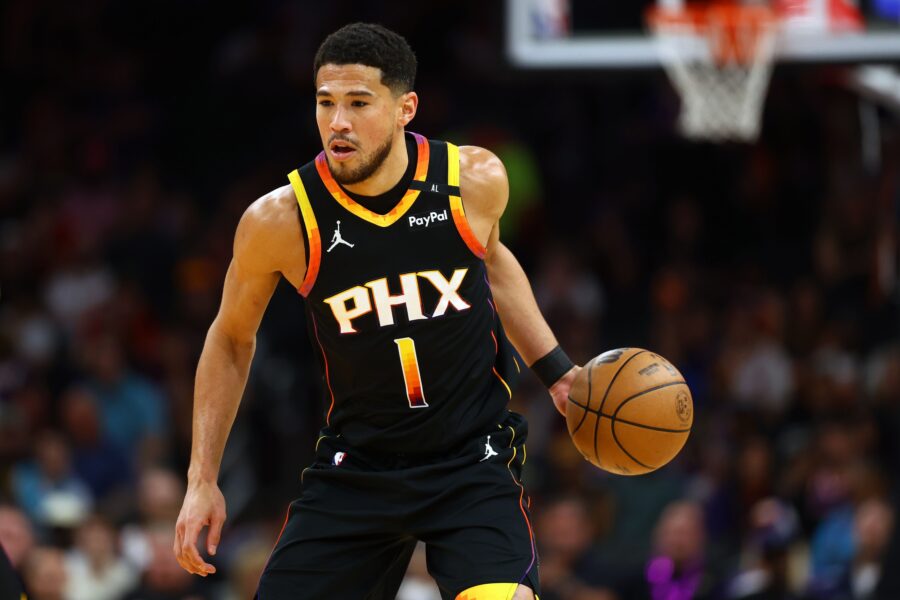
The Suns' offseason activity—re-signing Collin Gillespie, Jordan Goodwin, and Mark Williams, adding sharpshooter Luke Kennard in free agency, and trading for Miles Bridges—keeps Devin Booker anchored as the team's dual-engine offensive hub. The organization made no move to lighten his creation load or pivot away from the pick-and-roll gravity that defines their attack. Instead, they've added complimentary pieces: Kennard's three-point reliability fits the perimeter-spacing blueprint, and Bridges provides another wing scorer to operate alongside Booker in closing lineups. That's a roster design choice, not an accident.
But the depth picture remains unsettled, particularly in the frontcourt and at small forward. Early summer league action has surfaced some real concerns. Anthony Maluach, a younger prospect on the roster, has shown floor command and defensive intensity in his first two appearances—clear improvement in mobility and engagement. Donovan Peat, the 30th overall pick, has impressed relative to draft position, which is the floor expectation for late first-rounders; he's doing that job. Fleming's summer contribution, by contrast, has been a letdown. And depth wingman Brea's performance has raised legitimate questions about whether his skill set translates at NBA pace and physicality.
This matters for Booker's workload and shot diet. If the wings behind Bridges struggle to generate their own offense or space the floor consistently, Booker's usage will creep upward. The Suns won't have the luxury of load-managing his touches. Every roster role player who can't execute—spacing, cutting, decision-making—increases the gravity tax on the primary ballhandler.
From a prop-betting lens, Booker's assist total becomes the critical lever. His creation volume is structural, not circumstantial. If Kennard and the returning role players (Gillespie, Goodwin) hit their three-point looks at expected rates, Booker's assist total should stabilize in his seasonal range—roughly 6.5 to 7.5 assists per game depending on minutes. But if perimeter personnel underperform at spacing, Booker will either force more difficult shots or turn the ball over more frequently trying to manufacture offense against packed defenses. The early summer league film suggests Peat's development and Maluach's upside are real, but Fleming and Brea are not filling the depth void yet. Booker's assist line will likely price higher than it should relative to floor probability if the market hasn't yet fully processed the depth risk. Until Phoenix's wing rotation proves it can generate secondary offense, lean cautiously on Booker assist overs only if his line is priced below 6.5 for a full-minute game—below that mark, even modest assist inflation covers the variance.