Suns Lock in Brooks at $73M: Validation of a Career Arc Reset
By Ty Whitney ·
Dillon Brooks' extension signals Phoenix's confidence in his elevated role—and hints at how the Suns' offensive architecture may shift around his scoring volume.
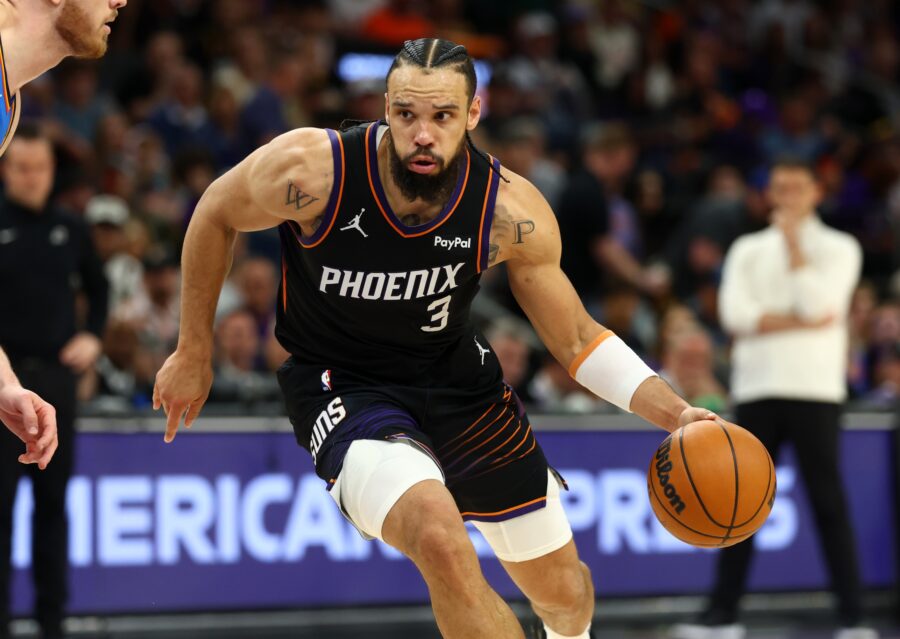
The Suns have agreed to a three-year, $73 million extension with Dillon Brooks, per ESPN's report Wednesday. The deal represents organizational validation of Brooks' first season in Phoenix, when he averaged 20.2 points on 17.1 shot attempts per game—both career highs. That scoring output arrived after the Rockets deal that sent him west alongside the Kevin Durant acquisition, positioning Brooks as a permanent piece of the Suns' forward rotation rather than a short-term complement.
The extension carries real significance beyond the contract size. Brooks entering his age-33-34 window on a long-term deal means Phoenix is betting on sustained production from a player whose career trajectory had flattened in Houston. His 20.2 PPG last season represented a 4-point jump from his Rockets average and arrived on identical shot volume, suggesting improved efficiency rather than simply higher volume. That efficiency gain—shooting 45.1% from the field, 37.2% from three—is the mechanical driver of the deal's logic. The Suns are not overpaying for volume; they are committing to the shooter Brooks proved himself to be.
For the Suns' offensive profile, Brooks' confirmation as a long-term option affects shot allocation and spacing. He becomes a more predictable scoring option in pick-and-roll actions and spot-up situations, which stabilizes the team's perimeter balance. With Devin Booker and Kevin Durant already occupying primary creation duties, Brooks' role is defined: secondary scoring wing who can operate in the 16-20 PPG range without requiring the ball in his hands constantly. That clarity changes how prop markets should price his upcoming-season output.
The betting angle hinges on market recency bias around Brooks' 20.2-point average. Books will likely shade his season-long scoring line upward from historical benchmarks—he was a 16-17 PPG player in Memphis and Houston before last year. However, the extension itself is an internal valuation signal that Phoenix expects him to maintain closer to that 20-point mark than to regress to 17. If his season line opens at 18.5 or 19.5 points, the Suns' willingness to commit $24+ million annually suggests lean-toward-over territory. The mechanism is not a hot-hand bet; it is organizational confidence expressed through a long-term contract. Organizations do not extend players they expect to decline. Conversely, if the market prices him at 21+ points, the extension does not eliminate regression risk—it simply confirms the Suns believe he can hold the mid-to-high-19s range rather than guarantee another 20+ season.