Duren Stalemate Signals Detroit's Center Puzzle Won't Resolve Fast—and What That Means for the Pistons' Spacing
By Erik Schwartz ·
The Pistons' restricted free agent talks with Jalen Duren have plateaued, forcing a reckoning about roster construction that will ripple through their offensive efficiency all season.
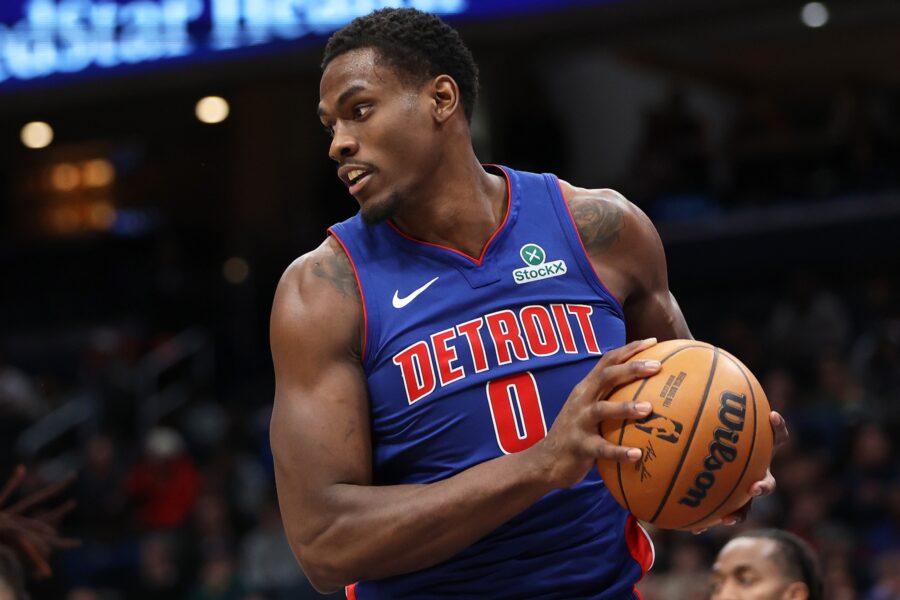
The Pistons' offseason negotiation with restricted free agent Jalen Duren has ground to a halt. Per Marc Stein, Detroit has achieved only "modest progress" in contract talks with the 22-year-old center, despite publicly naming him the top priority. Duren is eligible for a 25% supermax worth $41.24 million next season and roughly $239 million over five years, but the Pistons are pushing him toward a more cap-friendly deal. That divergence—between what Duren can legally command and what Detroit is willing to pay—has left both sides treading water as the offseason enters its final weeks.
The Pistons face a structural bind. They've already committed resources to John Collins, Isaiah Joe, Gary Harris, and Taurean Prince, tightening their financial flexibility. Duren has limited leverage; no rival team has sufficient cap space to sign him to a competitive offer sheet that would force Detroit's hand. That should theoretically favor the Pistons, but Duren can accept Detroit's $9.6 million qualifying offer and reset the market next summer as an unrestricted free agent. It's a risk-laden play—he'd be badly underpaid in 2026-27—but it protects his long-term optionality. Detroit's unwillingness to explore a sign-and-trade compounds the jam; if talks collapse, the Pistons are betting Duren folds rather than gamble on his future earnings.
The roster moves around Duren tell the real story. Adding perimeter players (Collins, Joe, Harris, Prince) alongside Duren signals an offense built around floor-spacing and positionless play. But if Duren sits out the season on a qualifying offer or ends up on another team via sign-and-trade—both materially possible outcomes—Detroit's floor spacing suffers. A Pistons squad counting on Collins to stretch the five while Duren anchors the middle requires Duren to actually be on the court and healthy. Long-term center contract uncertainty almost always depresses the efficiency of guards and wings who depend on rim-running and drive-and-kick flow.
For prop purposes, this stalemate creates a volatility tax on Detroit's entire offensive ecosystem. If Duren is locked in and healthy for 2026-27, the Pistons' spacing metrics improve and assist totals for their guards rise. But every week this contract limbo persists increases the probability that Duren misses games due to hold-out tension or ends up traded. The market will eventually price Duren's availability at a discount—taking unders on Pistons team totals and Duren's own assist totals in early-season matchups before a resolution is prudent. Once a deal is struck or a trade is finalized, that discount reverses sharply. The angle is ephemeral; it survives only through the contract resolution.
Elsewhere, the Lakers' acquisition of Walker Kessler for four first-rounders and pick swaps—along with Ziaire Williams' signing after a private workout—reflects a front office confident in Luka Doncic's timeline. The Kessler deal was expensive but deliberate; the Lakers promised Doncic a high-level center and followed through. That decisiveness stands in sharp contrast to Detroit's paralysis. For the Pistons, prolonged uncertainty around their own All-Star-caliber center is a competitive liability they can't afford while the league's title contenders are consolidating talent.