NBA
Wembanyama's Pick-and-Roll Finishing Is Reshaping San Antonio's Offensive Load
A single highlight reveals the structural shift driving Spurs efficiency: Wembanyama operating as a roll man, not a perimeter scorer, fundamentally changes how defenses must account for his 7-foot-4 frame.
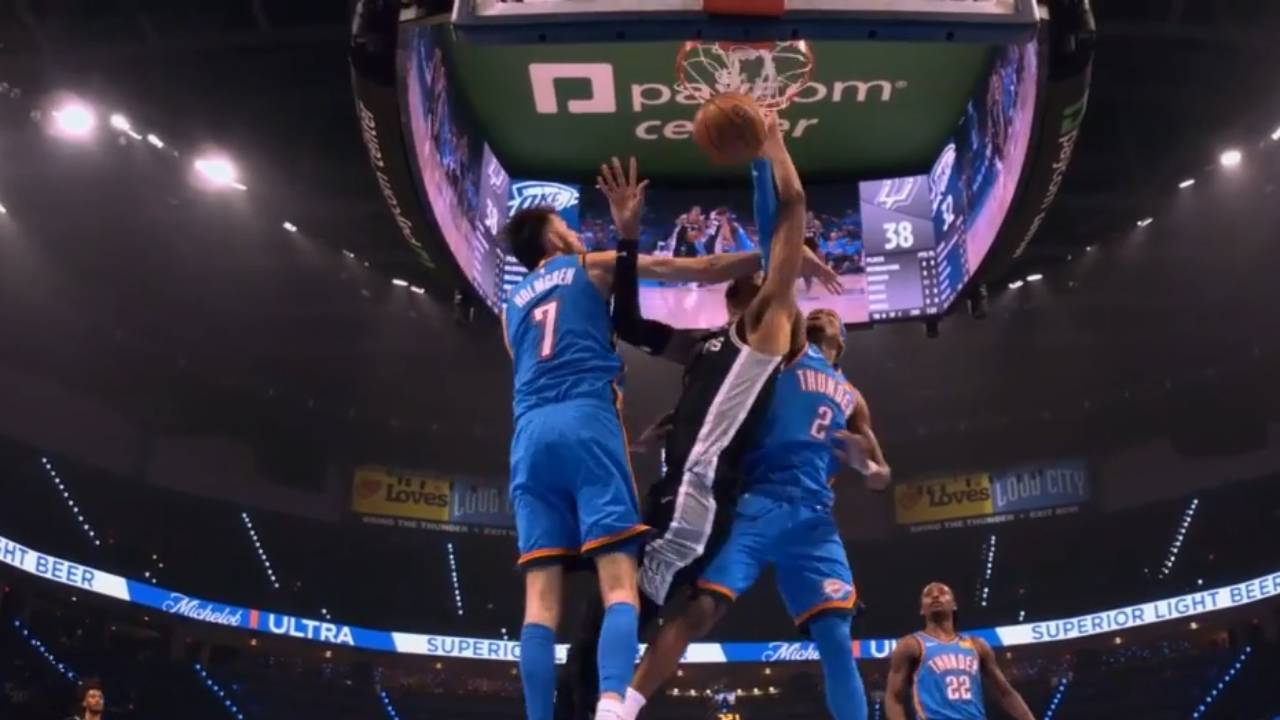
Victor Wembanyama's left-handed finish in the paint—a catch-and-convert off a Stephon Castle pick-and-roll—isn't a viral moment isolated from offensive architecture. It's evidence of San Antonio's operational pivot in year two. The Spurs are deliberately running pick-and-roll action through Castle as the initiator, with Wembanyama rolling rather than spotting up. This shift has concrete scoring consequences.
The play itself dismantles a defensive principle: Chet Holmgren and Shai Gilgeous-Alexander were tasked with containing Wembanyama's roll, but his length and footwork in tight spaces—the ability to catch at the rim and finish in one motion through traffic—creates a matchup problem no standard big can solve. When you're 7-foot-4 and operating within five feet of the basket on a roll, rim protection becomes an angle problem, not a size problem. Holmgren's length was immaterial; Wembanyama's control in the paint overrode it.
This roll-man role is the mechanism driving Wembanyama's points-per-possession efficiency in the half-court. When he spaces the floor, defenses load toward Castle's penetration and leave shooters open. When he rolls, defenses collapse to the paint and Wembanyama finds cutters or weak-side shooters. The dunk is the byproduct of a defense choosing between two bad outcomes. From a betting standpoint, this means Wembanyama's interior-scoring volume—particularly dunks and restricted-area attempts—becomes more predictable and repeatable than perimeter shot totals. His points line moves with Castle's usage and the opposing center's switching capability, not with his three-point variance.
San Antonio's interior scoring depth has materialized as the season progresses. Keldon Johnson and Jeremy Sochan provide secondary finishers, but Wembanyama's gravitational pull at the rim means his interior-scoring streaks correlate to overall offensive pace and pick-and-roll frequency. Against defenses that struggle with small-ball switching or lack an elite rim-runner at center (like Oklahoma City does with Holmgren), Wembanyama's restricted-area frequency spikes. This is not a single-game edge—it's a multi-matchup pattern that survives line movement because it reflects Spurs scheme, not moment-to-moment variance.
For prop players, the durable edge is Wembanyama's points total when San Antonio faces switching-heavy defenses without elite interior anchors. His per-game average will climb on nights when Castle runs 6+ pick-and-rolls in the half-court, a metric worth tracking in pre-game film. The line doesn't yet account for this volume stability; most sportsbooks still price Wembanyama's points on three-point shooting variance rather than roll-man efficiency. That mispricing persists because a single dunk doesn't move the needle. A season-long pattern of 18-22 restricted-area attempts per game, though, absolutely does.