Wembanyama's Early Aggression in Game 7 Signals Offensive Intent Against Thunder Defense
By PropBetEdge Editorial Team ·
A first-quarter sequence reveals San Antonio's willingness to attack Holmgren in space—a tactical choice with implications for Wembanyama's scoring volume and efficiency in a playoff elimination game.
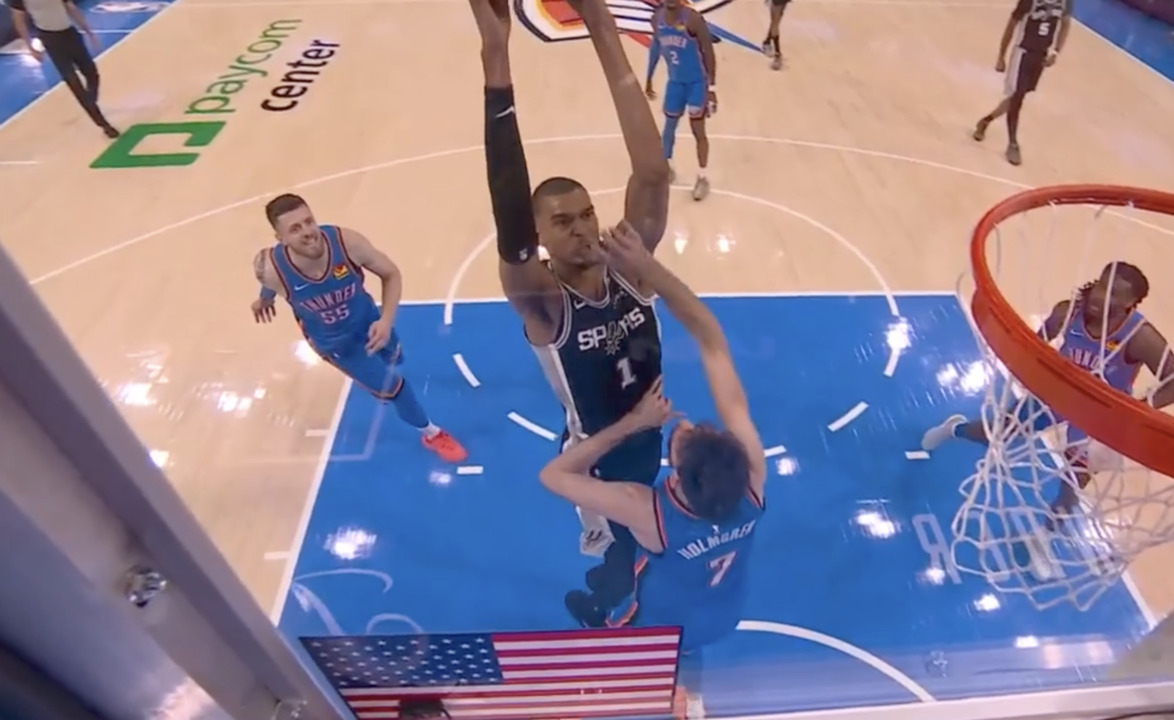
Victor Wembanyama converted a give-and-go in the first quarter of Game 7 against Oklahoma City, finishing at the rim over Chet Holmgren to establish early offensive momentum for the Spurs. The play itself was straightforward—a quick pass-and-cut that exploited space in the Thunder's interior—but its context matters: San Antonio entered this elimination game needing to establish pace and scoring efficiency early, and Wembanyama's willingness to attack downhill rather than settle into perimeter shot-taking suggested the Spurs' game plan centered on exploiting mismatches in transition.
Oklahoma City's defense has built its identity on switching and rim protection, but a give-and-go attack targets the temporal gap between that switching process. Holmgren is a legitimate rim defender—elite shot-blocking numbers carry weight—but he's also a developing offensive player who can't always recover laterally when caught in space. When Wembanyama operates in motion rather than isolation, he forces Thunder defenders into uncomfortable decisions: follow him off the ball and open driving lanes for role players, or stay home and let him attack the basket directly. A first-quarter sequence that shows San Antonio exploiting this fault line is not noise—it's a schematic tell.
For bettors tracking Wembanyama's scoring profile in Game 7 specifically, the early aggression and made layup signal two things. First, Spurs offensive movement is generating clean looks rather than forcing difficult mid-range or three-point attempts. Second, Wembanyama is being positioned to attack rather than space. This typically correlates with higher efficiency (finishing around the basket beats launching threes in high-variance scenarios) and moderate volume—he's not hunting 25+ shot attempts, but the ones he's taking arrive in rhythm. Against a Thunder team that has struggled to contain pick-and-roll action in previous games, that pattern compounds.
The prop implication hinges on whether this opening sequence represents sustained offensive flow or an early-game anomaly that cools as OKC adjusts. Given that Game 7 elimination contests rarely feature significant tactical pivots mid-game, the Spurs' commitment to attacking Wembanyama's way into the paint in Q1 likely persists. His points total in Game 7 is priced on season averages and recent playoff output; a game plan that prioritizes attack over spacing typically elevates his scoring probability within his expected range rather than creating outlier upside. The edge, if it exists, is moderate and tied to execution consistency rather than a radical tactical shift.