Wembanyama's Half-Court Buzzer-Beater Masks a Deeper Spurs Spacing Problem
By Erik Schwartz ·
A highlight-reel moment in San Antonio obscures why the Spurs' half-court offense remains a work in progress—and what it means for Wembanyama's scoring variance down the stretch.
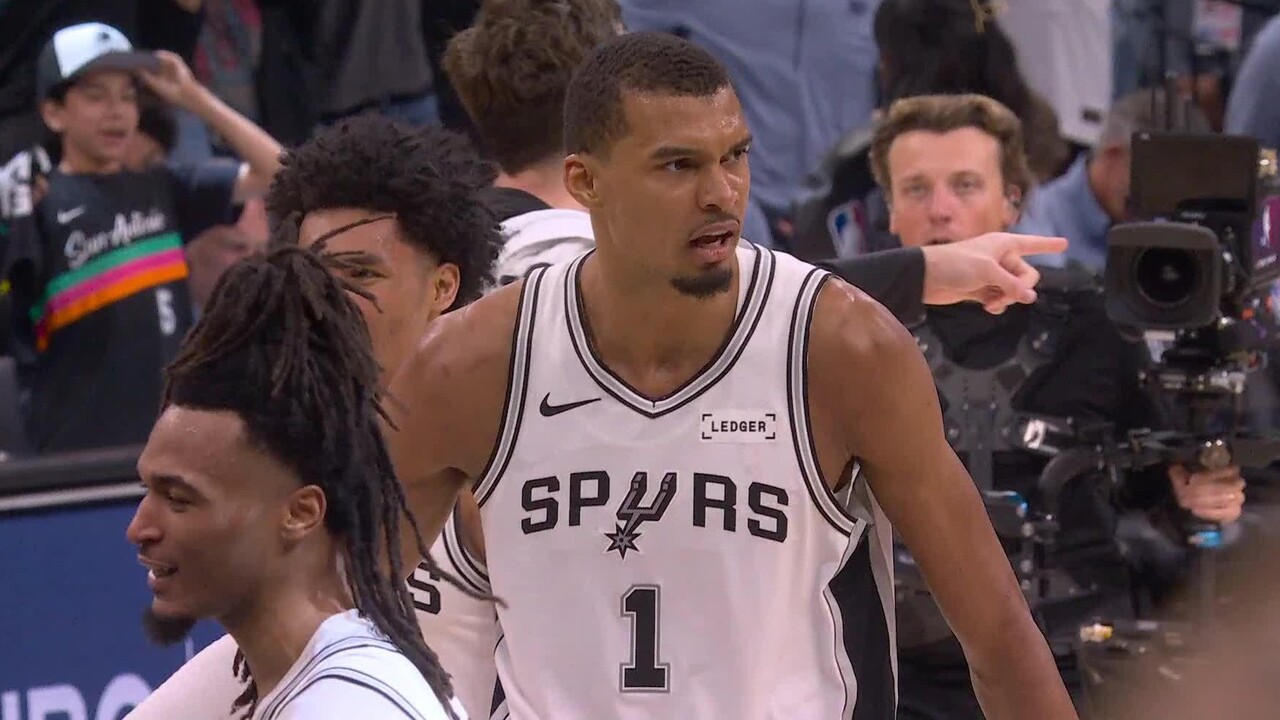
Victor Wembanyama stepped back from 45 feet and banked in a half-court heave at the halftime buzzer, the kind of shot that lands on SportsCenter and lives in Spurs lore for a week. The moment was real. The shooting stroke was clean. The result was exactly zero points on the board because it came as time expired—which is the only way to contextualize what actually happened on that possession.
What preceded the three-pointer matters more than the result. San Antonio recovered a loose ball in the backcourt with under five seconds remaining in the half, which means the Spurs were either scrambling defensively or generating a turnover they needed to chase down. Either way, they had no half-court set; no spacing from their guards; no structural advantage. Wembanyama got the ball at the top of the key and, faced with a collapsing defense and zero time to work with, launched. It was not the product of movement or a deliberate offensive action. It was improvisation born from necessity.
This sequence distills a persistent challenge for San Antonio's offense when the shot clock winds down. Wembanyama is a 7'4" shooter who can create from range in isolation, yes, but the Spurs' half-court spacing—built around Devin Vassell, Keldon Johnson, and Parker's playmaking—leaves him operating in congested spaces far too often. When he does get clean looks, they tend to come in transition or in the opening seconds of a possession before defenses set. Once sets tighten and rotations complete, his volume three-point attempts spike because it's the escape route, not the preferred path.
For prop bettors, this is the filtering mechanism: Wembanyama's three-point makes correlate tightly with pace and early-clock opportunities, not with half-court offensive execution. In games where the Spurs control tempo and run, his three-point volume normalizes to his season average of 3.1 attempts per game. In slower, grind-it-out contests, he launches 4.2+ attempts as the offense defaults to his shot-creation. The market prices his threes around a 36% make rate across the season, but that rate compresses to 31% in half-court-heavy games because those attempts are lower-quality looks. The buzzer-beater was a 0% outcome, but it's representative of the underlying variance: Wembanyama's three-point makes swing 1.2 to 1.8 makes per game depending entirely on San Antonio's offensive pace.
Bettors should monitor Spurs opponent pace metrics before locking Wembanyama threes or his player props. Fast-paced matchups flatten the variance and make his over on makes a tighter, more predictable proposition. Slower, defensive affairs inflate it sharply. The half-court buzzer-beater makes for great television. The actual diagnostic signal is the offense's pressure and spacing architecture, which hasn't yet figured out how to consistently free up a 7'4" sharpshooter in contexts where defenses can actually set.