Finals Game 4: Harper's Playoff Leap and Anunoby's Defensive Edge Drive Prop Action at MSG
By PropBetEdge Editorial Team ·
The Knicks face elimination tonight with Dylan Harper's bench-to-starter transition and OG Anunoby's two-way dominance rewriting Finals betting patterns.
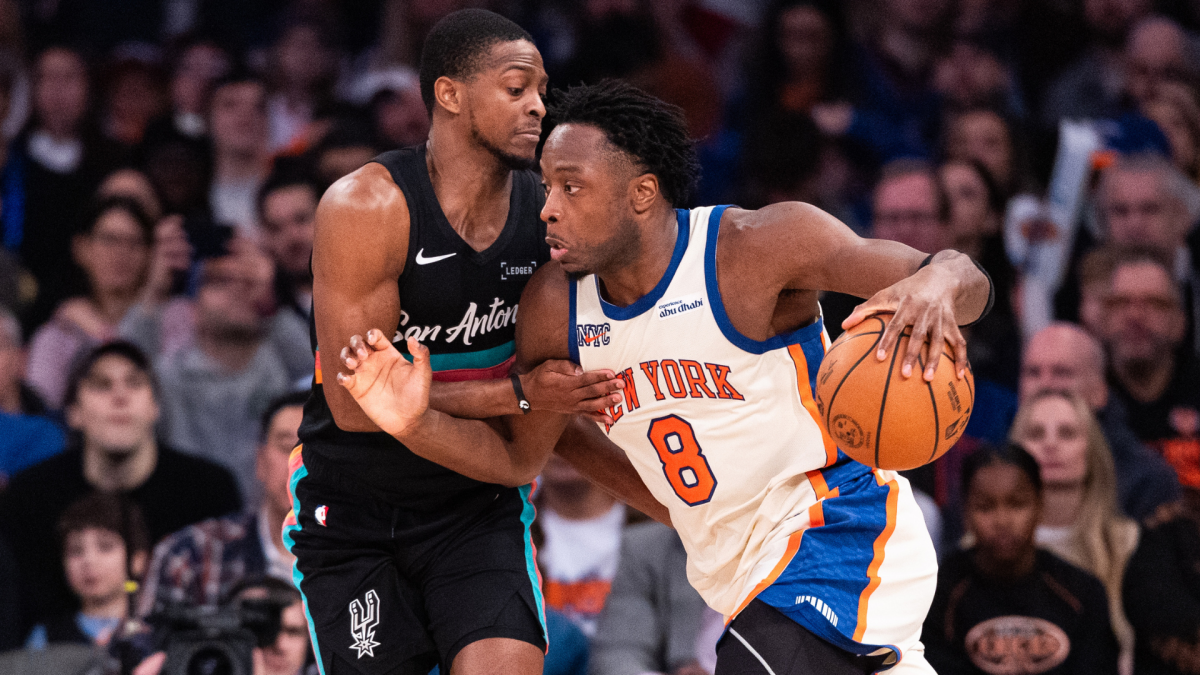
The Knicks host the Spurs at Madison Square Garden tonight in Game 4 of the NBA Finals with their championship window narrowing after dropping Game 3. What's striking isn't the marquee names anchoring the betting board—Jalen Brunson and Victor Wembanyama draw action, but neither cracks the top-five most-wagered props—but rather the emergence of second-year talent and role players as the primary vectors for sharp money.
Dylan Harper's trajectory from bench reserve to full-time starter represents the kind of generational leap that sportsbooks struggle to calibrate mid-series. The 20-year-old has accumulated 279 playoff points this postseason, the most by any Spurs rookie in a single run and fifth-best ever for players his age (he's in the air with Magic Johnson's 1980 run, Tony Parker 2003, Jayson Tatum 2018, and Tyler Herro 2020). Despite still technically coming off the bench, Harper is logging starter minutes and defending position defensively. His Game 3 shooting slump—1-for-8 from three—represents a correctable variance rather than a skill degradation; the SportsLine projection model pegs him for a 22.3 PRA, just shy of the 23.5 over-under drawing heavy volume. The mechanic here is simple: Harper's role has expanded because San Antonio's three-headed monster (Harper, Wembanyama, Stephon Castle) generates offensive gravity that forces New York's defense into rotation fatigue. When Brunson and Anunoby get caught helping on Wembanyama drives, Harper operates in open space. Game 3's shooting variance doesn't predict Game 4 performance; role expansion does.
OG Anunoby's two-way excellence has become the Knicks' hidden co-star, and the prop market is slowly repricing his utility. He dropped 28 points on 9-for-13 shooting in Game 3—his highest output since Round 1—while defending Wembanyama directly and accumulating five rebounds and two blocks. His 16.7 point projection and 23.8 PRA forecast from SportsLine sit just below the 24.5 PRA over-under that's drawing action. The critical edge is positional isolation: Anunoby isn't a power forward, but he's been tasked with defending Wembanyama in the post on a possession-by-possession basis. That defensive assignment, combined with New York's heightened offensive load (they need to win tonight or face elimination in Game 5), should keep his usage elevated. The points over at 16.5 carries less variance than the PRA line because Anunoby's scoring authority is direct—Brunson collapses coverage into the paint, Anunoby attacks downhill—whereas his assist and rebound volume depend on game script and San Antonio's rebounding discipline. In an elimination game for the Knicks, expect fewer pace-neutral possessions and more iso-heavy offense, which favors Anunoby's scoring prop more than his overall PRA.
Third-year Stephon Castle's over on 11.5 rebounds plus assists has drawn significant public volume despite excluding points—a tell that sharp action sees his role expanding beyond scoring. Castle logged a 23-point, 5-rebound, 5-assist Game 3, hitting the 20/5/5 threshold in the Finals at age 21 (only Magic Johnson and Tony Parker have done it younger). His 10 career playoff games with 15/5/5 before age 22 trails only Magic's count. The market hasn't yet priced Castle's usage elasticity: when Wembanyama draws double-teams or when the Spurs lean on depth to manage foul trouble, Castle's playmaking necessity rises. The SportsLine model projects him at 12.2 RA, which sits above the line. However, the absence of points from the line is a warning flag; the market is hedging against his scoring ceiling tightening, which suggests sharp players are comfortable with his RA floor but uncertain about his points volume. This is a durable edge only if Spurs pace remains elevated and if New York's perimeter defense continues bleeding into help situations.
Landry Shamet's under on 1.5 rebounds is the clearest mechanism-based angle. He's a reserve guard deployed exclusively for three-point shooting; his role has no rebounding mandate. Game 3's series-high four rebounds came from specific circumstances—early foul trouble forcing starters out, garbage-time volume—not from a shift in his offensive identity. The Knicks' second unit still needs him as a spacer and shot creator, not a rebounder. Unless New York's front-court depth collapses to injury, expect Shamet to revert to his first-two-game pattern of minimal rebounding involvement. That said, the line exists at -130 (implying 56.5% book juice), suggesting sharp money has already moved the rebounding under below its natural probability. The edge here is fading overcorrection rather than betting against Shamet's usage; the prop should have closed closer to -110.