Spurs' Backcourt Collapse in Western Finals: Harper's Exit Compounds Fox's Absence
By Erik Schwartz ·
San Antonio's starting guard rotation just fractured mid-series against Oklahoma City, forcing emergency lineup decisions that will reshape both teams' offensive schemes.
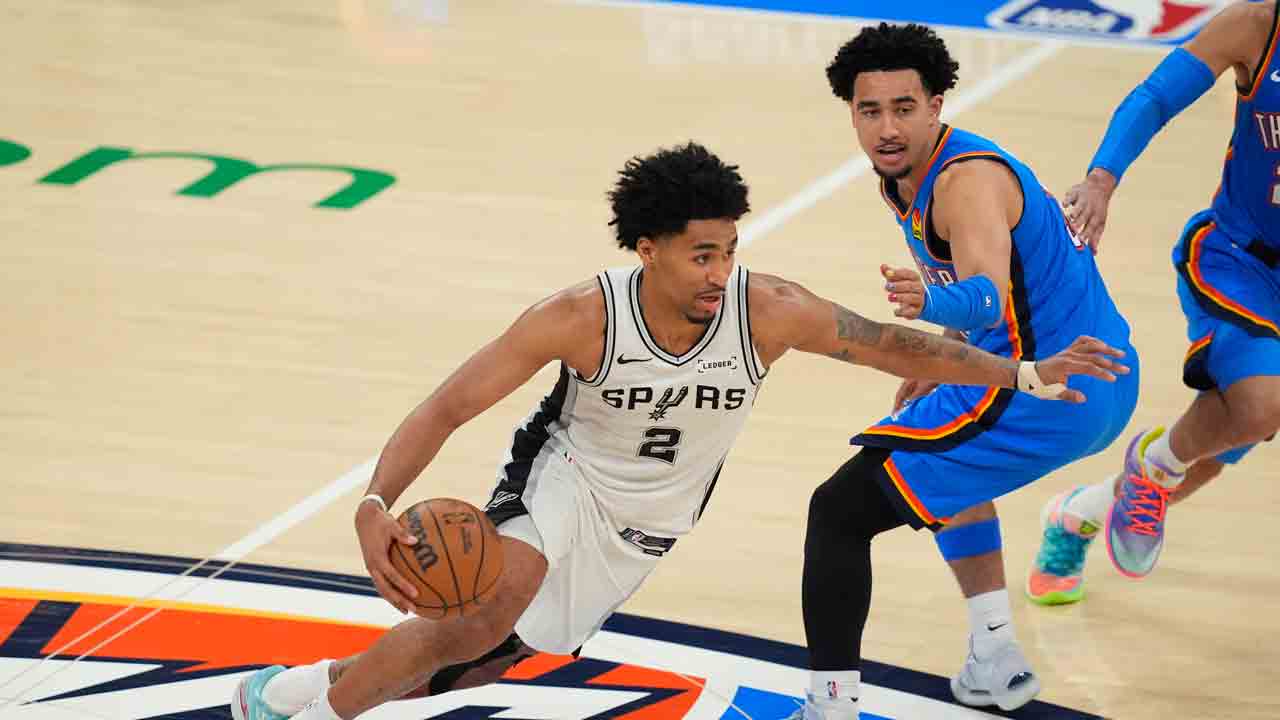
De'Aaron Fox's right ankle was always going to be a series-long problem—severe enough that regular-season caution wouldn't apply in the playoffs—but the Spurs had a contingency plan in rookie Dylan Harper, who had already proven himself as a playoff performer. That buffer just evaporated. Harper left Game 2 in the third quarter after two awkward falls a minute apart, leaving the Spurs without their two primary backcourt options heading into Game 3 on home floor. Oklahoma City capitalized to even the series at 1-1 with a 122-113 win, but the real damage was organizational: San Antonio's flexibility in pick-and-roll execution, transition speed, and ball-handling depth just contracted sharply.
Fox's absence was manageable because Harper had delivered. In Game 1, the 20-year-old put up 24 points, 11 rebounds, six assists, and seven steals—a playoff record for San Antonio and a statement performance from someone barely past his teens. He wasn't just filling the All-Star-level void; he was creating value on both ends at a level most rookies take years to reach. Coach Mitch Johnson's pre-game assessment of Harper—that buying into a winning-player role while suppressing individual scoring upside is "ridiculous" for a playoff rookie—telegraphed exactly how much the Spurs were leaning on his maturity and two-way impact.
Now San Antonio faces forced improvisation. Victor Wembanyama (25 PPG in regular season, the team's anchor) will see increased offensive load, but more pressure falls on the ball-handlers in reserve: whoever steps into the starting backcourt will face a Thunder defense that just held them to 113 points at home. Oklahoma City's defensive switching scheme is built to trap smaller guards in space; without Fox's creation or Harper's athleticism to punish mismatches, the Spurs' spacing collapses and Wembanyama gets fewer clean looks in transition.
From a prop angle, the injury sequence points toward sharp market inefficiency in two places. First, Thunder team total and spread lines will tighten—the market has already begun pricing in San Antonio's diminished backcourt fluidity, but books may lag on how much that compresses the Spurs' offensive ceiling. Second, Wembanyama's usage and scoring line will spike higher than pre-series projections. He's entering Game 3 without his two primary relief wings in the backcourt; defenses can compress on him more aggressively because fewer secondary playmakers exist to make reads. His scoring is also about to carry more of the offensive burden. Look for his points total to climb 2-3 points from its regular-season mean, and his assists total to dip (more shot attempts per touch, fewer secondary creators to feed). The edge here is persistence—not a single-game spike. Wembanyama's role expansion in a Fox/Harper-less series will hold through Game 7 if it goes there, because the Spurs' backcourt depth doesn't repair mid-series.