Harper's Finals Emergence Rewrites Spurs' Offensive Script in Game 4
By Erik Schwartz ·
A rookie's mid-range confidence in the Finals spotlight signals San Antonio has unlocked a secondary scorer who can collapse defenses and create angles the Knicks didn't prepare for.
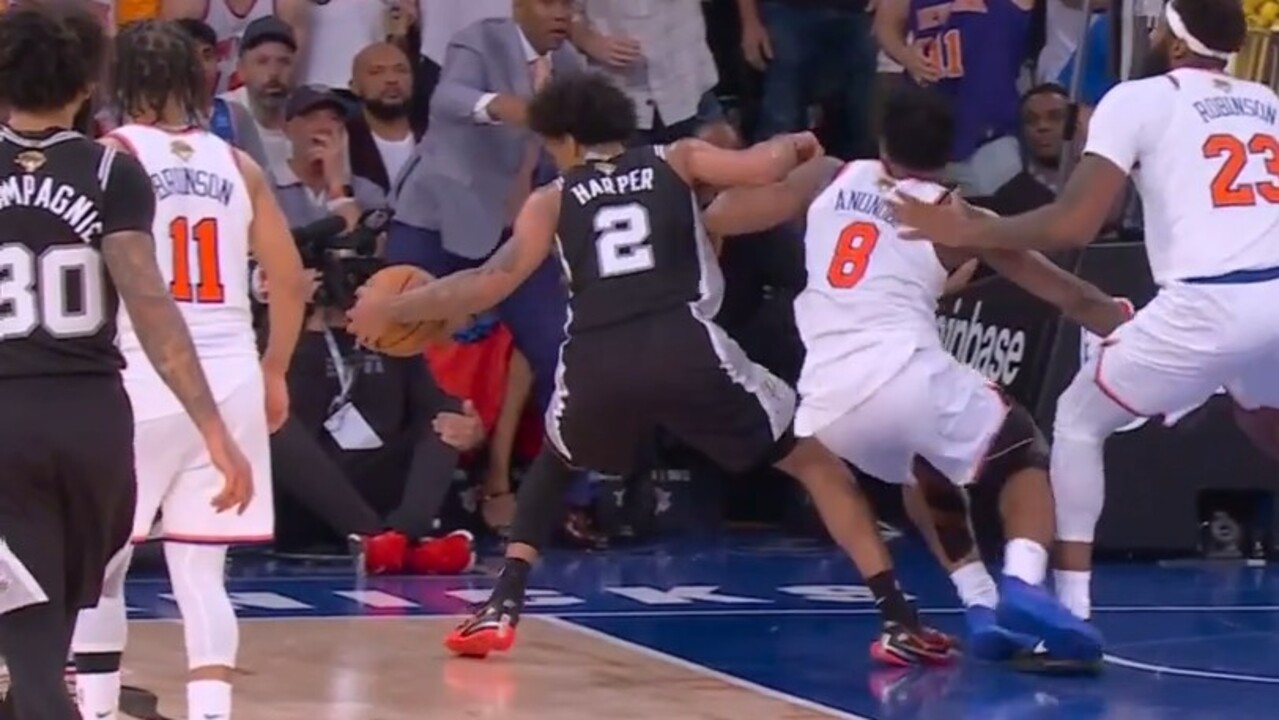
Dylan Harper's turnaround jumper over O.G. Anunoby in Game 4 of the NBA Finals wasn't just a highlight—it was a structural statement. The Spurs rookie, thrust into a Finals rotation earlier than most mock drafts projected, is operating with the offensive clarity of a player three years into his career, not three months. His willingness to attack closeouts with a controlled spin move and rise over one of the league's best perimeter defenders suggests San Antonio has found a third scoring axis beyond the obvious.
The mechanics matter here. Harper's mid-range game has always lived in his scouting report, but Finals execution—especially in high-leverage moments—separates theoretical talent from realized impact. Against a Knicks defense built on switching and ball pressure, that turnaround becomes more than a bucket. It's a tell that the Spurs can generate scoring without funneling everything through pick-and-roll or spot-up motion. When a rookie confident enough to shake a defender and create separation appears in the Finals, the opposing defense has to make an immediate recalibration.
New York's personnel leans heavily on wing length and switching athleticism. Anunoby is a premier perimeter stopper, but a player who can create his own shot off the dribble—especially one operating with Harper's footwork and range—forces the Knicks to either blitz off-ball or accept mid-range volume. The Spurs have been searching for exactly this: offensive flexibility that doesn't evaporate when double-teams arrive.
For prop bettors, Harper's emergence in this series carries immediate implications. His assist rate and scoring usage have both climbed incrementally through the Finals; Game 4 marks the first instance where he's attacked a elite defender with clear intent and technical command. If the Knicks maintain their switching framework, expect Harper's mid-range opportunities to remain available. His points prop—hovering around 12–14 depending on the book—should be viewed as a cautious lean over if he's matched against perimeter defenders shorter than 6'7". The mechanism isn't volatile: small guards and wing-heavy lineups without a true power forward force the Spurs into Harper's hands more often, directly correlating with his shot volume and efficiency. This isn't a single-game spike—it's a series development. If he posts another 14+ points in Game 5, the market will have already adjusted, but the underlying matchup leverage persists.