Wembanyama's Defensive Pivot Turns Game 4 Into Statement Win; Series Reset Begins Tuesday
By Erik Schwartz ·
San Antonio's 21-point Game 4 throttling of Oklahoma City hinged on rim protection and perimeter suffocation—two variables that will drive prop movement in Game 5.
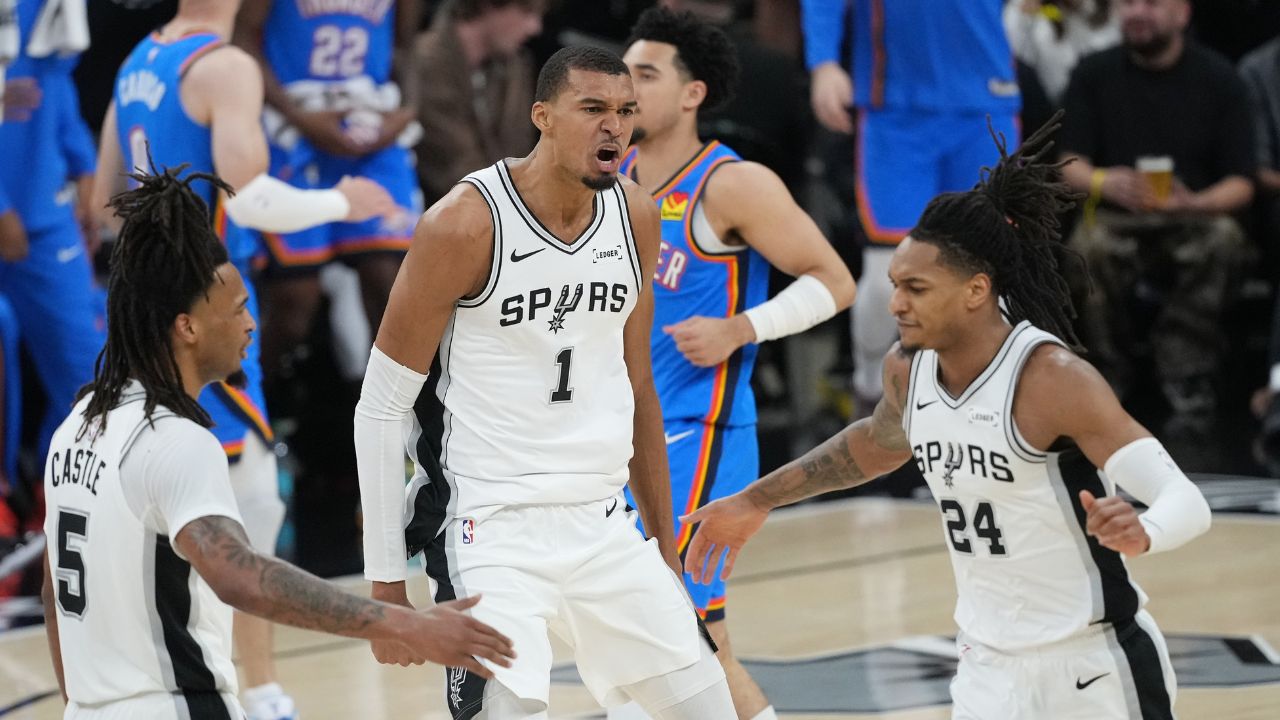
Victor Wembanyama took personal inventory after Friday's 15-point loss and showed up Sunday ready to enforce it. The Spurs' 7-foot-4 center posted 33 points, eight rebounds, five assists, and three blocks in a 103-82 dismantling of the Thunder that lashed the series back to a tie at 2-2. San Antonio's reserves—who got outscored 76-23 in Game 3—flipped the bench battle decisively: 30 points to Oklahoma City's 34, a structural flip that signaled the Spurs had corrected their depth exposure. More tellingly, the Spurs held the Thunder to 33 percent overall shooting and 18 percent from three (6-of-33), the second-lowest postseason output Oklahoma City has recorded.
The game's architecture mattered more than the margin. San Antonio's opening 16-0 run wasn't noise; it was a statement of defensive identity. Wembanyama anchored the rim (three blocks), while Stephon Castle and De'Aaron Fox (12 points, 10 rebounds, five assists) rotated with precision off the ball. The Spurs registered an assist on all 10 first-quarter field goals—a ball-movement metric that doesn't just win games, it demoralizes opponents relying on isolation offense. Oklahoma City managed only 38 points through two quarters, tied for its second-lowest half in the last five postseasons. The Thunder's record in such situations is damning: 2-9 when held under 40 in any half over that span.
Shai Gilgeous-Alexander's 6-for-15 shooting performance against Spurs perimeter pressure hints at the scalability of San Antonio's approach. With Game 5 in Oklahoma City—where the Thunder shoot 48 percent at home but face the same switching schemes—the Spurs' rim-and-arc containment becomes the fulcrum. Wembanyama's three-block output, his pick-and-roll positioning, and Fox's five assists all track to ball movement that collapses weak-side coverage. If San Antonio replicates this spacing discipline, Oklahoma City's isolation-heavy offense—which thrives when defenders are planted on the perimeter—suffocates.
For prop bettors, the implications are concrete. Wembanyama's 33-point, high-efficiency performance was not an outlier born of emotional catharsis; it was the output of a system that fed him lobs (Vassell's alley-oop in the first quarter exemplified this), isolation advantages when the Thunder went small, and second-chance looks as San Antonio controlled the glass. His points prop should tighten in Game 5, but the floor is elevated because Oklahoma City lacks a rim-protector who can deny him touch efficiency. More urgently, Shai Gilgeous-Alexander's FGA (15 attempts on Sunday) and assisted-to-unassisted ratio suggest the Thunder will lean harder on isolation ball in Oklahoma City, a design that invites Wembanyama blocks and forces teammates into harder shot creation. Game 5 unders at current totals are underpriced if San Antonio's perimeter discipline holds; Thunder totals are vulnerable, particularly if Chet Holmgren again draws foul trouble defending Wembanyama in space.
The series has reset. San Antonio proved Friday was a one-game failure, not a ceiling. Oklahoma City must solve the Spurs' pick-and-roll switching without allowing easy lobs—a puzzle they haven't solved in two games when San Antonio brought the structure Sunday displayed. Game 5 is not a coin flip; it's a referendum on whether Oklahoma City can generate offense against the league's most disruptive interior defender when that defender is locked into the game plan.